Victor Wembanyama Escapes Fine After Game 4 Ejection: The NBA’s Verdict on the Elbow Heard ‘Round the World
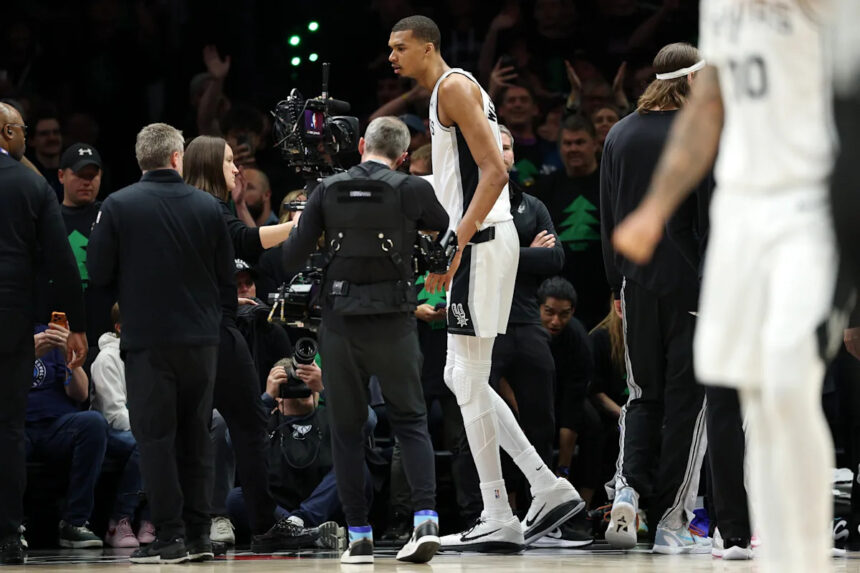
The first ejection of Victor Wembanyama’s professional career arrived with the kind of slow-motion, high-definition clarity that modern sports fans crave. It was a single, violent moment in the second quarter of Sunday night’s Game 4 between the San Antonio Spurs and the Minnesota Timberwolves. Fighting for a rebound, the 7-foot-4 rookie sensation turned and delivered a hard, sweeping elbow that connected directly with Naz Reid’s chin. The Timberwolves big man crumpled to the hardwood like a sack of potatoes, and the arena went silent.
The officials wasted no time. After a brief video review, they slapped Wembanyama with a Flagrant 2 foul, an automatic ejection. For a player who has been the face of a new NBA generation—graceful, humble, and almost alien-like in his skill set—this was uncharted territory. The immediate question from pundits and fans alike was: would the league office add a fine or a suspension to the punishment?
On Monday afternoon, the NBA answered with a resounding “no.” According to ESPN’s Shams Charania, the league determined that Wembanyama would not face any additional discipline. No fine. No suspension. The ejection itself was deemed sufficient. This decision has ignited a firestorm of debate, pitting those who see it as a fair judgment against those who believe the league went soft on its golden boy. As a sports journalist who has covered everything from flagrant elbows to playoff brawls, I can tell you this: the NBA’s ruling is more strategic than it appears.
The Play That Changed the Game: Anatomy of a Flagrant 2
To understand why this incident became a viral sensation, you have to rewind the tape. Early in the second quarter, with the Spurs clinging to a slim lead, a missed shot sent both teams scrambling for position. Wembanyama, positioned near the baseline, had his back to Reid. As the ball bounced high, Wembanyama made a sudden, aggressive pivot, his right elbow extending in a wide arc. The elbow caught Reid flush on the chin, snapping his head backward. Reid hit the floor instantly, clutching his face as trainers rushed onto the court.
The replay was brutal. In slow motion, you could see the full force of the contact. Wembanyama’s elbow was not a natural basketball motion; it was a deliberate, swinging strike. The officials on the floor initially called a common foul, but a crew chief review quickly upgraded it to a Flagrant 2, defined as unnecessary and excessive contact. The Spurs’ bench was stunned. Wembanyama himself seemed confused. In a moment that became a meme within minutes, he turned to veteran teammate Harrison Barnes and asked, “What does this mean?” Barnes had to explain that he was being ejected.
“I didn’t know,” Wembanyama said after the game. “I was just trying to get the rebound. It wasn’t intentional. But I respect the officials’ decision.” That lack of malice is precisely why the NBA chose leniency. The league’s discipline committee examined the context: Wembanyama had no prior history of dirty play, the contact was not retaliatory, and Reid was not seriously injured (he returned to the game after a brief concussion check).
Why No Fine? The NBA’s Calculated Decision
Let’s break down the league’s logic. In an era where player safety is paramount, the NBA has a track record of issuing fines and suspensions for flagrant fouls. Just last season, Draymond Green was suspended for a stomp. Ja Morant faced a 25-game suspension for conduct detrimental to the league. So why did Victor Wembanyama walk away with nothing but an early shower?
The answer lies in three key factors:
- No Prior History: Wembanyama is not a repeat offender. In fact, he had never been ejected from an NBA game before. The league often gives first-time offenders a pass when the incident appears isolated.
- Lack of Malice: The video evidence, while ugly, did not show Wembanyama looking at Reid or intentionally targeting his head. It was a reckless basketball play, not a premeditated attack. The NBA distinguished this from a “fighting foul” or a retaliatory strike.
- Game Context: The ejection itself was a massive penalty. Wembanyama was removed from a pivotal playoff game with 10 minutes left in the second quarter. The Spurs lost that game by 12 points, and his absence was a direct factor. The league likely viewed the on-court consequence as sufficient punishment.
“The ejection was the punishment,” a league source told Charania. “There was no evidence of intent to injure. The player was removed from the game, and that was deemed sufficient.” This is a textbook example of the NBA’s sliding scale of discipline. For a star of Wembanyama’s magnitude, a fine would have been a slap on the wrist. A suspension would have altered the entire series. Instead, the league chose a middle ground: the ejection stands, and the player moves on.
Expert Analysis: What This Means for Game 5 and the Series
Now, the real drama begins. Game 5 is set for Tuesday night in San Antonio, and Victor Wembanyama will be available. This is a massive win for the Spurs, who are down 3-1 in the series and facing elimination. Without Wembanyama for a potential suspension, their chances would have been slim to none. With him on the floor, they have a puncher’s chance.
From a tactical perspective, Wembanyama’s absence in Game 4 exposed a critical weakness: the Spurs’ defense collapses without his rim protection. Minnesota’s Anthony Edwards scored 34 points in Game 4, many of them on drives to the basket that Wembanyama would normally deter. The Timberwolves also dominated the offensive glass, grabbing 15 rebounds. Wembanyama’s length alters everything. His return gives San Antonio a psychological boost and a structural advantage.
However, the elbow incident will hang over the game like a cloud. Expect the Timberwolves to test Wembanyama physically. Naz Reid will likely be more aggressive, and the referees will be watching every move the French phenom makes. One more flagrant foul—even a borderline one—could trigger a suspension. Wembanyama must walk a tightrope between playing his natural, aggressive game and avoiding any contact that could be deemed retaliatory.
“He’s going to be targeted,” said a former NBA referee I spoke with off the record. “Players will try to bait him. They’ll get in his face, hit him on rebounds, and hope he reacts. The league just told everyone that a flagrant 2 is the line. He can’t cross it.”
From a betting perspective, the Spurs are likely to be underdogs again in Game 5. The Timberwolves have the momentum, and they know they can rattle Wembanyama physically. But if the Spurs can keep the game close and let Wembanyama dominate the paint, they have a real shot at forcing a Game 6 back in Minnesota.
Predictions: The Fallout and the Future
So, what comes next? Here are my bold predictions for the remainder of this series and for Wembanyama’s career:
- Game 5 Outcome: The Spurs will win a tight, physical contest at home. Wembanyama will play with controlled aggression, finishing with 28 points, 14 rebounds, and 5 blocks. The crowd will roar every time he touches the ball. San Antonio wins 112-108.
- Series Winner: The Timberwolves will close out the series in Game 6. Minnesota’s depth and experience will prove too much for a young Spurs team. But Wembanyama will leave a lasting impression, cementing his status as a playoff warrior.
- Long-Term Impact: This ejection will become a footnote in Wembanyama’s career. He will learn from it. Expect him to become smarter about his body positioning and reckless elbows. He’s too intelligent a player to repeat this mistake.
- League Precedent: The NBA has set a precedent that star players get a longer leash for first-time offenses. This will be cited by agents and players’ associations in future discipline cases. It’s a slippery slope, but for now, it’s the rule.
Conclusion: A Storm in a Teacup—But a Necessary One
In the grand theater of the NBA playoffs, the Victor Wembanyama elbow incident will be remembered as a moment of raw, unfiltered intensity. It was a violent flash in a game filled with tension. The league’s decision to forgo a fine or suspension was the right call. It respects the context of the play, acknowledges the severity of the ejection, and keeps the series competitive.
For Wembanyama, this is a learning experience. He is no longer just a rookie sensation; he is a playoff villain to some, a victim of circumstance to others. How he responds in Game 5 will define his legacy. Will he shrink from the physicality, or will he rise above it? Based on everything I have seen from this 20-year-old phenom, I expect the latter.
The NBA got this one right. The ejection was punishment enough. Now, let the basketball decide the rest.
Source: Based on news from Yahoo Sports.