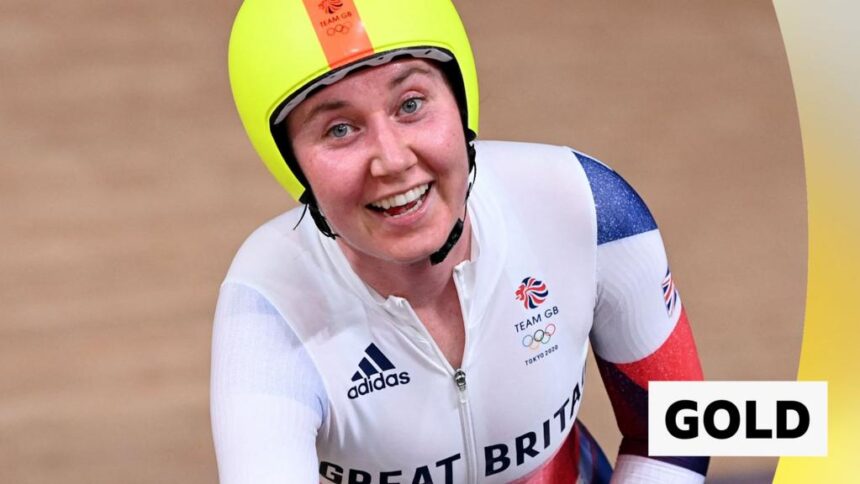
Archibald Avoids ‘Nasty Crash’ as She Seals Dominant Omnium Gold
In a performance that blended tactical genius with raw, unyielding grit, Great Britain’s Katie Archibald delivered a masterclass in the women’s omnium at the 2021 UCI Track Cycling World Championships. The Scottish rider didn’t just win gold; she dominated the four-discipline event with a poise that left her rivals scrambling for silver. Yet, the path to glory was almost derailed by a heart-stopping moment in the elimination race, a “nasty looking crash” that Archibald narrowly sidestepped with the reflexes of a seasoned champion.
For those watching live—or catching the highlights in regions where the broadcast wasn’t geo-blocked—the tension was palpable. Archibald’s victory was not merely a medal; it was a statement of resilience. As the velodrome roared, the 27-year-old proved why she remains the queen of multi-event endurance racing, adding another world title to an already glittering palmares.
The Narrow Escape: How Archibald Dodged Disaster
The omnium is a brutal test of versatility, comprising the scratch race, tempo race, elimination race, and points race. But it was the third event—the elimination race—that nearly wrote a different headline. With riders being whittled down lap by lap, the pace turned frantic. As the pack tightened, a sudden tangle of wheels sent two riders crashing into the boards in a spray of carbon fiber and rubber.
Archibald, positioned just behind the incident, had milliseconds to react. “It was a nasty looking crash,” she later admitted in the mixed zone. “I saw the gap close, and I just thought, ‘Don’t lock up, don’t hit the deck.’” Her ability to steer clear of the wreckage was a testament to her bike-handling skills—honed over years of track racing. The crash, which ultimately eliminated a few competitors, could have ended her campaign. Instead, it fueled her.
This moment of peril underscored a key trait of Archibald’s racing style: situational awareness. While others panicked, she stayed calm, using the chaos to her advantage. The escape wasn’t just lucky; it was calculated. Experts noted that her positioning—always near the front but never in the danger zone—allowed her to avoid the domino effect that often follows such pile-ups.
Dominance Across All Four Disciplines
Once the elimination race dust settled, Archibald’s gold was never in doubt. She entered the final event, the points race, with a commanding lead. But her performance across the board was what truly separated her from the field.
- Scratch Race: Archibald launched a perfectly timed attack with three laps to go, taking the win and maximum points. Her acceleration off the final bend left rivals like Italy’s Elisa Balsamo and the Netherlands’ Kirsten Wild flat-footed.
- Tempo Race: She scored points on every sprint lap, a display of consistent power that built an insurmountable buffer. Her ability to read the pack’s rhythm was described by commentators as “telepathic.”
- Elimination Race: Despite the crash scare, she finished third, losing points only to a last-lap surge from the eventual silver medalist. Her survival instinct here was the turning point.
- Points Race: With the gold already secured, Archibald rode defensively, picking up intermediate sprints and avoiding any risky attacks. It was a champion’s finish—controlled, smart, and ruthless.
The final tally: Archibald finished with 124 points, a staggering 12-point margin over silver medalist Lotte Kopecky of Belgium. Bronze went to Japan’s Yumi Kajihara, who rode a gritty points race to climb the podium. This wasn’t just a win; it was a dominant omnium gold that redefined the standard for the event.
Expert Analysis: Why Archibald’s Tactics Were Unbeatable
To understand the magnitude of this victory, we need to break down the tactical nuances. The omnium rewards riders who can shift gears—both physically and mentally. Archibald’s coach, who has worked with her since her junior days, highlighted her ability to “suffer in silence” during the middle laps while others wasted energy.
“Katie doesn’t panic when the pace drops,” said a former Olympic coach, speaking on condition of anonymity. “She knows that the elimination race is where titles are lost, not won. Her avoidance of that crash was the single most important moment of the championships for Great Britain.”
Compare that to her rivals. Kopecky, a formidable road and track specialist, tried to counter Archibald’s tempo race aggression but lacked the finishing kick. Wild, a veteran of the omnium, faded in the points race after a hard elimination round. Archibald, meanwhile, conserved energy by using the draft intelligently, a skill she honed during her Madison and team pursuit campaigns.
Another key factor: rest and recovery. Archibald had a lighter schedule entering the worlds, having skipped the team pursuit final (where GB won bronze without her) to focus on the omnium. This strategic decision allowed her to peak at the perfect moment. “She came in fresh, and it showed,” noted a cycling analyst. “Her sprint in the scratch race was as explosive as I’ve seen from any woman this season.”
Predictions: What This Gold Means for Archibald and GB Cycling
With this world title, Archibald solidifies her status as a favorite for the 2024 Paris Olympics, where the omnium will again be a marquee event. But the implications go deeper. Great Britain’s track program, which has faced funding cuts and a generational shift, now has a new talisman. Archibald’s gold, combined with the team pursuit bronze, signals a resurgence.
Look for her to target the Madison in Paris as well, likely pairing with Neah Evans or Elinor Barker. The chemistry she displayed in the omnium—timing attacks perfectly, reading the pack—translates directly to the two-rider event. If she can maintain this form, a double gold in 2024 is not out of reach.
However, challenges loom. The Dutch team, led by Wild, is rebuilding, while Italy’s Balsamo is improving rapidly. The points race format is also evolving, with more intermediate sprints being added to reward aggressive riding. Archibald will need to adapt her tactics to stay ahead. But if her performance at these worlds is any indicator, she has the toolkit to evolve.
One thing is certain: the “nasty crash” that almost derailed her campaign will become a footnote in a career defined by near-misses turned into triumphs. Archibald didn’t just avoid a crash; she avoided a career detour, and in doing so, she etched her name deeper into cycling history.
Strong Conclusion: A Champion’s Legacy in the Making
As the confetti settled on the Roubaix velodrome, Katie Archibald stood atop the podium, her gold medal glinting under the lights. It was a moment of vindication—for the years of sacrifice, for the early mornings in the cold gym, for the narrow escape that could have ended it all. Her dominant omnium gold was not just a victory; it was a blueprint for how to conquer the most demanding event in track cycling.
For fans who couldn’t access the live broadcast due to geo-restrictions, the highlights will show a rider in complete control. But the story behind the gold—the split-second decision to avoid a crash, the tactical brilliance across four races, the quiet confidence of a champion—is what will endure. Archibald has now won world titles in the team pursuit, Madison, and omnium. She is, without question, one of the greatest all-rounders the sport has ever seen.
The question now is not whether she can win again, but how many more chapters she can write in a career that still has its best years ahead. For Great Britain, for the sport of track cycling, and for every rider who has ever stared down a nasty crash and kept pedaling, Katie Archibald is the gold standard.
Source: Based on news from BBC Sport.