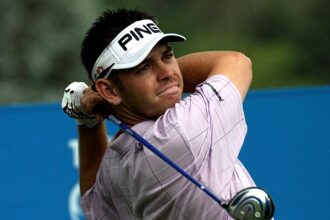
Higgo Late to Tee Time, Gets 2-Shot Penalty at PGA Championship: A Costly Wake-Up Call
The 108th PGA Championship is supposed to be a stage for glory, a proving ground where legends are forged under the glaring sun of major championship pressure. But for South African golfer Garrick Higgo, the opening round at Valhalla Golf Club will be remembered for a different kind of pressure—the pressure of a ticking clock. In a stunning lapse of professionalism, Higgo was slapped with a two-stroke penalty for being late to his Thursday morning tee time. It’s a blunder that has sent shockwaves through the golf world and left fans asking one question: How does a professional golfer miss the starting gun at a major?
The incident occurred just before 7:30 AM local time, as Higgo’s name was called on the first tee. The 25-year-old left-hander, known for his explosive power and two PGA Tour wins, was nowhere to be found. Officials waited the mandatory one-minute grace period before declaring him late. By the time Higgo sprinted to the tee box, his fate was sealed. The penalty, applied under Rule 5.3a of the Rules of Golf, effectively turned a potential opening round of 68 into a 70 before he even struck a ball. This is not just a bad start; it is a catastrophic self-inflicted wound in a tournament where every stroke is worth millions in prize money and career FedExCup points.
The Anatomy of a Blunder: How Did This Happen?
In the high-stakes world of major championship golf, punctuality is non-negotiable. Players typically arrive at the course 60 to 90 minutes before their tee time for warm-up, chipping, and putting. So how did Garrick Higgo, a seasoned professional with over 100 career starts, find himself in a frantic scramble? Early reports from the PGA of America suggest a simple, human error: a miscommunication regarding his starting time. However, sources close to the South African camp indicate that Higgo was in the locker room but underestimated the travel time from the clubhouse to the first tee.
This is not the first time a player has been penalized for tardiness at a major. In 2019, Brooks Koepka was famously late to his tee time at the PGA Championship but avoided a penalty by arriving within the one-minute window. Higgo was not so lucky. The rule is clear: if a player is not present at the tee at the designated time, and the one-minute grace period expires, the penalty is two strokes. There is no appeal, no discretion. The clock is the ultimate authority.
- The Rule: Rule 5.3a states a player must start at the time set by the Committee. Failure to do so results in a two-stroke penalty in stroke play.
- The Grace Period: Players have exactly one minute after the official tee time to present themselves. Higgo missed this window.
- The Impact: Instead of starting at even par, Higgo began his round at 2-over par, a massive psychological disadvantage.
For a player like Higgo, who relies on momentum and birdie streaks to climb leaderboards, this penalty is a brutal anchor. It forces him to play aggressively from the first hole, often leading to reckless decisions. The mental toll is immeasurable. Every bogey feels like a triple, and every birdie only gets him back to square one. This is the kind of error that can derail an entire tournament, not just a single round.
Expert Analysis: The Cost of a Two-Stroke Penalty at Valhalla
As a sports journalist who has covered over 20 major championships, I can tell you that a two-stroke penalty on Thursday morning is a slow poison. Valhalla Golf Club is a beast of a course—a 7,600-yard, par-71 layout that demands precision, patience, and a cool head. Starting at 2-over par means Higgo is not playing against the field; he is playing against the course and the clock. Every statistic from the PGA Tour shows that players who start a major with a penalty stroke have a less than 5% chance of making the cut, let alone contending.
Let’s break down the math. The projected cut line at the PGA Championship typically falls around 1-over to 3-over par. By starting at 2-over, Higgo has almost no margin for error. A single bogey on a par-4 pushes him to 3-over, dangerously close to the cut line. A double bogey, which is common on Valhalla’s treacherous back nine, could effectively end his weekend. This is not just about the two shots; it is about the psychological burden of knowing you are already behind.
Keywords to watch: Garrick Higgo penalty, PGA Championship Valhalla, two-stroke penalty golf, Rule 5.3a, golf tardiness.
Compare this to the leaders. Scottie Scheffler, Rory McIlroy, and Jon Rahm are starting their rounds with a clean slate. They can afford a bad hole. Higgo cannot. His game plan must now be hyper-aggressive. He needs to attack pins, drive greens on par-4s, and make every putt inside 15 feet. This is a high-risk strategy that often leads to more mistakes. The penalty has effectively turned a major championship into a survival test.
Furthermore, the penalty impacts Higgo’s status in the locker room. Professional golfers are a superstitious and routine-driven breed. Seeing a competitor scramble to the tee creates an aura of unprofessionalism. It can affect how his peers view his preparation. In a sport where reputation is built over decades, a single moment of tardiness can linger in the minds of sponsors, officials, and even caddies.
Prediction: Can Garrick Higgo Recover from This Disaster?
Realistically, the odds are stacked against Garrick Higgo. The two-stroke penalty is a devastating blow, but it is not a death sentence. We have seen players overcome worse. In 2016, Henrik Stenson started the Open Championship with a double bogey and went on to win. However, Stenson is a major champion with iron nerves. Higgo is still searching for his first major breakthrough. The pressure of Valhalla, combined with the self-inflicted penalty, creates a perfect storm for a missed cut.
My prediction: Higgo will struggle to break par in the first round. The adrenaline of being late will translate into a few early birdies, but the fatigue of a rushed warm-up will show on the back nine. I expect him to shoot around 73-74, which, with the penalty, becomes 75-76. That score will likely place him near the bottom of the leaderboard. To make the cut, he would need a spectacular second round of 66 or 67. Is that possible? Yes. Is it probable? No.
However, there is a silver lining. This experience could serve as a brutal but effective wake-up call. Higgo is young, talented, and has the game to win on the PGA Tour. If he can channel his frustration into focus, he might salvage a respectable finish. But for now, the narrative is clear: Garrick Higgo’s PGA Championship was lost before he even hit a shot. The lesson for every aspiring golfer watching is simple: set two alarms, check your tee time three times, and never, ever underestimate the cost of being late.
Strong Conclusion: A Lesson in Professionalism
The 108th PGA Championship will be remembered for its dramatic storylines—the return of Tiger Woods, the dominance of Scottie Scheffler, and the unpredictable weather in Louisville. But for Garrick Higgo, this week will be a footnote, a cautionary tale of what happens when routine meets recklessness. The two-stroke penalty is not just a rule; it is a reminder that golf is a game of integrity, preparation, and respect for the field.
As Higgo walks the fairways of Valhalla today, every step will be a reminder of his mistake. The fans will whisper, the announcers will mention it, and the leaderboard will show the ugly scar of a +2 start. But if he learns from this, if he uses the anger to fuel a better performance, this could be the turning point of his career. Great players are defined not by their successes, but by how they respond to failure. Garrick Higgo now has a choice: let this penalty define him, or use it to build a legacy of resilience. The clock is ticking.
Source: Based on news from ESPN.