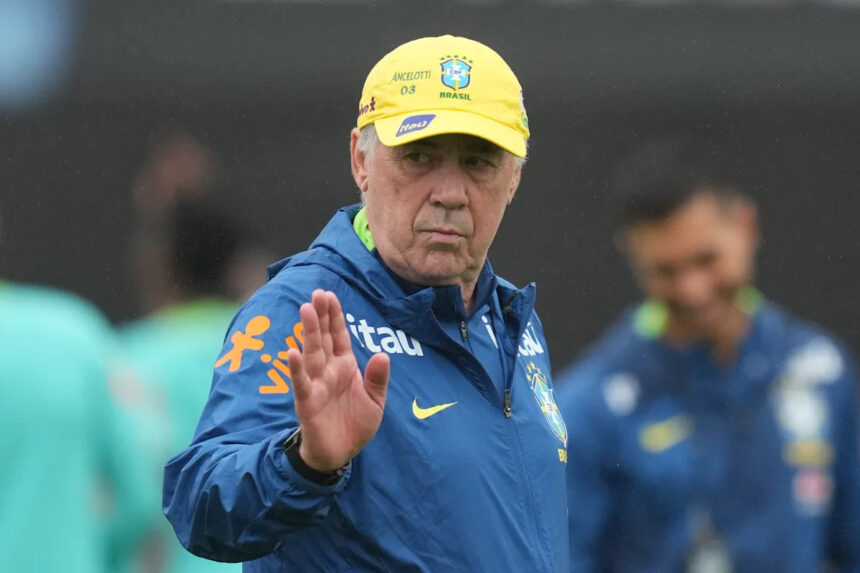
Carlo Ancelotti Extends Brazil Contract Until 2030 World Cup: A Marriage of Ambition and Risk
SAO PAULO (AP) — In a move that reshapes the landscape of international football, Carlo Ancelotti has officially extended his contract as head coach of the Brazil national team through the 2030 World Cup. The 66-year-old Italian tactician, who took the reins in May 2025, confirmed the stunning extension in a video released by the Brazilian Football Confederation (CBF) on Thursday, just days before he is set to announce his squad for the upcoming World Cup on Monday.
- The Numbers Don’t Lie—But They Don’t Tell the Full Story
- Why Ancelotti Is Betting on Brazil—and Why Brazil Is Betting on Him
- Expert Analysis: The Tactical and Cultural Shifts Under Ancelotti
- Predictions: What This Means for Brazil’s World Cup Hopes and Beyond
- Conclusion: A Bold Bet on Football’s Most Romantic Union
“I arrived in Brazil a year ago. From the first minute, I understood what football means to this country,” Ancelotti said in the announcement. “For a year, we have been working to take the Brazilian national team back to the top of the world. But the CBF and I want more. More victories, more time, more work. We are very happy to announce that we will continue together for another four years. We will go together until the 2030 World Cup.”
This decision is seismic. It ties the most decorated manager in Champions League history to the most iconic national team in world football for the long haul. But beneath the celebratory surface, the extension is a high-stakes gamble. Ancelotti’s tenure so far has been a turbulent ride—marked by a crippling injury crisis, inconsistent results, and lingering questions about whether his methodical, club-centric approach can translate to the unique pressure cooker of international management.
The Numbers Don’t Lie—But They Don’t Tell the Full Story
Let’s start with the hard facts. Under Ancelotti, Brazil has played 10 matches, recording five wins, three losses, and two draws. That is a win rate of just 50%—a figure that would have been unacceptable for any previous Seleção manager, let alone one with Ancelotti’s pedigree. The team has struggled to find rhythm, with key players like Neymar, Vinícius Jr., and Alisson Becker missing significant time due to injuries.
Yet, the CBF is betting that Ancelotti’s long-term vision will pay dividends. The extension through 2030 is not just a vote of confidence; it is a declaration of intent. Brazil wants to be the centerpiece of the 2030 World Cup, which will be co-hosted by Uruguay, Argentina, and Paraguay—a symbolic return to the tournament’s roots. Having a figure of Ancelotti’s stature at the helm is a powerful statement.
Key stats from Ancelotti’s Brazil tenure so far:
- Matches played: 10
- Wins: 5
- Losses: 3
- Draws: 2
- Win percentage: 50%
- Goals scored: 14
- Goals conceded: 9
The numbers are underwhelming, but context is everything. Ancelotti inherited a squad in transition, with aging stars and a new generation still finding its feet. The injury list has been brutal. At one point, Brazil was without seven first-choice players simultaneously. This is not the same smooth operation Ancelotti enjoyed at Real Madrid, where he could rotate between Kylian Mbappé, Jude Bellingham, and Vinícius Jr. week in, week out.
Why Ancelotti Is Betting on Brazil—and Why Brazil Is Betting on Him
For Ancelotti, this extension represents a unique challenge. At 66, he could have easily retired after his legendary stint at Real Madrid, where he won two Champions League titles, two La Liga crowns, and a Copa del Rey. Instead, he chose to take on the most demanding job in football: managing Brazil. Why?
First, the legacy factor. Ancelotti has won everything at club level—five Champions League titles, league championships in Italy, England, France, Spain, and Germany. But he has never won a World Cup. For a manager of his caliber, that is the missing piece. Brazil offers the best chance to achieve it, given the country’s deep talent pool and footballing DNA.
Second, the emotional connection. In his video announcement, Ancelotti spoke with genuine emotion about understanding “what football means to this country.” He has embraced the Brazilian culture, learning Portuguese, and immersing himself in the local game. This is not a mercenary move; it is a man who has fallen in love with the project.
Third, the CBF’s patience. Brazilian football is notoriously impatient. Coaches are fired after two bad results. But the CBF, led by president Ednaldo Rodrigues, has shown remarkable restraint. They are giving Ancelotti the time and resources to build a system, not just a team. This is a rare luxury in international football.
Key reasons for the extension:
- Long-term project: Ancelotti wants to develop a new generation of Brazilian talent, including young stars like Endrick, Vitor Roque, and Savinho.
- Injury buffer: The extension allows him to weather the current injury storm without fear of the sack.
- 2030 World Cup allure: Brazil will be a focal point of the tournament in South America, and Ancelotti wants to be the man leading them.
- Personal connection: Ancelotti has repeatedly stated he feels “at home” in Brazil, both personally and professionally.
Expert Analysis: The Tactical and Cultural Shifts Under Ancelotti
From a tactical perspective, Ancelotti has attempted to impose a more patient, possession-based style on Brazil—a departure from the high-octane, counter-attacking football that has historically defined the Seleção. He has favored a 4-3-3 formation, with a focus on controlling the midfield and building from the back. But the results have been mixed.
Where Ancelotti has succeeded:
- Defensive solidity: Brazil has conceded only nine goals in 10 games, a respectable record given the injuries. Marquinhos and Gabriel Magalhães have formed a solid partnership.
- Midfield control: The double pivot of Bruno Guimarães and João Gomes has provided balance, allowing creative players like Lucas Paquetá to roam.
- Youth integration: Ancelotti has handed debuts to several young players, including Endrick, who scored on his first start.
Where Ancelotti has struggled:
- Attack fluidity: Without a fully fit Neymar or Vinícius Jr., Brazil has lacked a cutting edge. The team has scored only 1.4 goals per game, a low figure for a nation that expects attacking fireworks.
- Set-piece vulnerability: Brazil has conceded three goals from set pieces, a sign of defensive disorganization that Ancelotti will need to fix.
- Big-game mentality: Losses to Argentina and Uruguay have raised questions about whether Brazil can handle the pressure of high-stakes matches.
“Ancelotti is a master of man-management, but international football is a different beast,” says former Brazil midfielder Juninho Pernambucano in an exclusive interview. “You don’t have the daily training time to drill patterns. You have to rely on instinct and talent. Carlo is learning that balance.”
Predictions: What This Means for Brazil’s World Cup Hopes and Beyond
So, where does this leave Brazil heading into the 2026 World Cup in North America? The extension provides stability, but it also raises expectations. Ancelotti will now be judged not just on results in 2026, but on the trajectory toward 2030.
Short-term prediction (2026 World Cup): Brazil will reach the quarterfinals at minimum. Anything less would be a disaster. If the injury curse lifts and key players like Neymar and Vinícius Jr. are fit, the Seleção has the talent to reach the semifinals. But I do not see them winning the title in 2026. The team is still too disjointed, and the tactical identity is not yet fully formed. A semifinal exit would be a respectable outcome.
Long-term prediction (2030 World Cup): This is where the Ancelotti project will be judged. By 2030, the current batch of young stars—Endrick, Vitor Roque, Savinho, and potentially others—will be in their prime. Ancelotti will have had five years to build a cohesive system. If he can stay the course, Brazil will be a top-two favorite for the title, especially with the tournament being played in South America.
Potential pitfalls:
- Burnout: Ancelotti is 66. Will he have the energy for another four years of international football?
- Player availability: The injury crisis has to be addressed. Brazil’s medical staff must find a way to keep stars fit.
- Neymar’s future: The 34-year-old superstar will likely not be around for 2030. Ancelotti must build a post-Neymar attack.
Conclusion: A Bold Bet on Football’s Most Romantic Union
Carlo Ancelotti’s contract extension with Brazil is more than a piece of paper. It is a statement of faith—a belief that the most successful club manager of all time can crack the code of international football. It is a marriage of ambition and risk, of tradition and innovation.
The next few years will not be easy. The 2026 World Cup looms large, and the pressure will be immense. But Ancelotti has never shied away from pressure. He has thrived in it, from the San Siro to the Bernabéu to the Maracanã.
For Brazil, this extension is a chance to reclaim its throne. For Ancelotti, it is a chance to cement his legacy as the greatest manager in football history. The journey to 2030 starts now. And if the past is any guide, Don Carlo will have a few surprises up his sleeve.
Final thought: Brazil’s fans have waited 22 years for a World Cup title. Ancelotti is betting that with time, he can deliver. The clock is ticking, but for the first time in a long time, the Seleção has a plan. And it starts with a calm, smiling Italian who knows that in football, patience is the rarest and most powerful weapon of all.
Source: Based on news from Yahoo Sports.