FIFA’s New Frontier: The FIFA Peace Prize and the Politics of the Beautiful Game
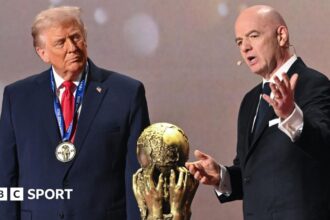
The world of international football is no stranger to grand spectacles and unexpected announcements, but FIFA’s latest initiative has sent shockwaves far beyond the touchlines. In a move that intertwines global diplomacy with the planet’s most popular sport, FIFA has announced the creation of the FIFA Peace Prize. This new award, set to be presented during the 2026 World Cup draw in Washington D.C., aims to honor individuals who have “taken exceptional and extraordinary actions for peace” and “united people across the world.” With the shadow of former US President Donald Trump looming large as the widely speculated first recipient, the award has instantly ignited a fiery debate about the intersection of sports, politics, and the very definition of peacemaking in the 21st century.
Beyond the Trophy: Decoding FIFA’s Strategic Gambit
At first glance, the FIFA Peace Prize appears to be a logical extension of football’s long-held, if often idealized, self-image as a force for global unity. FIFA President Gianni Infantino’s statement framed the award as a necessary beacon: “In an increasingly unsettled and divided world, it is fundamental to recognise the outstanding contribution of those who work hard to end conflicts and bring people together in a spirit of peace.” He further emphasized that football “stands for peace” and the award will “recognise the enormous efforts of those individuals who unite people, bringing hope for future generations.”
However, expert analysis suggests this move is as much a geopolitical chess play as it is a humanitarian gesture. FIFA, under Infantino, has consistently sought to expand its influence and forge alliances with global power brokers. The choice of Washington D.C. for the inaugural award ceremony—coinciding with the draw for a World Cup hosted by the United States, Canada, and Mexico—is a deeply symbolic one. It signals a deliberate alignment with American political and cultural capital. Instituting such a prize allows FIFA to position itself not just as a sports governing body, but as a quasi-diplomatic institution, wielding soft power on the world stage. The award becomes a tool for relationship-building, one that can generate goodwill (or controversy) with specific nations and leaders.
The Trump Conundrum: A Controversial Front-Runner
The immediate and pervasive speculation that Donald Trump will be the first recipient is the defining narrative of this new award. This expectation transforms the FIFA Peace Prize from a abstract concept into a concrete and highly charged political event. Proponents of such a choice would likely point to the Abraham Accords, the series of normalization agreements between Israel and several Arab nations brokered by the Trump administration, as the quintessential “exceptional action for peace” FIFA seeks to recognize. They would argue it represents a tangible, legacy-defining diplomatic breakthrough that altered regional dynamics.
Critics, however, see a profound irony. They contend that Trump’s tenure was marked by profound domestic and international division, rhetoric often described as inflammatory, and a “America First” foreign policy that strained traditional alliances. Key points of contention include:
- Perceived Divisiveness: Critics argue his political career was built on polarizing rhetoric, making the “united people across the world” criterion a point of fierce debate.
- FIFA’s Own Values: The award could clash with FIFA’s publicly stated campaigns for social inclusion, diversity, and anti-discrimination, given the controversies surrounding Trump’s statements on various social issues.
- The Politicization of Sport: Bestowing such an honor on a figure as politically divisive as Trump would inevitably be seen as FIFA taking a side in global politics, potentially alienating a significant portion of the global football community.
The selection of Trump would guarantee global headlines, but it risks overshadowing the World Cup draw itself and miring FIFA in a prolonged controversy about the politicization of the sport.
Predictions and Potential Backlash: The Road to 2026
The announcement of the winner will be one of the most scrutinized moments in FIFA’s recent history. If Trump is indeed the recipient, we can expect a polarized and explosive reaction:
Immediate Reactions: A torrent of both praise and condemnation from world leaders, football associations, and human rights groups. Sponsors, increasingly sensitive to brand alignment with social values, may face pressure and could privately express concerns to FIFA.
Ceremony Protests: The Washington D.C. award ceremony could become a focal point for large-scale protests, drawing attention away from the World Cup draw and creating significant security challenges.
Player and Coach Activism: High-profile players and coaches, who have become increasingly vocal on social and political issues, may use their platforms to speak out against the decision, creating internal tension within the football world.
Long-term Legacy: The award could set a precedent that makes the FIFA Peace Prize a tool for recognizing controversial, realpolitik achievements rather than grassroots peacebuilding. Alternatively, a surprise selection of a less politically charged figure—perhaps a humanitarian worker or a diplomat from a different region—could help FIFA recalibrate the narrative, though it would now be seen as a direct snub to Trump and his allies.
Conclusion: A Prize That Tests Football’s Soul
The inauguration of the FIFA Peace Prize represents a monumental gamble. In seeking to elevate football’s role as a universal peacemaker, FIFA has stepped directly into the arena of global political conflict. The award’s credibility and future will be irrevocably shaped by its first recipient. Honoring a figure like Donald Trump would be a stark declaration that FIFA prioritizes diplomatic deal-making and alliances with political power, regardless of the divisiveness surrounding the individual. It would be a prize for geopolitical outcomes, not necessarily for the spirit of unity.
Ultimately, the FIFA Peace Prize has already achieved one thing: it has sparked a necessary and uncomfortable conversation. It forces fans, players, and officials to question what “peace” and “unity” truly mean in the context of global football. Does the beautiful game stand for a sanitized, feel-good version of harmony, or is it willing to wade into the messy, contentious realities of world politics? The answer will be revealed not just in Washington D.C., but in the global reaction that follows. One thing is certain: as the 2026 World Cup approaches, the draw for the tournament may share the spotlight with a draw for football’s very soul.
Source: Based on news from BBC Sport.
Image: CC licensed via en.kremlin.ru