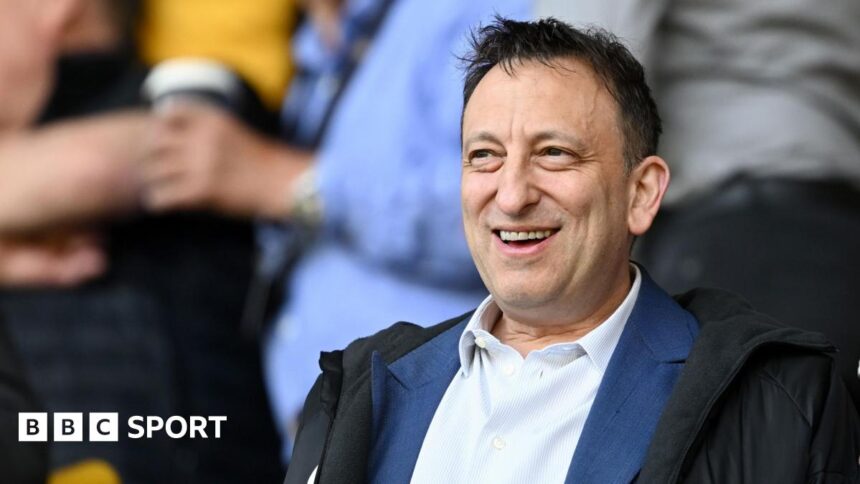
Brighton Owner Tony Bloom Vehemently Denies “Entirely False” Betting Allegations
The world of football finance and governance has been rocked by serious allegations against one of the Premier League’s most respected figures. Tony Bloom, the owner and chairman of Brighton & Hove Albion, has issued a forceful denial following a report linking him to a multi-million dollar anonymous betting account. The claims, if proven, would constitute a direct breach of Football Association rules and cast a long shadow over his celebrated tenure at the Amex Stadium.
The Allegations: A “John Doe” and a $70 Million Winning Streak
This week, a report by The Guardian detailed an ongoing legal case in the United States centered on an anonymous high-stakes gambler known only as “John Doe.” This individual is reported to have amassed winnings of approximately $70 million (£52 million) through an offshore betting platform. The core of the allegation is that this lucrative streak included bets placed on matches involving Brighton & Hove Albion.
The report explicitly linked Bloom, a man with a renowned background in professional gambling and statistical analysis, to being the individual behind the “John Doe” alias. Given Bloom’s ownership of Brighton since 2009, such activity would be a clear violation of FA Rule E8, which strictly prohibits individuals involved in the game from betting on matches or competitions in which they are involved.
In a swift and unequivocal statement, a spokesperson for Bloom responded: “The allegations are entirely false. Mr Bloom has never placed a bet on any Brighton match since becoming the club’s owner, nor has he placed a bet with the offshore betting organization referred to in the Guardian’s article.”
Tony Bloom: The “Spider” Who Built a Modern Football Club
To understand the gravity of these claims, one must first understand Tony Bloom’s unique profile. Known in gambling circles by the nickname “The Spider” for his intricate web of analytical models, Bloom made his fortune through sports betting and poker before turning his strategic mind to football.
His ownership of Brighton is widely regarded as a blueprint for sustainable, data-driven success:
- Transformed the club from League One strugglers to established Premier League and European competitors.
- Pioneered a cutting-edge recruitment model that has identified and sold talent for hundreds of millions in profit.
- Invested heavily in infrastructure, including the state-of-the-art American Express Stadium and elite training facility.
- Holds minority stakes in other clubs, including Heart of Midlothian and Melbourne Victory, fostering a multi-club network.
This record makes the allegations particularly jarring. Bloom’s entire football project is built on a reputation for intelligence, integrity, and strict adherence to the rules of the game. A breach of betting regulations would not only be a violation but would fundamentally undermine the philosophy he has instilled at the club.
Expert Analysis: Navigating a Legal and Reputational Minefield
From a sports governance perspective, this situation presents immediate and serious questions. The FA’s betting rules are unambiguous, designed to protect the integrity of the sport from even the perception of insider influence or conflict of interest.
“This is the cardinal sin in football administration,” notes Dr. Liam Carter, a sports law academic. “The rules exist to eliminate any possibility that an owner could influence a match’s outcome for financial gain elsewhere, or even benefit from privileged information. For a figure of Bloom’s stature, the reputational damage could be severe, regardless of the legal outcome. The cloud of suspicion alone is damaging.”
The legal dimension is equally complex. The US case is a separate civil matter, but its findings could trigger investigations by both the Football Association and the Premier League. They would be compelled to launch their own inquiries if presented with credible evidence. For now, Bloom’s categorical denial is the central fact from a football regulatory standpoint.
Furthermore, Bloom’s multi-club ownership adds another layer. FA and UEFA rules are increasingly scrutinizing such networks to ensure no single entity exerts undue influence across competitions. An adverse finding in a betting scandal would have severe ramifications for his entire football portfolio.
Predictions and Potential Outcomes for Brighton and Bloom
The path forward hinges on developments in the US legal case and the responses of football’s governing bodies. Several scenarios could unfold:
- Full Vindication: If Bloom successfully proves the “John Doe” link is false and no evidence emerges, his reputation may recover, though some lingering doubt may persist among critics.
- FA Investigation: The most likely next step is a formal inquiry by the FA. They will demand all relevant information from Bloom and potentially seek evidence from the US proceedings. This process could be lengthy.
- Severe Sanctions: Should evidence surface contradicting Bloom’s denial, the consequences would be extreme. Potential sanctions range from a lengthy suspension from all football activity to a forced sale of his club ownerships. The Premier League’s Owners’ and Directors’ Test would also come into sharp focus.
- Club Stability: In the short term, Brighton’s on-field operations, led by CEO Paul Barber and the football staff, are insulated. However, long-term strategic vision and transfer market strategy are inextricably linked to Bloom’s leadership and funding.
The immediate impact will be one of distraction. As Brighton continues to build on its success, questions about its owner will be an unwelcome backdrop. The club’s statement of support for Bloom is crucial, but the football world will be watching for any crack in that united front.
Conclusion: A High-Stakes Game of Truth and Integrity
Tony Bloom stands at a critical juncture. The allegations strike at the heart of his dual identity: the poker-faced gambler who became the architect of a footballing miracle. His legacy, currently defined by transforming Brighton into a model club, is now under unprecedented threat.
For now, his denial is absolute. The burden of proof lies with those making the claims. The coming weeks and months will be a tense wait for clarity from the US courts and for any movement from football’s regulators. This is more than a tabloid scandal; it is a direct challenge to the integrity of one of the game’s modern success stories. The football community must balance the principle of innocent until proven guilty with its unwavering duty to police its own. For Tony Bloom and Brighton & Hove Albion, the most important match of the season is now being fought not on the grass, but in the realms of law and reputation.
Source: Based on news from BBC Sport.
Image: Source – Original Article