Beyond the Bronze: The Heisman Trophy’s Storied Past and a Historic 2024 Showdown
The chill in the December air isn’t just a sign of winter; it’s the palpable tension of college football’s most prestigious individual honor hanging in the balance. On December 13th, in the heart of New York City, the Heisman Trophy will be awarded once more, anointing the player deemed the most outstanding in the land. This year’s ceremony carries a unique electricity, fueled by a surprising favorite and a historic finalist poised to shatter precedent. To understand the magnitude of the moment, we must first journey through the rich, nearly century-long history of the iconic bronze statue.
A Legacy Cast in Bronze: From Berwanger to the Modern Era
The story begins not in a football cathedral of the South or Big Ten, but at the University of Chicago. In 1935, halfback Jay Berwanger, known as the “One Man Gang,” became the inaugural recipient of what was then called the DAC Trophy, awarded by the Downtown Athletic Club. The award was renamed the Heisman Trophy the following year, following the death of the Club’s athletic director, John Heisman. Berwanger’s win set a template of excellence, but his legacy includes a remarkable footnote: the first-ever NFL Draft pick, he declined to play professionally, a decision unimaginable today.
The trophy’s history is a mirror reflecting the evolution of the game itself. For decades, it was almost exclusively the domain of running backs and quarterbacks from powerhouse programs. Legends like Doak Walker, Roger Staubach, and Tony Dorsett etched their names into lore. The late 20th and early 21st centuries saw the quarterback firmly seize the spotlight, with dynamic passers like Doug Flutie, Barry Sanders (in a breathtaking outlier season at running back), and Tim Tebow defining their eras. The award doesn’t just honor a season; it encapsulates a player’s ability to capture the national imagination with a combination of statistics, leadership, and iconic moments on the biggest stages.
Key Eras in Heisman History:
- The Early Dominance (1930s-1950s): Running backs and multi-threat players ruled, with winners like Les Horvath and Vic Janowicz.
- The Quarterback Emergence (1960s-1990s): While great backs still won, QBs like Staubach, Flutie, and Andre Ware began to claim more trophies, signaling the sport’s strategic shift.
- The Spread Offense Revolution (2000s-Present): The trophy became nearly a quarterback-exclusive award, with stats exploding in pass-happy systems. Winners like Robert Griffin III, Lamar Jackson, and Joe Burrow posted video-game numbers.
2024: A Race of Firsts and Underdog Narratives
This year’s Heisman race defies recent convention. Leading the odds is not a quarterback from Alabama, Ohio State, or Georgia, but Indiana’s Fernando Mendoza. The Hoosiers’ signal-caller has orchestrated a stunning turnaround in Bloomington, combining efficient passing with gritty, clutch playmaking. His candidacy is built on willing a traditionally middling program into conference championship contention, a narrative Heisman voters have historically cherished. Mendoza represents the classic “most valuable player” archetype, whose value is measured beyond mere stats in the wins he directly manufactures.
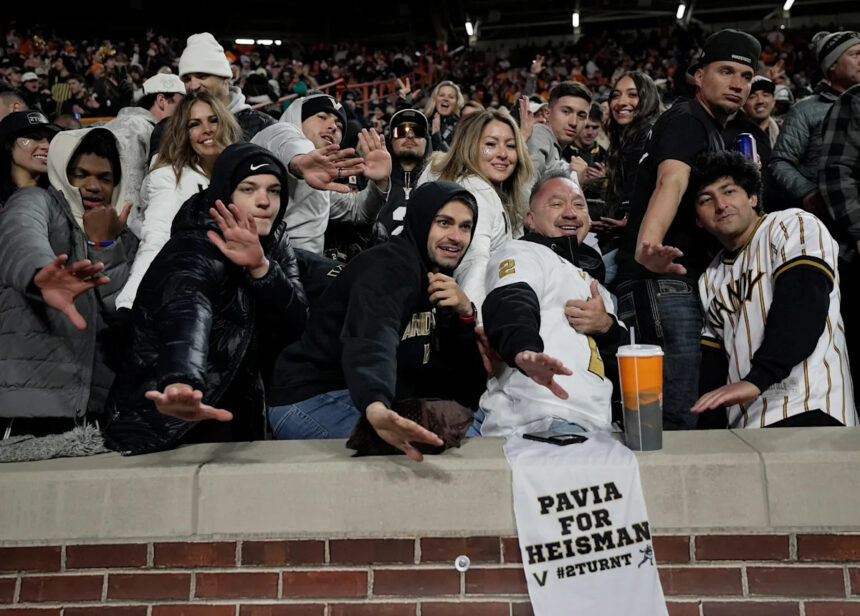
Yet, the story generating seismic waves comes from Nashville. Diego Pavia, the electric quarterback for Vanderbilt, isn’t just in the conversation; he is a finalist with the second-best odds. This fact is monumental. Vanderbilt football, an academic powerhouse in the SEC’s brutal landscape, has never had a Heisman finalist. Pavia’s cannon arm and improvisational genius have made the Commodors must-watch television and, more importantly, a competitive force in the nation’s toughest conference. His presence in New York isn’t just a personal achievement; it’s a paradigm-shifting moment for his entire institution, proving that even in the NIL and transfer portal era, a diamond in the rough can polish itself into a national treasure.
Expert Analysis: What the Voting Reveals
The Mendoza-Pavia showdown is a fascinating case study in Heisman criteria. Traditionally, the award demands a combination of:
- Statistical Dominance: Both players have this, though their numbers may not reach the stratospheric totals of recent winners in more potent offenses.
- Team Success: Mendoza’s Hoosiers likely have the edge in win-loss record, a key voter metric.
- The “Heisman Moment”: A single, defining play or game that etches a candidate into memory. Both have several candidates for this clip.
- Narrative Power: This is where the race is won. Mendoza is the revitalizer. Pavia is the history-maker from a program where history is rarely made on the gridiron.
The vote will hinge on whether the electorate values program-elevating success (Mendoza) or groundbreaking, precedent-shattering excellence against a tougher weekly slate (Pavia). The absence of a clear frontrunner from a perennial playoff team has opened the door for these compelling, unconventional stories. Furthermore, the regional voting patterns will be critical; Pavia’s performance in the SEC, watched closely by a large bloc of southern voters, could provide a significant boost that past Vanderbilt players could never dream of.
Prediction and Lasting Legacy
Forecasting the Heisman is an exercise in understanding the mood of over 900 voters—media members, past winners, and fans. While the safe money, both literally and figuratively, is on Fernando Mendoza, the intangible momentum behind Diego Pavia feels historic. Voters are presented with a rare opportunity: to reward an outstanding season, or to actively participate in making history by placing a Vanderbilt Commodore on the most exclusive list in sports.
Our prediction leans into the power of that legacy. In a razor-thin race, Diego Pavia will edge out Mendoza to win the 2024 Heisman Trophy. His candidacy checks every box: elite talent, statistical proof, a “Heisman Moment” (or three) against top-tier SEC competition, and an undeniable, once-in-a-generation narrative for his school. It would be an outcome that echoes the award’s original spirit—honoring the most outstanding player, regardless of pedigree.
Conclusion: More Than an Award, A Cultural Touchstone
From Jay Berwanger in 1935 to the upcoming ceremony on December 13th, the Heisman Trophy has transcended sports to become a cultural icon. It is a chronicle of football’s evolution, a maker of legends, and a dream that fuels thousands of young athletes. Whether the name called is Mendoza, Pavia, or a dark horse, the winner will join a fraternity where legacy is forever intertwined with history. This year, that history is particularly potent, reminding us that the Heisman’s greatest magic lies in its ability to surprise, to elevate the unexpected, and to forever change the trajectory of a player—and sometimes, an entire program—with the simple phrase, “The winner is…” The 2024 award won’t just honor a season’s excellence; it will celebrate the very essence of college football’s unpredictable drama.
Source: Based on news from Yahoo Sports.