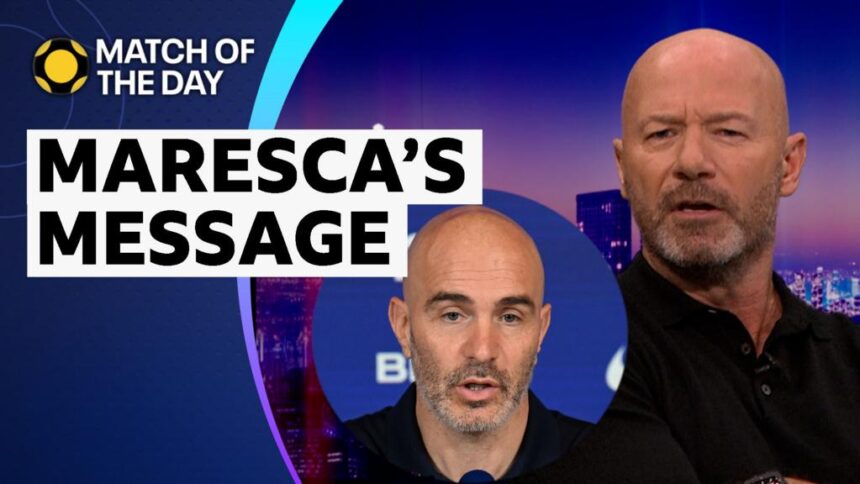
‘He’s Got to Be Careful’: Decoding Maresca’s Targeted Chelsea Press Conference
The final whistle at Stamford Bridge brought a 2-0 victory over Everton, a clean sheet, and a welcome three points. Yet, the most compelling drama of the day unfolded not on the pitch, but in the press room. Enzo Maresca, Chelsea’s new architect, delivered a post-match conference that was less a celebration and more a meticulously calibrated message. Between the lines of praise for his players lay a pointed, almost public, memorandum. The question now echoing through SW6 is a simple one: who was the real audience for Maresca’s words?
A Victory Overshadowed by Verbal Jabs
On the surface, the narrative was positive. Chelsea controlled large portions of the game against a stubborn Everton side. The goals, while not a torrent, were well-worked. The defensive structure, a cornerstone of Maresca’s philosophy, looked more cohesive. Yet, the Italian’s tone was notably restrained, pivoting quickly from match analysis to broader, more strategic concerns. He spoke not like a coach satisfied with a job well done, but like a project manager acutely aware of obstacles being placed in his path. This was not frustration with effort, but with environment. The subtext was clear: the victory is a step, but the process is being tested from within.
Decoding the Directive: Who is “He”?
The most telling moment came when Maresca, discussing the integration of young players and the squad’s development, offered a seemingly generic warning: “He’s got to be careful.” In the vacuum of a press conference, “he” could be anyone. But the context Maresca built around it painted a vivid picture.
- The Subject was Squad Planning and Patience: Maresca was explicitly talking about managing young talent within the relentless grind of the Premier League calendar.
- The Philosophy is Non-Negotiable: He reiterated his commitment to a specific, possession-dominant style, a system that requires specific players and, crucially, time.
- The History is a Blueprint: References to the need for a “clear path” and avoiding past “instability” were barely-veiled allusions to the club’s recent revolving-door policy.
When pieced together, the “he” in Maresca’s warning points less at an individual player and more at the decision-making apparatus above him. This was a public reminder to the sporting directors and ownership that his project requires unwavering support and strategic alignment, not impulsive deviations. It was a call for the board to “be careful” not to undermine the long-term vision with short-term panic or incongruent signings.
The Unseen Battle: Coach vs. The Chelsea Model
Maresca’s comments shine a harsh light on the fundamental tension at the heart of modern Chelsea. On one side is a coach, a disciple of the Pep Guardiola school, who believes in a methodical football ideology. His system is his star. On the other side is a data-driven ownership model that has aggressively invested in youthful potential, often expecting immediate returns and maintaining a deep, competitive squad. The clash is between a purist’s vision and a conglomerate’s portfolio.
By speaking out, Maresca is attempting a pre-emptive strike. The January transfer window looms, and with it, the perennial whispers of big-money moves. His press conference was a boundary-setting exercise. He is signaling that every signing must fit his tactical mold, and that the development of his current squad—players like Palmer, Caicedo, and the returning Lavia—must not be disrupted by constant churn. It is a bold power play from a new manager, asserting his primacy over the sporting project.
Predictions: Storm Clouds or Clearer Skies?
This public maneuvering sets the stage for a critical period at Chelsea. The trajectory of Maresca’s tenure may well hinge on the reaction to his targeted message.
The Optimistic Scenario: The board receives the message as intended—a passionate coach safeguarding his project. They align their recruitment strategy entirely with Maresca’s needs, providing targeted, system-specific players in January. The public show of conviction unites the club, and the team, feeling secure in the plan, accelerates its development. This becomes a turning point in club-coach harmony.
The Pessimistic Scenario: The ownership views this as a challenge to their authority. The structural tension remains, leading to disagreements over transfer targets. The “careful” warning goes unheeded, resulting in a fractured strategy. History tells us that at Chelsea, when the manager and the board enter a cold war, it is almost always the manager who departs first. Maresca’s comments could, ironically, become the first crack in his own foundation.
Conclusion: A Line in the Stamford Bridge Turf
Enzo Maresca’s press conference after the Everton victory was far more significant than the match itself. In choosing to voice his conditions and concerns publicly, he drew a line in the Stamford Bridge turf. This was not the rant of a stressed manager, but the calculated strategy of a manager determined to control the variables around him. He is betting that his vision is valuable enough for the club to fall in line.
The message is now received. The warning—”He’s got to be careful”—hangs in the air, a testament to the fragile balance at a club forever torn between project and instant profit. The coming months will reveal whether Maresca’s targeted press conference was a masterstroke of internal diplomacy or the first act of a familiar Chelsea drama. One thing is certain: the battle for Chelsea’s soul is being fought in the press room as fiercely as on the pitch.
Source: Based on news from BBC Sport.