Green Bay Gripped by Dread: Micah Parsons’ Noncontact Knee Injury Sends Shockwaves
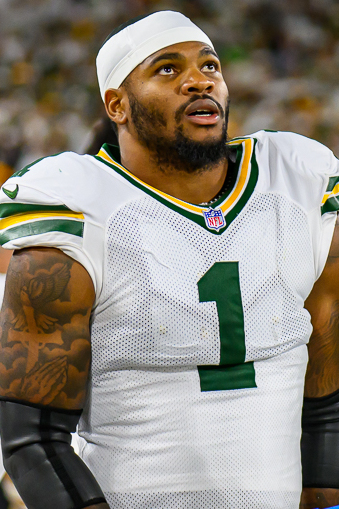
The air at Lambeau Field, typically thick with the scent of brats and bravado, turned cold with a familiar, stomach-churning dread in the third quarter of Sunday’s clash with the Denver Broncos. In a moment stripped of the game’s violent poetry, Green Bay Packers’ defensive cornerstone Micah Parsons planted his foot during a routine pass rush, crumpled to the turf without a hand laid on him, and immediately clutched his left knee. The stadium fell silent. This was the scenario every fan, coach, and executive fears most: the noncontact knee injury. The sight of the league’s most fearsome pass rusher succumbing to the fragility of his own athleticism has not only jeopardized the Packers’ season but has ignited a league-wide conversation about the price of elite performance.
The Anatomy of a Nightmare: What a Noncontact Injury Means
In the brutal ballet of professional football, contact injuries—the big hits, the tangled piles—are an accepted occupational hazard. A noncontact knee injury, however, operates on a different, more insidious level. It suggests an internal failure, a ligament or tendon giving way under the immense forces generated by the athlete’s own body. For a player like Parsons, whose game is built on explosive, turbo-charged changes of direction and breathtaking acceleration, the knee is a vulnerable nexus of power.
While official diagnosis is pending further MRI results, the immediate speculation from medical experts observing the mechanism of injury points to several alarming possibilities:
- ACL Tear: The anterior cruciate ligament is the king of catastrophic knee injuries. A rupture typically requires season-ending surgery and a grueling 9-12 month rehabilitation.
- MCL Sprain: A injury to the medial collateral ligament, often caused by a valgus (inward) collapse of the knee. Severity can range from a few weeks to multiple months.
- Meniscus Damage: Tearing of the knee’s crucial shock-absorbing cartilage. Recovery timeline varies drastically based on the tear’s location and severity.
“When you see an elite athlete like Parsons go down without contact, the first thought is always the ACL,” remarked Dr. Anya Sharma, a former NFL team orthopedic consultant. “These players push their musculoskeletal systems to the absolute limit. Sometimes, the very mechanics that make them extraordinary—the extreme cuts, the deceleration—create perfect storm conditions for a ligament to fail.”
Parsons’ Irreplaceable Impact and the Packers’ Daunting Void
To understand the magnitude of this loss, one must quantify the unquantifiable impact of Micah Parsons. He is not merely a pass rusher; he is the Packers’ defensive ecosystem. His presence alone dictates offensive game plans, forcing double and triple teams that free up teammates, collapsing pockets before plays can develop, and creating turnovers through sheer disruptive terror.
Let’s examine the stark reality of a Packers defense without its centerpiece:
- Pass Rush Catastrophe: Parsons accounts for over 35% of the team’s total pressures and sacks. Without his constant threat, opposing quarterbacks will have exponentially more time to dissect the secondary.
- Run Defense Vulnerability: His sideline-to-sideline range and ability to set a hard edge are foundational to Green Bay’s run fits. His absence creates rushing lanes that were previously sealed shut.
- Leadership Vacuum: Beyond stats, Parsons is the emotional engine of the unit. His energy, football IQ, and clutch playmaking are intangible assets that cannot be replicated by committee.
“You don’t replace a Micah Parsons,” said veteran NFL analyst Carl Jefferson. “You try to scheme around the gaping hole he leaves. The Packers will have to get creative with blitz packages, and players like Preston Smith and rookie Lukas Van Ness will have to produce at a level they’ve never been asked to before. It’s a monumental task.”
Navigating the Abyss: Green Bay’s Path Forward Without Its Star
The immediate aftermath of the injury plunges the Packers’ front office and coaching staff into a crisis management scenario. The coming days will involve a delicate balance of hope and pragmatism. First, the medical evaluation will set the course. If the injury is season-ending, the franchise’s entire 2024 trajectory shifts.
General Manager Brian Gutekunst now faces a series of unenviable decisions:
- Internal Solutions: Can a combination of Van Ness, Kingsley Enagbare, and Brenton Cox Jr. form a competent rotation? This is the most likely immediate path, but it represents a staggering drop-off in talent.
- The Trade Market: With the November trade deadline looming, do the Packers aggressively pursue a veteran pass rusher, potentially mortgaging future draft capital for a season now on a knife’s edge? Names like Brian Burns or Danielle Hunter would be costly but immediate fixes.
- Philosophical Shift: Defensive Coordinator Jeff Hafley may need to fundamentally alter his scheme, moving from a pressure-based defense to a more coverage-heavy approach to protect a diminished pass rush.
“This is where culture gets tested,” commented former Packers linebacker A.J. Hawk. “The ‘Next Man Up’ mantra is easy to say and hard to live. Someone in that locker room has to make a play they’ve never made before, consistently. The entire identity of that defense has to evolve overnight.”
A League-Wide Echo: The Human Cost of High Velocity
Parsons’ injury transcends the borders of Wisconsin. It is a stark, high-profile reminder of the physical lottery every NFL player enters each snap. In an era where players are faster, stronger, and more explosive than ever, the connective tissues—the knees, the ankles—are bearing unsustainable loads. Parsons, with his unique blend of size and linebacker-like agility, may represent a physical archetype that the sport itself is straining to contain.
This incident will inevitably reignite debates about field surfaces, training regimens, and even the length of the season. But at its core, it’s a human story. It’s about the agonizing uncertainty a young superstar faces in a quiet MRI tube, and the dreams of a franchise momentarily deferred by a single, innocuous step.
Conclusion: A Season Hangs in the Balance
The image of Micah Parsons being helped to the sideline, his weight carefully off his left leg, is an emblem of cruel sporting fate. The Packers’ Super Bowl aspirations, once vibrant, are now contingent on a medical report and the ability of an entire organization to rally in the face of devastating adversity. Whether this is a multi-week setback or a season-defining catastrophe, the landscape of the NFC has been irrevocably altered. For Green Bay, the mission is now one of resilience. For the rest of the league, it’s a sobering lesson in fragility. And for Micah Parsons, it’s the beginning of a personal battle—a fight back to the gridiron that will test his physical and mental fortitude like no blocker ever could. The road ahead is uncertain, but one thing is clear: the echo of that noncontact fall will resonate throughout Green Bay for a very, very long time.
Source: Based on news from ESPN.
Image: CC licensed via it.wikipedia.org