Baller League UK: A ‘New Sport’ Finding Its Feet in Football’s Shadow
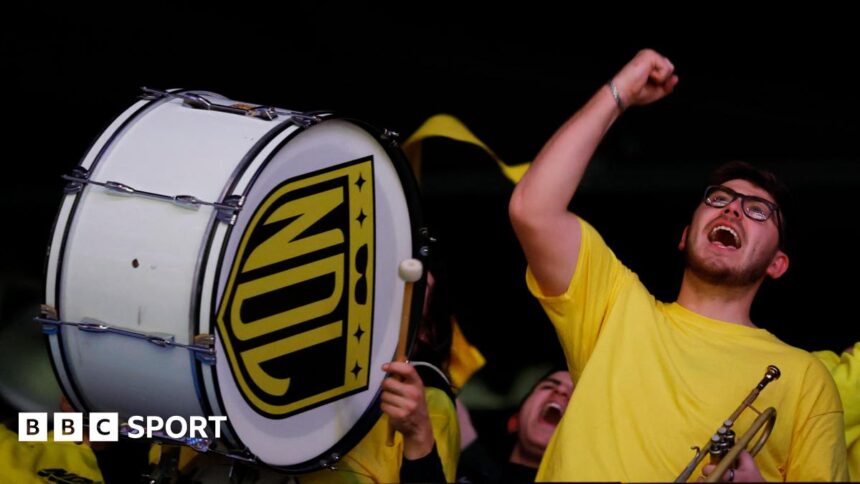
East London played host to two very different versions of the ‘beautiful game’ on a single Sunday. Just a stone’s throw from the hallowed London Stadium, where 58,669 fans witnessed the traditional drama of West Ham beating QPR in the FA Cup, a different, louder, faster heartbeat pulsed from a nearby arena. Here, roughly 4,000 supporters packed in for a marathon of end-to-end action as season two of Baller League UK concluded. It’s a contrast that defines this burgeoning competition: not yet a rival to football’s cathedrals, but a vibrant new attraction carving its own niche. As Wembley Rangers, managed by icons Ian Wright and Alan Shearer, lifted the trophy, the question hung in the air: is this a fleeting novelty, or a genuine ‘new sport’ with serious room to improve and grow?
More Than a Tournament: The Baller League Philosophy
To dismiss Baller League as mere six-a-side football is to miss its entire point. This is a product engineered for the short-attention-span, highlight-reel generation. The format is frenetic: six players per side, rolling substitutions, a smaller pitch with hockey-style boards, and a relentless shot clock that forces continuous attack. Matches are short, explosive bursts of energy. The atmosphere is less reverent silence and more festival—loud music, interactive fan challenges, and a palpable social media buzz running parallel to the on-pitch action.
Baller League chief executive Felix Starck’s bold claim that his competition surpasses the Premier League for the younger generation is its central thesis. He isn’t arguing about quality of play, but about engagement and accessibility. “We offer something the Premier League cannot,” Starck implies, “proximity, constant action, and a sense that this is ‘their’ space, unburdened by a century of tradition.” It’s football remixed for the TikTok age, where a spectacular miss might trend as hard as a winning goal, and former pros like Wright and Shearer are not distant legends but hands-on, mic’d up generals.
Season Two: Signs of Progress and Persistent Growing Pains
The conclusion of the second season offered clear evidence of a league evolving. The presence of 4,000 fans for a near five-hour finale shows a dedicated, if modest, core audience. The high-profile management duo delivering the title provides a stamp of authentic football credibility. The dramatic semi-final exit of a team like NDL proves narrative and unpredictability are taking root.
Yet, the ‘room to improve’ is equally evident. The league operates in a curious space:
- Identity vs. Gimmick: Balancing fast-paced innovation with sporting integrity is a tightrope walk. The shot clock and boards are defining features, but must not become the only talking points.
- Star Power Sustainability: Relying on retired legends for marketing is a strong start, but cultivating its own stars—players and personalities—is crucial for long-term health.
- Commercial Footing: Operating in the shadow of the FA Cup illustrates the vast financial and cultural chasm to bridge. Moving from a curiosity to a commercially robust entity is its next major hurdle.
- Sporting Depth: Beyond the final four, ensuring consistent quality and competitive balance across all teams will be key to maintaining fan interest throughout a season.
Expert Analysis: The Path from Novelty to Staple
From a sports business perspective, Baller League UK has executed a clever market entry. It has identified a gap—the desire for a live, social, and hyper-kinetic football-adjacent experience—and tailored a product to fit. Its use of digital-native storytelling, where content is created for platforms like YouTube and Instagram as much as for the live crowd, is textbook modern sports marketing.
However, the transition from “cool new thing” to a sustainable league is the ultimate challenge. Its growth likely hinges on a few critical factors:
Embracing Its Hybrid Nature: It should lean further into being a sport-entertainment hybrid. Think less minor football league, more akin to the NBA All-Star Weekend’s skills competitions—a celebration of flair, personality, and pure fun.
Grassroots Integration: Creating a pathway, or even a parallel amateur version of its format, could foster community and identify homegrown talent, reducing reliance on ex-pros.
Broadcast Innovation: Its natural home is streaming. Interactive broadcasts with player mics, fan-voted MVPs, and integrated social feeds could make the at-home experience uniquely compelling.
Predictions: What Does the Future Hold for Baller League?
The trajectory for Baller League is promising but precarious. In the short term, expect continued incremental growth. Season three will likely see slightly bigger crowds, more digital partnerships, and perhaps another big-name football figure getting involved. The format may tweak further, perhaps experimenting with new rule variations or a larger tournament structure.
The long-term future presents two divergent paths. One sees it plateauing as a popular offseason curiosity for football fans—a well-produced diversion but not a threat to the establishment. The other, more ambitious path, involves it solidifying its status as a genuine ‘new sport’ with its own ecosystem. This would mean professional players who are Baller League specialists, international expansion (a Baller League Europe?), and a broadcast deal that validates its standalone value. The latter is far harder, but the ambition is clearly there.
Conclusion: A Vibrant Work in Progress
As the cheers for Wembley Rangers faded in East London, the message was clear. Baller League UK is not pretending to be the FA Cup, nor does it want to be. It is building something different in the space between professional football, entertainment, and digital culture. It has successfully completed its proof-of-concept: yes, there is an audience for this faster, louder, more intimate version of the game.
Felix Starck’s vision of captivating a younger generation is being realized, one viral clip and one packed arena at a time. Yet, the phrase “room to improve” is not a criticism but its current reality and greatest opportunity. The foundation is laid. The challenge now is to build upon it with strategic patience, ensuring the league’s sporting credibility deepens alongside its entertainment value. Baller League has earned its place on the pitch. The next season will be about proving it’s here to stay.
Source: Based on news from BBC Sport.