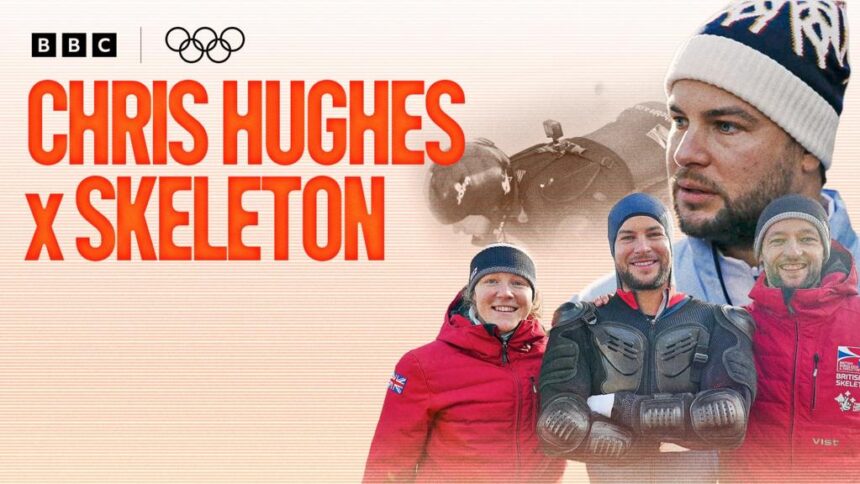
‘Absolutely Brutal!’ – Chris Hughes Confronts the Terror of a Skeleton Run
The world of elite winter sports is a universe away from the glitz of reality TV, a fact that TV personality Chris Hughes learned in the most visceral way possible. In a heart-in-mouth segment filmed ahead of the Milan-Cortina 2026 Winter Olympics, Hughes swapped the comfort of the studio for the sheer, unadulterated terror of a skeleton run. Under the tutelage of British skeleton stars Amelia Coltman and Marcus Wyatt, Hughes embarked on a journey that can only be described, in his own words, as “absolutely brutal.”
From Love Island to the Ice Track: A Trial by Fire (and Ice)
For the uninitiated, skeleton is arguably the most audacious sport in the Olympic canon. Athletes propel themselves head-first down a frozen chute at speeds exceeding 80 mph, their chin mere inches from the ice, with nothing but a small sled and a helmet for protection. It is a test of nerve, precision, and raw courage. Introducing this world to Chris Hughes, best known for *Love Island* and presenting roles, was a masterstroke in showcasing the sport’s insane demands. The segment, available to watch on the BBC, is more than just a celebrity challenge; it is a stark, unfiltered education in what it takes to be an Olympian.
The training began not on the ice, but on a dry push track. Here, the foundation of skeleton is laid: the explosive start. Marcus Wyatt, a World Cup medalist, and Amelia Coltman, one of Britain’s top prospects, drilled Hughes on the technique. The power required is immense. In under five seconds, athletes must sprint, load onto the sled, and find their aerodynamic position. For Hughes, this initial phase was a humbling lesson in athletic disparity. “You think it’s just jumping on a sled,” Hughes gasped, “but the power these guys generate is from another planet.”
The Descent: Confronting the “Brutal” Reality
Then came the moment of truth: the actual ice track. Even from the starting block, the perspective is terrifying. The track isn’t a slope; it’s a wall of ice disappearing into a twisting, turning tunnel. The psychological barrier is immense. Would Hughes go head-first? The footage captures the palpable fear. With Coltman and Wyatt offering last-second advice—”Keep your head down!” “Stay relaxed!”—the reality star took the plunge.
The run itself is a blur of violent noise, crushing G-forces, and instinctual survival. Skeleton athletes speak of “driving” the track, using minute shoulder and knee shifts to steer. For a novice like Hughes, it is simply about holding on and trying not to panic. The experience was transformative. “It’s the most insane thing I’ve ever done,” Hughes stated, visibly shaken after exiting the sled. “The G-force pins you down, the walls are a blur, and you have this surreal moment of thinking, ‘My face is on the floor of a ice tunnel going 70 miles an hour.’ It’s absolutely brutal. It gives you a whole new level of respect for what they do.”
This raw reaction underscores a critical point about skeleton. The challenge is not purely physical; it is profoundly mental. Experts break down the key psychological demands:
- Precision Under Pressure: A single error in steering can mean a catastrophic crash.
- Embracing Vulnerability: The head-first position triggers primal fear responses that must be controlled.
- Kinesthetic Awareness: “Feeling” the track through the sled while being battered by forces is a unique skill.
Expert Analysis: What Hughes’s Run Tells Us About Olympic Greatness
Watching a novice like Hughes tackle the skeleton provides invaluable insight into the caliber of athletes like Coltman and Wyatt. His struggle highlights their superhuman qualities. Amelia Coltman’s technical guidance to Hughes revealed the sport’s intricate detail. The “start,” she emphasized, is where races are often won or lost, a fact borne out in World Cup competition where hundredths of a second separate podium places.
Marcus Wyatt’s calm demeanor during the coaching session exemplifies the mindset required. For them, the “brutal” run is a canvas for their art. They aren’t just passengers; they are pilots. Their years of training have rewired their instincts, turning panic into calculated input. Hughes’s white-knuckle ride was a testament to their daily reality. This segment brilliantly demystifies the sport, moving the public perception from “they’re crazy” to “they are phenomenally skilled and brave athletes.”
Road to Milan-Cortina 2026: Predictions and Prospects
As the focus shifts to the Milan-Cortina 2026 Winter Olympics, the British skeleton program appears to be in a strong position. The experience gained from Beijing 2022, where Matt Weston secured a historic gold medal in the men’s event, has created a culture of success.
Based on current World Cup form and development trajectories, here are key predictions for Team GB:
- Marcus Wyatt will be a serious medal contender. His consistency and experience on the Cortina track could prove decisive.
- Amelia Coltman represents the exciting new generation. If her development curve continues, she could challenge for a top-10 or even podium finish, mirroring the breakthrough of previous British skeleton stars.
- The intense domestic competition within the British squad will be a major asset, pushing all athletes to peak at the right time.
The BBC’s coverage, which will include this gripping segment, is crucial for building a narrative around these athletes. Stories like Hughes’s terrifying trial make the Olympic performances relatable and awe-inspiring, giving viewers a tangible sense of the courage on display.
Conclusion: A Newfound Respect Forged on Ice
Chris Hughes’s skeleton adventure was more than just a viral video segment. It was a powerful piece of sports journalism that bridged the gap between spectator and participant. His authentic, fear-filled reaction and repeated description of “brutal” did more for the sport than any technical explanation could. It framed skeleton athletes not as daredevils, but as some of the most disciplined, courageous, and technically gifted competitors in all of sport.
As we look forward to following the Milan-Cortina 2026 Winter Olympics across the BBC from Friday, 6 February, we will watch the runs of Amelia Coltman, Marcus Wyatt, and their peers with radically different eyes. We will see the explosive start and understand the years of power training behind it. We will watch them navigate Curve 9 and comprehend the mental fortitude required to steer while compressed by G-forces. Thanks to one “absolutely brutal” run, the Olympic skeleton is no longer just a blur on our screens; it is a profound human achievement, earned one terrifying inch above the ice at a time.
Source: Based on news from BBC Sport.