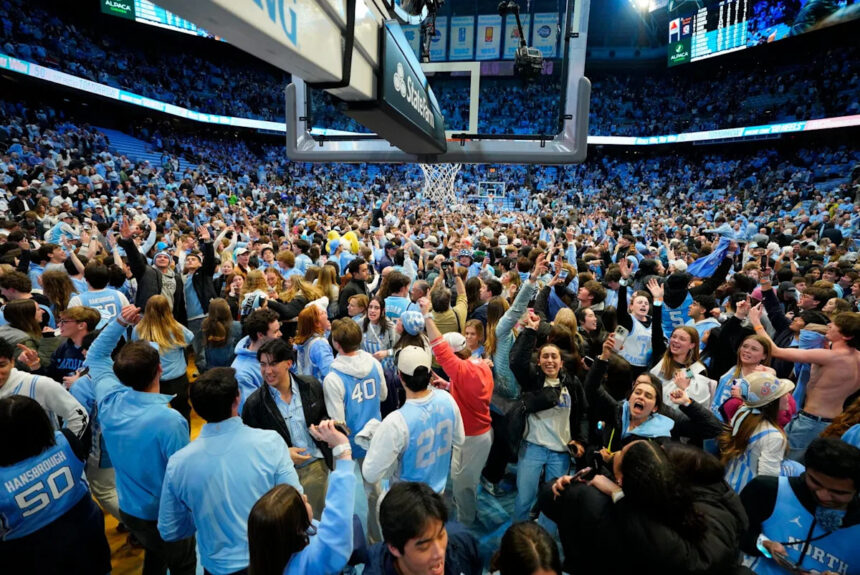
ACC Slams UNC with $50,000 Fine After Chaotic, Dangerous Court-Storming vs. Duke
The Atlantic Coast Conference’s swift and severe response was as unambiguous as a technical foul. On Sunday, the league office fined the University of North Carolina at Chapel Hill $50,000 for a clear violation of its event security policy, a direct consequence of the dangerous and chaotic scenes that unfolded following the Tar Heels’ dramatic 71-68 victory over archrival Duke. The fine, however, feels like a mere footnote to a larger, more troubling story—one where the timeless thrill of a last-second win was nearly eclipsed by a complete breakdown of fan safety and sportsmanship.
- A Perfect Storm of Chaos: The Sequence That Spun Out of Control
- Beyond the Fine: The Escalating National Debate on Fan Safety
- Expert Analysis: The Untenable Position of Schools and Conferences
- Predictions and Repercussions: What Comes Next for the ACC and College Basketball?
- Conclusion: A Victory Tarnished, A Tradition at a Crossroads
A Perfect Storm of Chaos: The Sequence That Spun Out of Control
The game itself was an instant classic, a masterpiece of the college basketball canon. With 0.4 seconds remaining and the score tied, UNC’s Seth Trimble launched a three-pointer that swished through the net. The initial reaction from many, including the sold-out Dean Smith Center crowd, was that the shot was too late. Believing the game was over, a tidal wave of Carolina students surged onto the court in a premature court-storming celebration.
Officials, however, ruled that time remained. What followed was a surreal and logistically nightmarish sequence. Security personnel and staff fought to clear the floor, pushing thousands of exuberant fans back to the sidelines so Duke could attempt a desperation inbounds play. When the final tenth of a second finally expired, the floodgates opened again. This two-phase storm created a perfect environment for confusion and conflict, as the barrier between celebrating fans and defeated opponents dissolved entirely.
“For me it’s hard to talk about the game when I was most concerned just for the safety of our players after the game,” Duke head coach Jon Scheyer said, his postgame comments striking a somber tone. The celebration had crossed a line. “I got staff members that got punched in the face. My family, pushing people away, trying to not get trampled. That’s not what this game is about.”
Beyond the Fine: The Escalating National Debate on Fan Safety
The ACC’s $50,000 penalty is not arbitrary. It is the maximum fine allowed under the conference’s event security policy, enacted in 2023 and strengthened just this past February. The policy employs a sliding scale of fines for court and field storms: $100,000 for a first offense, $250,000 for a second, and a staggering $1 million for a third. As UNC’s first violation, the fine was halved because the school met several conference-mandated security standards beforehand. The message is clear: the league is attempting to wield financial deterrence against a cultural phenomenon.
Yet, the incident in Chapel Hill immediately reignites a fierce national debate. Is a fine, even a hefty one, enough? In recent years, court-storming has led to serious player injuries, like when Iowa’s Caitlin Clark collided with a fan, and now, alleged assaults on coaching staff. The core question becomes: at what point does celebratory tradition become unacceptable liability?
- Financial Deterrence: The ACC’s policy is among the nation’s strictest, directly targeting school budgets.
- Security Theater vs. Real Prevention: Did the pre-game plans adequately account for the volatility of this specific rivalry? Clearing the court once is difficult; doing it twice in 30 seconds is nearly impossible.
- Cultural Shift: Fines punish the institution, but changing fan behavior requires a broader educational and enforcement campaign.
This was not a simple celebration. The allegations of Duke staff being punched transform the narrative from one of unsafe conditions to one of outright violence, a distinction that could force even more draconian measures in the future.
Expert Analysis: The Untenable Position of Schools and Conferences
From a logistical and legal standpoint, universities and conferences are in a bind. The electrifying, organic rush of students onto the court is a iconic image of college sports, a marketing tool as potent as any highlight reel. Yet, administrators live in fear of the lawsuit that will inevitably follow a catastrophic injury to a player, coach, or fan.
“The ACC had to act decisively here,” says a veteran collegiate athletics administrator who spoke on condition of anonymity. “The fine is almost secondary. The public reprimand and the paper trail are about establishing due diligence. When—not if—a major injury occurs during a storm, the conference and school can point to these policies and penalties to show they were trying to prevent it. It’s a stark example of managing institutional risk.”
The policy essentially makes schools responsible for policing the uncontrollable euphoria of thousands of young adults. Options like holding fans until the visiting team exits, employing more robust barrier systems, or even arresting participants are all on the table but come with their own public relations and practical costs. The UNC-Duke incident, with its double-storm and allegations of violence, provides a worst-case scenario blueprint that will be studied in security meetings across the country.
Predictions and Repercussions: What Comes Next for the ACC and College Basketball?
The fallout from this event will extend far beyond a single fine. We can expect several immediate and long-term consequences:
1. A Security Arms Race: Look for ACC schools, especially in high-stakes rivalries, to dramatically increase visible security presence for marquee games. This may include more barricades, earlier deployment of officers on the court perimeter, and pre-game PA announcements emphasizing the financial and legal penalties for storming.
2. Player and Coach Advocacy: Jon Scheyer’s powerful statement gives voice to a growing sentiment among coaches and players who feel like targets in these situations. Their increased public pressure will force conferences to consider even stricter measures, potentially including forfeits or technical fouls assessed before a storm begins—though such ideas are logistically fraught.
3. The Litigation Lightning Rod: The alleged punches thrown at Duke staff members open the door to potential criminal charges and civil lawsuits against individuals. If pursued, this could be the landmark case that finally shifts the calculus for fans, making them think twice before jumping the rail.
4. National Policy Discussion: The ACC is now at the forefront of this issue. Other Power 5 conferences will watch closely. If the steep fines prove ineffective as a deterrent—as this first test at UNC suggests they might be—the call for a uniform, NCAA-wide policy with even sharper teeth will grow louder.
Conclusion: A Victory Tarnished, A Tradition at a Crossroads
North Carolina’s win over Duke should be remembered for Seth Trimble’s clutch shot, for Hubert Davis’s coaching, for a pivotal moment in the ACC title race. Instead, it will be indelibly linked to a dangerous court-storming that led to a significant fine and serious allegations of violence. The ACC’s $50,000 penalty is a line in the sand, but the tide of fan emotion continues to wash over it.
The heart of college sports beats with passion and tradition, but it must also function with responsibility and safety. The chaotic scenes in Chapel Hill are a wake-up call. The current model of reactive fines is proving inadequate. The sport now stands at a crossroads: it must engineer a way to protect the competitive integrity and physical safety of everyone involved without completely sanitizing the raw, passionate atmosphere that makes it unique. The clock is ticking, and the next storm is always just one buzzer-beater away.
Source: Based on news from Yahoo Sports.