Carlos Alcaraz Defies the Brink, Conquers Alexander Zverev in Australian Open Epic
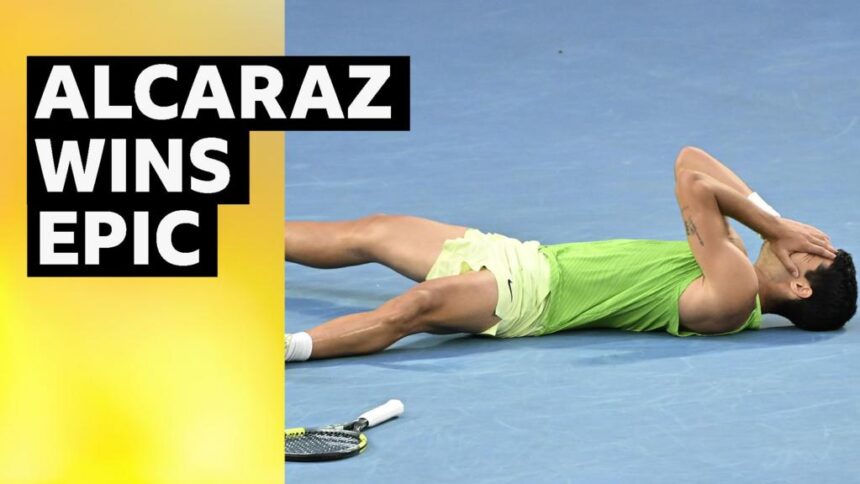
In the rarefied air of a Grand Slam semifinal, where legends are forged in the fire of crisis, Carlos Alcaraz authored a chapter that will resonate for generations. Facing a formidable Alexander Zverev and staring down a two-sets-to-one deficit, the young Spaniard didn’t just find a way to win; he unearthed a victory that defines a champion’s heart. In a four-hour, thirty-nine-minute masterpiece of physical endurance and psychological warfare, Alcaraz triumphed 6-3, 6-7(4), 6-1, 6-7(1), 6-4 to storm into his first Australian Open final, a stage he now owns on three of the sport’s four sacred grounds.
A Clash of Titans: Power vs. Poetry
From the first ball struck, the narrative was clear. This was a clash of diametrically opposed tennis philosophies. Alexander Zverev, the immovable object, unleashed a barrage of thunderous serves and flat, penetrating groundstrokes from the baseline, aiming to bully and bludgeon. His first-strike tennis was devastatingly effective, particularly in the tiebreaks where he conceded a mere five points combined.
Carlos Alcaraz, the irresistible force, countered with his signature brand of kinetic, all-court artistry. His game is a vibrant tapestry of furious topspin, jaw-dropping drop shots, and net-rushing bravado. The early stages saw Alcaraz’s variety disrupting Zverev’s rhythm, his ability to change speeds and spins drawing errors from the German’s racket. He claimed the first set with authority, but Zverev’s resilience, a hallmark of his recent resurgence, surfaced in a critical second-set tiebreak, leveling the match and setting the stage for a monumental struggle.
The Crucible: Alcaraz’s Midnight Miracle
The match’s pivotal, soul-searching turn came after Zverev seized the fourth set, again via a dominant tiebreak. The German, now one set from the final, seemed to have all the momentum. The physical toll was visible; Alcaraz, battling apparent cramping, moved with visible discomfort between points. The obituaries for his challenge were being drafted. Yet, within the confines of his own physical turmoil, Alcaraz located a profound mental fortitude that separates the great from the immortal.
Rather than retreat, he attacked. The fifth set became a testament to his champion’s psyche.
- Strategic Brilliance: He shortened points intelligently, using drop shots and sudden forays to the net to negate Zverev’s baseline power.
- Clutch Serving: In the decider’s biggest moments, his serve, often considered his relative weakness, delivered unreturnable bombs.
- Fearless Shot-Making: At 2-2, 0-30 down on his own serve—a potential crisis point—he produced a stunning, running forehand pass that electrified Rod Laver Arena and shifted the emotional axis of the match.
This was not just a comeback; it was a tactical and spiritual overhaul in real-time, executed under the most extreme pressure imaginable.
Expert Analysis: What This Victory Reveals
This semifinal was more than a match; it was a data-rich case study in modern championship mettle. For Zverev, it was a crushing reminder that in the era of the “Big Three” successors, sheer power alone is insufficient. While his serve and backhand were often impregnable, his inability to consistently disrupt Alcaraz’s rhythm with variety or adapt his game plan in the fifth set proved costly. His quest for a first major continues, but his form confirms he will remain a persistent threat.
For Alcaraz, this victory is a monumental evolution. He has now proven he can win the long, brutal physical wars, a question that occasionally followed him. Previously, his Grand Slam triumphs at the US Open and Wimbledon were characterized by explosive, dominant tennis. This was a victory of grit over grace, of problem-solving under duress. He demonstrated a veteran’s maturity, managing his body, his emotions, and the match’s ebbs and flows with the wisdom of a player far beyond his 20 years. It signals the development of a complete, resilient champion capable of winning in any style, on any surface, against any opponent.
The Final Frontier and a Shifting Landscape
As Alcaraz advances to face either Daniil Medvedev or Jannik Sinner in the final, he carries not just momentum, but an aura of inevitability. Having conquered his own physical limitations and a top-tier opponent in such dramatic fashion, he will step onto the court believing the trophy is his destiny. For the tennis world, this match felt like a symbolic passing of the torch. While Novak Djokovic’s reign is far from over, Alcaraz has now reached the final of three different majors, displaying a versatility and fearlessness that marks him as the sport’s new central pillar.
His game, a joyous fusion of past and present, is the blueprint for the future. More importantly, his heart, showcased in the Melbourne midnight hour, is the engine that will drive that future.
Conclusion: A Legacy Forged in Five Sets
Carlos Alcaraz’s victory over Alexander Zverev will be chronicled not merely as a semifinal win, but as a career-defining crucible. In the face of impending defeat and physical decay, he reached into a deep well of competitive character and produced a performance for the ages. He didn’t just beat Zverev; he overcame the immense weight of expectation, the pain of cramping, and the psychological hurdle of a fifth-set battle in a major semifinal.
This match transcended statistics and highlights. It was a raw, human drama of struggle and triumph that reminded everyone why we watch sports. By securing his place in the Australian Open final, Alcaraz has completed his set of major finals appearances and has emphatically announced that the future of men’s tennis is not just arriving—it is here, it is vibrant, and it possesses an indomitable will to match its breathtaking skill. The classic he authored against Zverev isn’t just a memory; it’s the foundation of a legend.
Source: Based on news from BBC Sport.