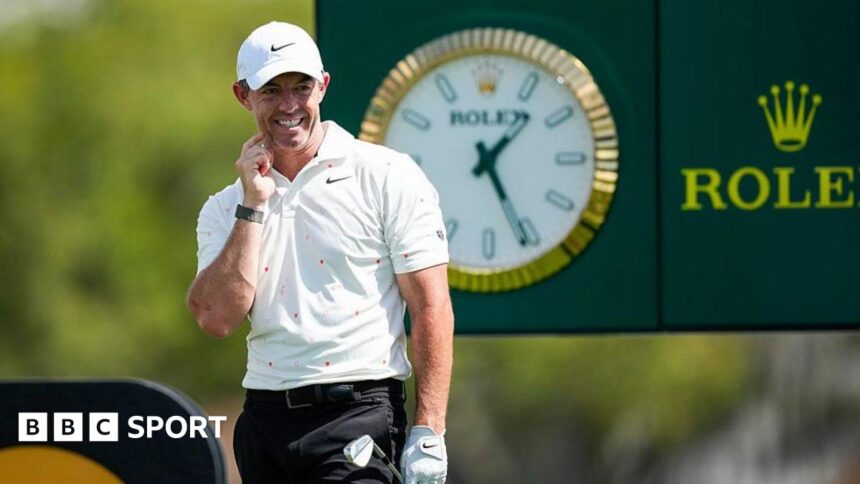
Back Spasms Sideline Rory McIlroy at Arnold Palmer Invitational, Casting Shadow Over Masters Prep
The crisp morning air at Bay Hill Club & Lodge, typically buzzing with the anticipation of a moving day shootout, was instead pierced by a wave of concern on Saturday. Rory McIlroy, a towering figure both in stature and on the leaderboard, was suddenly absent. Mere minutes before his third-round tee time at the Arnold Palmer Invitational, the PGA Tour announced McIlroy’s withdrawal due to a back injury, abruptly halting his quest for a second title at this prestigious event and sending a tremor through the golf world with the season’s first major just a month away.
A Sudden Twinge, A Painful Decision
The sequence of events unfolded with a frustrating familiarity for any athlete. McIlroy, who had grinded his way to a position inside the top 10 after 36 holes, reported feeling a “small twinge” in his back during his pre-round warm-up in the gym. The situation deteriorated rapidly on the practice range. What began as a minor concern worsened into full muscle spasms in his lower back, rendering him unable to make a competitive swing. About thirty minutes before he was due to start his round, the official withdrawal was confirmed.
In his statement, McIlroy’s disappointment was palpable. “Unfortunately, I’m not able to continue and have to withdraw,” he said. The timing could hardly be worse. The Arnold Palmer Invitational is a cornerstone of the PGA Tour’s Florida Swing, a critical testing ground of both skill and stamina ahead of the Masters Tournament. For McIlroy, who has been meticulously building his 2024 campaign around peaking at Augusta National, this interruption is more than a minor setback; it’s a disruption to a carefully orchestrated rhythm.
Expert Analysis: The Golfer’s Fragile Foundation
To understand the significance of this injury, one must appreciate the brutal physics of a modern golf swing. McIlroy’s action, a masterpiece of controlled violence, generates clubhead speeds consistently over 125 mph. This immense force is channeled through the body’s core, with the lower back acting as a critical transfer point.
“The lumbar spine in a golfer is like the shock absorber in a high-performance car,” explains Dr. Anya Sharma, a sports orthopedic specialist not involved in McIlroy’s care. “Muscle spasms are often a protective response—the body seizing up to prevent further, potentially structural, damage. For a player like Rory, it’s rarely a case of just ‘resting for a day.’ This type of acute, activity-induced spasm suggests an underlying vulnerability was triggered, likely from the cumulative stress of practice and play.”
The context of McIlroy’s recent schedule is key. His start to 2024 has been busy, featuring a victory in Dubai and intense competition on both the PGA Tour and in discussions off it. The wear and tear, both physical and mental, can subtly accumulate. Furthermore, Bay Hill’s demanding layout, with its thick rough and firm greens, requires powerful, aggressive swings from uneven lies—a perfect storm for a back on the edge.
- High-Velocity Swing: McIlroy’s power is a key asset but places exceptional torque on his lumbar spine.
- Course Demand: Bay Hill’s penal setup forces players into aggressive, full-body rotations often from unstable footing.
- Schedule Density: A global playing schedule limits extended periods of recovery and targeted strength work.
The Augusta Question: Implications for the Masters
This immediate withdrawal raises the inevitable, looming question: What does this mean for the Masters? Augusta National’s undulating terrain places its own unique demands on the back, requiring players to manufacture delicate shots from sloping lies. A compromised lower back doesn’t just affect driving; it undermines the stability required for the precise touch shots around the greens that win green jackets.
History offers a mixed prognosis. Tiger Woods has famously competed and won through significant back issues, but his path has been fraught with extended absences. McIlroy’s own career has seen intermittent back niggles, though none recently have caused a mid-tournament withdrawal. The severity of this episode will be determined by how quickly the spasms subside and how he responds to treatment.
“The key metric won’t be pain, but range of motion without inflammation,” notes veteran golf performance coach Michael Carter. “Can he make a full, committed rotation with confidence in a week? If he can’t practice fully at The Players Championship next week, the alarm bells will grow louder. The prep for Augusta is a specific build-up. Missing reps now is not ideal.”
McIlroy’s likely immediate plan will involve aggressive physical therapy, rest, and diagnostic imaging to rule out any disc-related issues. All eyes will now be on TPC Sawgrass. Whether he tees it up at The Players Championship—the Tour’s flagship event—will be the most telling sign of his health.
Predictions and the Road Ahead
Predicting the course of an injury is a fool’s errand, but we can map the potential scenarios:
- Best-Case Scenario: The spasms are acute but minor. With rest and treatment, McIlroy is able to compete at The Players, using it as a tune-up, and enters Augusta fully healthy. The withdrawal is seen as a prudent, precautionary blip.
- Moderate Scenario: Recovery is slower. He may skip The Players to ensure three full weeks of rehab and targeted preparation for the Masters. His lack of competitive reps would become a storyline, but a healthy McIlroy is always a threat at Augusta.
- Worst-Case Scenario: The back issue reveals a more persistent problem, requiring significant swing modifications or an extended break. This would cast serious doubt on his Masters readiness and his entire 2024 major championship pursuit.
The prudent nature of McIlroy’s decision to withdraw immediately is actually a positive sign. It shows a focus on the long-term prize rather than risking catastrophic injury for a single tournament. This maturity, born of experience, may be his greatest asset in navigating this setback.
Conclusion: A Stumbling Block on the Path to History
Rory McIlroy’s sudden exit from Bay Hill is a stark reminder of the fine line these athletes walk. In a sport where marginal gains are pursued with scientific precision, the human body remains an unpredictable variable. The quest for the career Grand Slam at the Masters is a burden and a blessing he carries, and this lower back injury has now introduced a formidable, physical obstacle into that narrative.
While the title at the Arnold Palmer Invitational will be won by another, the weekend’s most resonant story is one of fragility and resilience. McIlroy’s championship season has hit an unexpected speed bump. His response—how he heals, how he adapts, and how he returns—will define the next crucial chapter of his career. The road to Augusta just got a lot steeper, and the golf world holds its breath, hoping the sport’s most electrifying talent can recover in time for his most important appointment of the year.
Source: Based on news from BBC Sport.