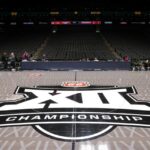
Big 12 Tournament Abandons LED Glass Court, Returns to Classic Hardwood After Player Safety Concerns
The Big 12 Men’s Basketball Tournament, a crucible of high-stakes competition, found itself at the center of a different kind of drama this week—one played out not between the lines, but on the very surface of the court itself. In a stunning mid-tournament reversal, conference officials announced they would swap the innovative LED glass court at Kansas City’s T-Mobile Center for a traditional hardwood court for the remainder of the event. The decision came after widespread reports from players and coaches about significant slipping and grip issues on the high-tech surface, prioritizing athlete safety and competitive integrity over cutting-edge spectacle. This move marks a rare and public recalibration in the often relentless march of sports technology, asking a fundamental question: when does innovation enhance the game, and when does it undermine it?
The Slippery Slope: Player Feedback Forces a Swift Pivot
The LED glass court, a marvel of modern engineering, promised a transformative viewing experience. With its ability to display dynamic animations, hyper-realistic team logos, and immersive graphics that seemed to move with the action, it was positioned as the future of basketball presentation. However, the future arrived with a literal stumble. Almost immediately during the tournament’s opening rounds, players were observed losing footing during routine cuts, hesitating on drives to the basket, and adjusting their movements to compensate for a perceived lack of reliable traction.
Player safety concerns quickly escalated from whispers to public statements. Coaches, whose primary mandate is to protect their athletes, voiced unease. The feedback was consistent and alarming: the surface was simply too slick under game conditions. The Big 12, to its credit, acted with remarkable speed. Rather than allowing the issue to persist through the critical semifinal and championship rounds, they executed a logistical overnight operation to remove the glass panels and install a standard, proven hardwood floor. This decisive action underscored a core principle: no amount of visual spectacle is worth compromising the well-being of the competitors or the purity of the competition.
Tradition vs. Innovation: Analyzing the Court Conundrum
This incident presents a fascinating case study in the tension between tradition and innovation in sports. For over a century, hardwood basketball courts have been more than just a playing surface; they are an iconic part of the sport’s identity. The feel, the sound of squeaking sneakers, the grain of the wood—these are sensory touchstones for players and fans alike. The wood offers a predictable, forgiving, and high-traction surface that the world’s best athletes have trained on since childhood.
The LED glass court, by contrast, represents the digital age’s desire to merge the physical game with a video-game-like visual layer. The potential benefits for broadcast and in-arena engagement are immense. However, this episode exposed critical flaws:
- Material Science vs. Athletic Performance: The proprietary glass surface, while designed for sport, may interact differently with the moisture and dust inherent in a high-intensity environment, affecting the efficacy of shoe rubber.
- Unintended Consequences: The focus on visual output may have inadvertently secondary to the primary function: providing a consistent, safe playing field.
- Psychological Impact: Even the perception of an unsafe surface can alter player behavior, leading to tentative play—the antithesis of the fearless competition the Big 12 Tournament is known for.
Expert analysts point out that while similar surfaces have been used for All-Star games and showcases without major issue, the do-or-die intensity of a conference tournament, where every possession is magnified, left no room for uncertainty.
The Domino Effect: Implications for the Sport and Beyond
The Big 12’s swift course correction will resonate far beyond Kansas City. It sends a powerful message to leagues, equipment manufacturers, and venues worldwide about the non-negotiable primacy of player feedback. This event will likely become a benchmark in discussions about implementing new playing surface technologies.
Look for several key repercussions:
- Enhanced Testing Protocols: Future innovations will undergo even more rigorous, game-simulation testing with elite athletes before being deployed in championship settings.
- Hybrid Solutions: The industry may pivot toward integrating LED technology along the sidelines or under transparent, wood-overlaid surfaces, rather than replacing the primary playing floor.
- Broadcast Innovation Focus: Networks might invest more in augmented reality (AR) graphics that can be superimposed on a traditional broadcast, achieving visual flair without physical risk.
Furthermore, the incident highlights the unique challenges of in-season tournament logistics. Unlike a permanent home court, these surfaces are installed temporarily, leaving less room for error and adjustment. The T-Mobile Center crew’s ability to facilitate a rapid floor swap is a minor miracle of event management, but it’s a scenario no league wants to repeat.
Looking Ahead: The Future of the Court in a Digital Age
So, does this mean the dream of an interactive court is dead? Not necessarily. But the Big 12’s experience serves as a crucial reality check. Predictions for the path forward suggest a more measured, player-centric approach. The core product—the game itself—must be protected at all costs. Innovation will likely be channeled into areas that don’t directly impact the biomechanics of play: advanced stat overlays for broadcasts, immersive fan experiences via mobile apps, and enhanced arena lighting and sound.
The hardwood court has proven its resilience for a reason. Its return for the Big 12 semifinals and championship game was met with relief from players and purists. The sight of familiar wood grain during the tournament’s most pivotal moments was a tacit acknowledgment that some traditions are foundational. The squeak of sneakers, the pounding of the dribble, and the solid footing for a game-winning jump shot are sounds and sensations that no pixel can replicate—or risk compromising.
In conclusion, the 2024 Big 12 Tournament will be remembered not just for its champion, but for its profound mid-stream correction. The conference faced a classic dilemma between dazzling spectacle and sporting substance and chose substance. By heeding the concerns of its athletes and reinstating the traditional hardwood court, the Big 12 reaffirmed that the heart of basketball lies in the competition itself, not the medium on which it is displayed. This episode isn’t a rejection of progress, but a vital reminder that in sports, the most important innovations are those that elevate the athlete, not just the audience. The floor, it turns out, is not just a screen; it is the stage upon which dreams are pursued, and its integrity must remain sacrosanct.
Source: Based on news from ESPN.