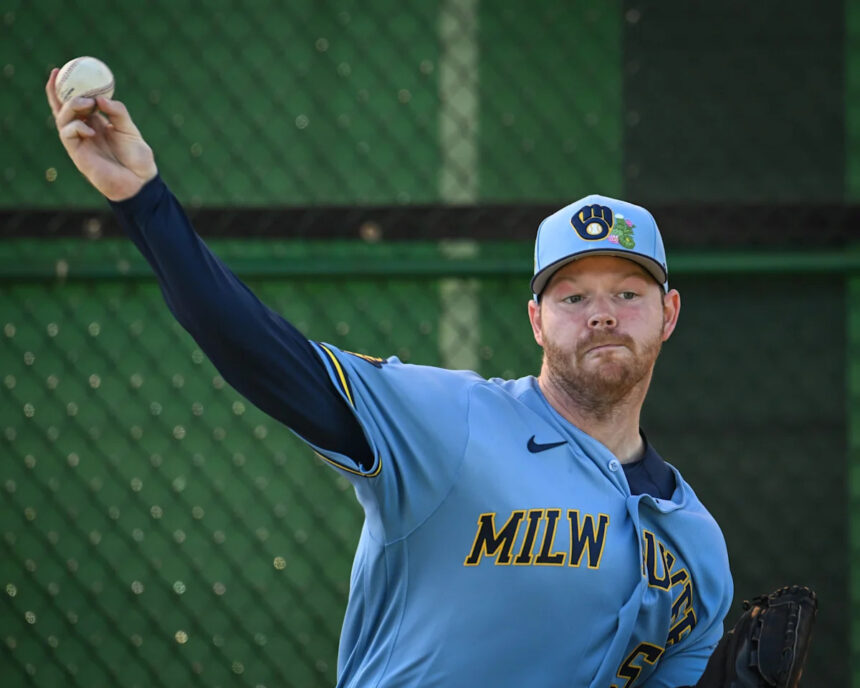
Brandon Woodruff’s Spring Finale: A Tale of Two Outings and the Road Ahead
The Arizona sun had long since baked the Phoenix dirt into a hardpan, but the heat of the night still shimmered over the Brewers’ complex. In a game where the offense sizzled—a seven-run third inning capped by a Christian Yelich homer—the most scrutinized performance belonged to a man on the mound. Brandon Woodruff, making his final Cactus League start, authored an outing that was equal parts reassuring and perplexing, a microcosm of a pitcher in the delicate, final stages of building for the marathon ahead. For three innings, he looked the part of the ace. In a laborious fourth, questions about velocity and stamina surfaced like a desert mirage. As the Brewers pack for Milwaukee, the central query is clear: What’s next for Brandon Woodruff?
The Spring Training Build-Up: Process Over Results
For established veterans like Woodruff, spring training statistics are often meaningless hieroglyphics. The goal is not a pristine ERA, but a checklist of physical benchmarks. Woodruff’s final line—three-plus innings, three runs allowed, two home runs surrendered—tells a deceptive story. The true narrative lies in the process he and the Brewers’ staff meticulously follow.
Woodruff’s primary objective was to build pitch count and endurance, simulating the “up-down” rhythm of a regular-season start. Pitchers accomplish this by going multiple innings, sitting as they would between frames, and then returning to the mound. Woodruff successfully registered four “ups,” beginning the fourth inning before his night ended. This is a critical, often grueling, part of spring preparation that has little to do with the hits allowed in that final push.
“It was a good first three innings there,” Woodruff assessed postgame. “The fourth, it’s part of the build up. That’s the tough part, is just trying to get the pitch count up, get out there and then kind of add the long innings.” This honest appraisal underscores the spring training philosophy for a workhorse starter: the body must be conditioned to recover and perform repeatedly, a task more challenging than the act of pitching itself in March.
Decoding the Velocity Dip: Cause for Concern or Standard Operating Procedure?
The most discussed moment of Woodruff’s outing came in that fateful fourth inning. After cruising through the initial frames, he surrendered back-to-back home runs. The radar gun readings that accompanied them raised eyebrows: fastballs clocked at 88.6 and 88.8 mph, a noticeable drop from his typical 95-97 mph range.
Immediately, the analyst and fan mind races to concerns about health or mechanics. However, context is paramount. Several factors could explain this velocity fluctuation:
- Intentional Pacing: Veteran pitchers, especially in their final spring start, often focus on execution and feel over max effort. They might be working on a specific pitch or location, sacrificing velocity for precision.
- Fatigue Simulation: The “up-down” routine is designed to create fatigue. A pitcher working on his fourth “up” after sitting is, by design, not in his freshest state. How he manages stuff and commands through that fatigue is a valuable lesson.
- Physical Preservation: With the grueling 162-game season looming, a pitcher like Woodruff is wise to avoid unleashing his absolute peak velocity in a meaningless exhibition. The arm is being calibrated, not unleashed.
Most importantly, Woodruff himself dismissed health concerns. “I feel good physically, so that’s important,” he stated. For a pitcher with his injury history, that declaration carries more weight than any radar reading in March.
Expert Analysis: Reading Between the Lines of the Outing
From a pitching development perspective, Woodruff’s start was a textbook late-spring progression. The early innings showed a pitcher with sharp command and a diverse arsenal, striking out four. The later struggle was a controlled experiment in adversity management.
“What you look for with a guy like Woody this time of year is arm health, the repeatability of his delivery, and how his secondary pitches are progressing,” says a former MLB pitching coach. “The home runs on slower fastballs are a red flag only if the pitcher is trying to throw his best heater. If he’s working on arm-side run or two-seam action at 88-90 mph, those can get hit. The key is he came out of it feeling strong. That’s the win.”
The Brewers’ pitching development staff is renowned for its data-driven approach. They will be less concerned with the results and more focused on metrics like spin efficiency, release point consistency, and the movement profile on his changeup and slider. Woodruff’s ability to log the “ups” and increase his pitch count under game conditions is the primary box checked.
Predictions: What’s Next for Woodruff and the Brewers’ Rotation?
So, what does this mean for the start of the regular season? Based on this buildup, we can make several educated predictions.
First, expect a cautious ramp-up. It is unlikely Woodruff will be fully stretched out to 90-100 pitches on Opening Day. The Brewers may employ a strategic opener or have a long reliever at the ready for his first turn or two through the rotation. The organization’s priority is having a healthy, dominant Woodruff in September, not necessarily April 5th.
Second, velocity will return with competitive adrenaline. When the lights are on for real and the standings matter, Woodruff’s competitive fire will ignite. The 88-mph fastballs will likely be a spring footnote, replaced by the premium velocity that makes him one of the league’s most feared pitchers. His performance was a classic case of a veteran managing his spring training workload intelligently.
Third, his role as a rotation anchor remains unchanged. Despite the spring stat line, Woodruff, when right, is a co-ace alongside Corbin Burnes. His leadership and playoff experience are irreplaceable. The Brewers’ championship aspirations hinge on his right arm being sound for the long haul, a fact not lost on a front office that has carefully managed his innings for years.
Conclusion: The Final Tune-Up is Just the Beginning
Brandon Woodruff’s spring training finale was not a masterpiece of pitching. It was something more valuable: a successful, controlled step in a long-term process. The seven-run inning by his offense provided a festive backdrop, but Woodruff’s night was a solitary grind of building, testing, and preparing.
The back-to-back homers and the velocity dip are talking points, but they are not alarm bells. They are the expected friction of a high-performance engine being carefully broken in. Woodruff’s calm demeanor and positive health report are the ultimate takeaways. As the Brewers transition from the dry heat of Arizona to the hopeful chill of Milwaukee, they do so with a key pitcher on schedule, building not just pitch count, but the foundation for a season they hope extends deep into October. The work in Phoenix is done. The real work, for Woodruff and the Brewers, is about to begin.
Source: Based on news from Yahoo Sports.