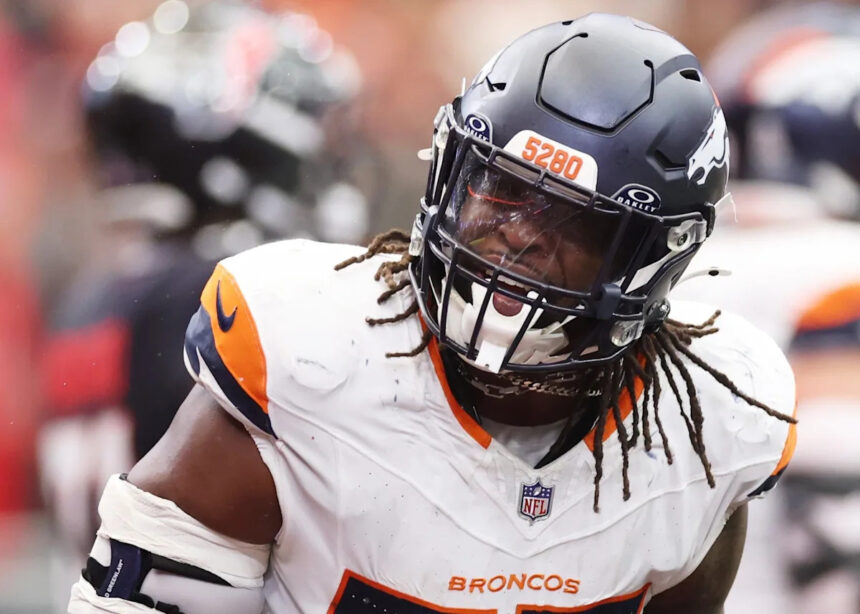
Bronzos Release Dre Greenlaw in Calculated Cap Maneuver, Save Over $6 Million
The winds of change are blowing through the Denver Broncos’ facility in Englewood, and they carry the distinct scent of fiscal pragmatism. In a move that prioritizes financial flexibility over proven talent, the Broncos have reportedly released veteran inside linebacker Dre Greenlaw. The decision, first reported by NFL Network’s Ian Rapoport, follows the team’s commitment to retain other defensive pieces and underscores the relentless salary cap calculus that defines the NFL offseason. For a franchise navigating the costly aftermath of a major quarterback trade, every dollar saved is a strategic asset.
The Financial Anatomy of the Move
To understand why the Broncos parted ways with a player of Greenlaw’s caliber, one must look at the ledger. According to the authoritative salary cap site OverTheCap.com, this transaction is a classic example of a “cap-saving” cut with a lingering cost.
The Broncos will incur a **dead money** charge of approximately $4.33 million for the 2024 season. Dead money is a cap charge for a player no longer on the roster, representing previously paid bonuses that must still be accounted for. However, by removing Greenlaw’s base salary from the books, the team creates a net gain of just over **$6 million in salary cap space**.
This brings Denver’s total projected cap space for 2024 into a more workable range, providing crucial oxygen for General Manager George Paton and Head Coach Sean Payton. This newfound flexibility can be directed toward several pressing needs:
- Extending key young players approaching new contracts.
- Adding depth in the secondary or along the defensive line.
- Creating a financial buffer for in-season acquisitions.
- Potentially absorbing a larger cap hit for a quarterback move.
While the dead money is a sunk cost, the liberated $6 million is a tool for future team building. In the NFL’s economic ecosystem, liquidity often trumps loyalty.
Greenlaw’s Rocky Road in Denver
Dre Greenlaw’s tenure with the Broncos was a story of “what could have been,” marred persistently by the injury bug. Acquired with significant fanfare, the hard-hitting linebacker brought a reputation for instinctive play and defensive leadership from his prior success. His style of play—a blend of explosive tackling and coverage hustle—was exactly what Denver’s defense craved.
Unfortunately, his time in the orange and blue became a cycle of rehabilitation. A significant injury early in his Broncos career set the tone, and subsequent ailments limited his availability and, when he did play, his peak effectiveness. This created a difficult paradox for the coaching staff: a player too talented to easily replace when healthy, but too unreliable to count on for a full 17-game grind.
The team’s recent moves signaled a shifting priority. The re-signings of **Alex Singleton**—the defensive captain and tackling machine—and **Justin Strnad**, a core special teamer and reliable backup, solidified the middle of the defense with known, durable commodities. This provided the Broncos with the foundational security needed to make the difficult decision on Greenlaw. In the brutal accounting of professional sports, availability is not just an asset; it is often the primary currency.
Expert Analysis: A Necessary, Forward-Looking Decision
From a pure football perspective, losing a player of Greenlaw’s potential is a blow to the defensive playmaking ceiling. When right, he was a three-down linebacker capable of changing the momentum of a drive with a key stop or a forced fumble. His absence leaves a question mark next to Singleton in the heart of the defense.
However, from a team-building and strategic standpoint, this cut is defensible and even savvy. The NFL’s salary cap is a rigid, unforgiving framework. Teams that succeed long-term are those that make cold, correct financial decisions before sentimental ones. Paying a premium for a player who cannot consistently stay on the field is a luxury the Broncos, in their current competitive and cap-strapped state, cannot afford.
This move is less about Dre Greenlaw the player and more about the Denver Broncos the organization. It is a clear signal that Sean Payton is meticulously reshaping the roster in his image, prioritizing players who are consistently available and fit his system. The re-signing of the ever-present Alex Singleton, contrasted with the release of the oft-injured Greenlaw, paints a vivid picture of this philosophy.
Predictions: What’s Next for the Broncos and Greenlaw?
The fallout from this transaction will ripple in two directions: toward the Broncos’ draft board and toward Greenlaw’s next opportunity.
For Denver, inside linebacker instantly jumps higher on the list of draft needs. While Josey Jewell remains a free agent and could potentially be re-signed at a lower cost, expect the Broncos to be active in addressing the position. They could target a day-two pick (Rounds 2-3) for an immediate contributor or seek a value signing in the later waves of free agency. The draft capital saved from other positions may now be reallocated to find a young, cost-controlled running mate for Singleton.
For Dre Greenlaw, his next chapter will be one of the more intriguing subplots of the league’s second wave of free agency. When healthy, he is a starting-caliber NFL linebacker. The key for him will be passing a physical and convincing a contender—likely one with a need at linebacker and a strong medical/training staff—that his injury woes are behind him. He could be a classic high-risk, high-reward signing for a team like the Cowboys, Eagles, or a defensive-minded squad like the Rams, looking for a talented piece to complete their defensive puzzle.
Conclusion: A Turn of the Page in Denver
The release of Dre Greenlaw marks the end of a brief, frustrating chapter for both player and team. It is a sober reminder of the NFL’s harsh realities, where financial health and roster reliability must constantly be balanced against raw talent. The Broncos, under the clear-eyed direction of Sean Payton, have chosen cap space and certainty over potential and past investment.
This decision fortifies the team’s financial standing as they navigate a pivotal offseason, granting them the maneuverability to address other glaring holes. While the sight of Greenlaw making plays for another team may sting, the logic behind the move is sound. In the high-stakes game of NFL roster construction, sometimes the best addition is subtraction. The Broncos have subtracted a question mark and added a vital resource: opportunity. How they use that $6 million in cap space will be a defining element of their 2024 campaign.
Source: Based on news from Yahoo Sports.