Brooklyn Nets Jersey History: The No. 44 and Hubert Davis’s Final Chapter
In the vast tapestry of the Brooklyn Nets’ franchise history, woven across 52 jersey numbers and over 600 players, some threads are bold and defining, while others are subtle yet integral to the complete picture. The journey from the ABA’s New Jersey Americans to the modern NBA’s Brooklyn Nets is a saga of evolution, carrying with it a rich legacy of the men who wore the uniform. As we continue our series commemorating every jersey number, we arrive at No. 44—a digit worn by 21 different players. Among them is a name known more for his beginnings and his post-playing career than his brief tenure in New Jersey: Hubert Davis. His single season with the 2004 Nets represents the quiet closing act of a respected 12-year NBA journey, a final note in a career defined by sharpshooting and professionalism.
From Chapel Hill to The Garden: The Making of a Sharpshooter
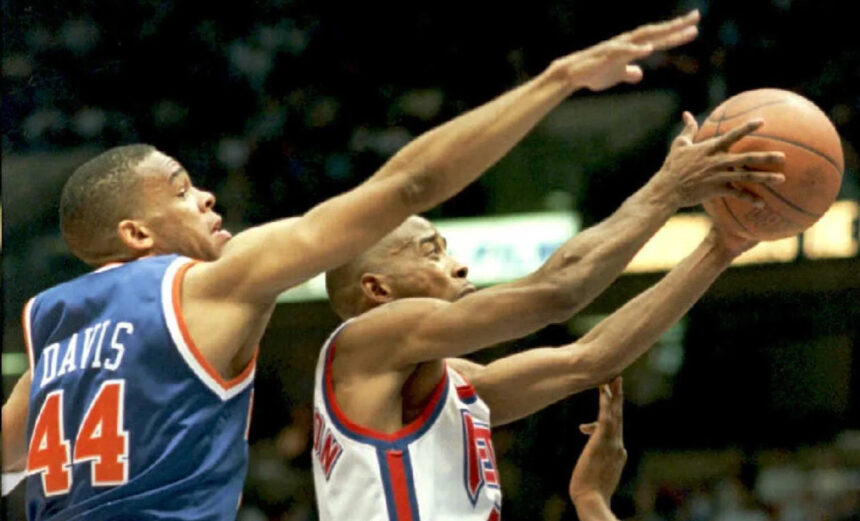
Before the No. 44 jersey hung in a Nets locker, it was synonymous with a specific skill set honed at basketball’s highest levels. Hubert Davis emerged from the University of North Carolina as a premier shooting guard, a product of Dean Smith’s famed system. Drafted 20th overall in 1992 by the New York Knicks, Davis stepped into the pressure cooker of Madison Square Garden and thrived. He wasn’t just a rookie; he was a key rotational piece on Pat Riley’s notoriously physical, defensively elite Knicks teams that battled Michael Jordan’s Bulls and reached the 1994 NBA Finals.
Davis’s role was crystal clear: space the floor and knock down shots. In an era before analytics fully championed the three-pointer, Davis was a pioneer of efficiency. His career three-point percentage of .440 remains one of the highest in NBA history. His time in New York established his reputation as a reliable, high-character player who performed under the brightest lights. After stints with Toronto, Dallas, Washington, and Detroit, Davis carried this identity as a veteran leader—a trait that would define his final NBA stop.
The 2004 Nets: A Transitional Season and a Veteran’s Role
When Hubert Davis signed with the New Jersey Nets in September 2004, the franchise was at a crossroads. The glorious back-to-back NBA Finals runs led by Jason Kidd were fading into the rearview. The team had traded Kenyon Martin that offseason and would soon deal away Kerry Kittles. The 2004-05 season would become a struggle, ending with a 42-40 record and a first-round playoff exit.
Into this environment of change stepped the 34-year-old Davis. He was no longer the dynamic scorer of his Knicks days, but his value had transformed. Wearing No. 44, Davis embodied the veteran presence every team needs. His contributions were measured not in minutes or points, but in stability and wisdom.
- Mentorship: On a team still featuring Jason Kidd, Richard Jefferson, and a young Nenad Krstic, Davis provided a steady, professional example, particularly for developing guards.
- Shooting Expertise: Even in limited action, Davis remained a threat from deep, requiring defensive respect and helping to space the floor for the team’s primary creators.
- Institutional Knowledge: Having played for elite coaches like Pat Riley and Don Nelson, Davis brought a deep understanding of NBA systems and what it took to win.
His statistical line for the Nets—2.3 points per game in 42 appearances—tells only a fraction of the story. Hubert Davis’s final season was about closing a career with the same grace and preparedness with which he played.
No. 44 in Nets Lore: A Number of Varied Legacies
Placing Davis’s tenure in context requires looking at the other 20 players who have worn No. 44 for the franchise. The number lacks a single, iconic long-term star but features a fascinating array of characters and contributors across different eras.
In the ABA days, it was worn by high-flying forward George Carter, a key scorer for the champion 1974 New York Nets. In the 1980s, it belonged to bruising big man Mike Gminski, a consistent double-double threat and fan favorite during the Meadowlands era. The number also had brief, memorable stints with players like Scott Burrell in the late 90s. This patchwork history makes the number a microcosm of the franchise itself: diverse, evolving, and representing both star power and role players. Hubert Davis’s chapter is the definitive closing entry for No. 44 in the New Jersey Nets era, a fitting final act for a number often associated with skilled, intelligent players.
Legacy and Looking Forward: From the Hardwood to the Broadcast Booth
The end of the 2004-05 season marked the end of Hubert Davis’s NBA playing career. However, his impact on basketball was far from over. He seamlessly transitioned into broadcasting, where his deep knowledge of the game, articulate analysis, and calm demeanor have made him a respected voice, most notably as a lead analyst for ESPN’s college basketball coverage.
This second act reinforces the essence of his time with the Nets. Davis was always a student and teacher of the game. His brief tenure in New Jersey was the on-court culmination of that, preparing him for a successful post-playing career. When fans see him on broadcast today, they are seeing the same analytical mind and passionate spirit that he brought to his final season in No. 44.
Predicting the future of No. 44 in Brooklyn is an interesting exercise. The number currently sits unofficially retired, not hanging in the rafters but resting respectfully since Davis. In the modern NBA, where numbers are often chosen for personal significance, it’s only a matter of time before a new player claims it. When they do, they will inherit a number with a rich, understated history—from ABA champions to steady centers to the final, professional days of a lifelong shooter like Hubert Davis.
Conclusion: A Subtle Stitch in the Nets’ Tapestry
The history of a franchise is not written solely by its superstars. It is compiled through the contributions of every player who dons the uniform, even if for a single season. Hubert Davis’s stint with the 2004 Nets is a perfect embodiment of this. His No. 44 jersey represents the valuable role of the veteran sage, the professional who bridges eras and teaches by example. In a season of transition for the Nets, Davis provided stability, wisdom, and a direct link to the league’s hard-nosed, fundamental past. As we chronicle the 52 numbers of the Nets’ journey, Davis’s chapter on No. 44 reminds us that every jersey has a story, and every story—whether of championships or quiet conclusions—is a vital part of the whole. His legacy, now flourishing in the broadcast booth, ensures that the intelligence and skill he showcased in that final season continue to influence the game he loves.
Source: Based on news from Yahoo Sports.