Chelsea’s Huddle Headache: Rosenior’s Tactical Tweak to Avoid Unwanted Noise
The pre-match ritual is sacred in football. From the synchronized warm-up to the final handshakes, it’s a theatre of psychological preparation. For Chelsea, a new act was introduced just four matches ago: a full-team huddle in the centre circle, led by captain Reece James. What began as a show of unity has swiftly escalated into a full-blown controversy, pitting team solidarity against competition regulations and sporting etiquette. Now, head coach Liam Rosenior faces a delicate decision: stand firm on principle or tactically retreat to avoid what he calls “more noise.”
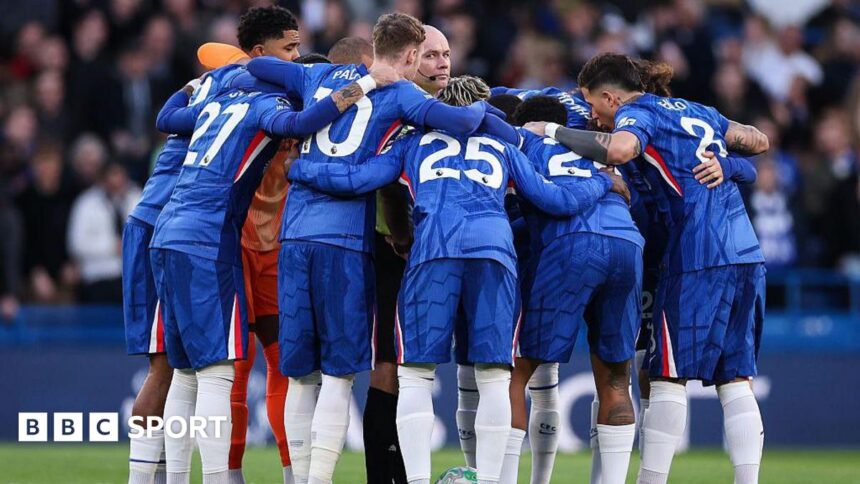
The flashpoint arrived before Saturday’s narrow 1-0 defeat to Newcastle at Stamford Bridge. As referee Paul Tierney stood over the ball, ready to start the match, Chelsea’s players enveloped him in their circle. The surreal image of an official seemingly trapped inside the opposition’s motivational talk went viral, sparking debate and, crucially, drawing a formal warning from the match officials. With a pivotal Champions League clash against Paris Saint-Germain looming, Chelsea’s huddle is under more scrutiny than some of their recent performances.
The Centre Circle Standoff: Unity or Provocation?
Liam Rosenior, a manager known for his thoughtful and progressive approach, was quick to clarify the huddle’s intent. “It’s about us, it’s about togetherness,” he stated. In a season of transition and high pressure, fostering a siege mentality can be a powerful tool. The visual of eleven players locked in, eyes fixed on their captain, is designed to project an image of an unbreakable unit to opponents and fans alike.
However, the pre-match protocols in football are clear and long-established. The centre circle and the ball are the focal point for kick-off. By occupying that space, Chelsea inadvertently—or perhaps deliberately—disrupted Newcastle’s ability to start the game promptly. Officials warned that this act risks a mass confrontation, as the opposing team approaches to begin the match only to find their path blocked by a gathering of opponents. What Chelsea sees as internal focus, the authorities and some observers view as gamesmanship, an attempt to assert territorial dominance and disrupt the opposition’s rhythm before a ball is even kicked.
The incident with Paul Tierney was particularly telling. His refusal to move from the ball was a silent but powerful enforcement of the laws. It transformed the huddle from a private moment into a public stalemate, undermining its intended effect and creating the very “noise” Rosenior seeks to avoid.
Rosenior’s Dilemma: Principle vs. Pragmatism
Rosenior’s public comments reveal a coach caught between two compelling forces. On one hand, he wants to support his captain and preserve a ritual that his players have bought into. “My players don’t want to antagonise and bring more noise on ourselves,” he conceded, acknowledging the unintended consequences. This statement is key to understanding the likely outcome.
For a manager, unnecessary distractions are the enemy. The build-up to a Champions League knockout match against PSG should be about Kylian Mbappé’s runs, not about where Reece James gives his team talk. Rosenior is pragmatic enough to know that continuing the centre-circle huddle now turns it into a defiant gesture, making it the story rather than the football. The official warning from referees has also raised the stakes; persistence could lead to formal sanctions for delaying the restart or unsporting behaviour.
The decision, therefore, transcends symbolism. It becomes a game management issue. Will moving the huddle be seen as a capitulation, or will it be a savvy move to eliminate a petty controversy and refocus his squad? For a tactician like Rosenior, the choice is increasingly clear.
The PSG Preview: Where Will the Huddle Land?
All signs point to a strategic relocation for Tuesday night’s European spectacle. While Rosenior confirmed “a decision has not yet been made,” the logic is inescapable. The Parc des Princes is a cauldron of intensity; adding fuel by provoking the officials and the home team with a pre-match standoff would be managerial malpractice.
We can anticipate several alternative scenarios:
- The Tunnel or Touchline Huddle: The most probable shift. Conducting the ritual in the tunnel or by the technical area maintains the unity display without infringing on the pitch’s formal pre-kickoff space.
- A Shortened or Discreet Circle: A quicker, less obtrusive gathering in their own half, potentially after the handshakes but before taking positions.
- Abandoning It Entirely for This Game: The nuclear option. Given the heightened scrutiny, Rosenior may deem it wise to shelve the practice for one night to ensure all talk is about tactics, not team huddles.
The key takeaway is that the content of Reece James’s message is far more important than its geography. The leadership and tactical reminders he delivers are the true substance; the circle is merely the container. Moving it doesn’t dilute the message; it simply delivers it in a less contentious package.
Broader Implications and The Road Ahead
This micro-drama touches on a larger theme in modern football: the search for marginal psychological gains. From specific warm-up routines to coordinated goal celebrations, teams are constantly innovating in the mental arena. Chelsea’s huddle experiment is part of this trend, but it has brushed against the sport’s established conventions.
The fallout offers a lesson for all teams. Pre-match psychology is effective only when it doesn’t backfire. A gesture that galvanizes your own team but also unites and angers the opposition and puts the referee on alert is a net negative. The best psychological ploys are those that are felt, not just seen—the relentless high press from the first whistle, a defiant defensive shape, a blistering counter-attack.
For Chelsea’s season, this is a minor subplot, but it is revealing. It shows a team actively seeking an identity and a bond, which is a positive. It also shows a management team willing to adapt based on feedback, which is essential. How they handle this small issue could reflect their ability to handle the much larger pressures of the season’s climax.
Final Whistle: A Circle Squared Away
Chelsea’s brief flirtation with the centre-circle huddle appears to be coming to an end, not with a bang, but with a pragmatic shuffle to the sidelines. Liam Rosenior’s primary job is to win football matches, not wage symbolic wars over pre-match positioning. By likely moving the huddle, he is not showing weakness; he is demonstrating strategic intelligence. He is removing an irritant, silencing a trivial narrative, and freeing his players to concentrate on the monumental task of beating PSG.
The ultimate truth is this: the most powerful statement Chelsea can make will not be made with their arms around each other before kick-off. It will be made with their relentless running, tactical discipline, and clinical finishing during the 90 minutes that follow. The huddle’s spirit can—and should—live on in Chelsea’s play. The circle itself? It’s just a shape on the grass, and for Chelsea’s sake, it’s one they’ll probably now avoid.
Source: Based on news from BBC Sport.