Chelsea’s Pedro Neto Apologises for Ball Boy Incident: A Moment of Madness Overshadows PSG Defeat
The beautiful game is often a theatre of raw, unfiltered emotion. Passion fuels its greatest moments, but occasionally, that same fire spills over into regrettable acts that stain the spectacle. In the chaotic, dying embers of Chelsea’s chastening 5-2 defeat to Paris Saint-Germain in the Champions League last-16 first leg, it was Pedro Neto who provided a stark, ugly reminder of that fine line. The Portuguese winger’s inexplicable decision to push over a ball boy has ignited a firestorm of controversy, shifting the post-mortem from a tactical dismantling to a discussion of conduct, composure, and consequence.
The Incident: A Flashpoint in Parisian Chaos
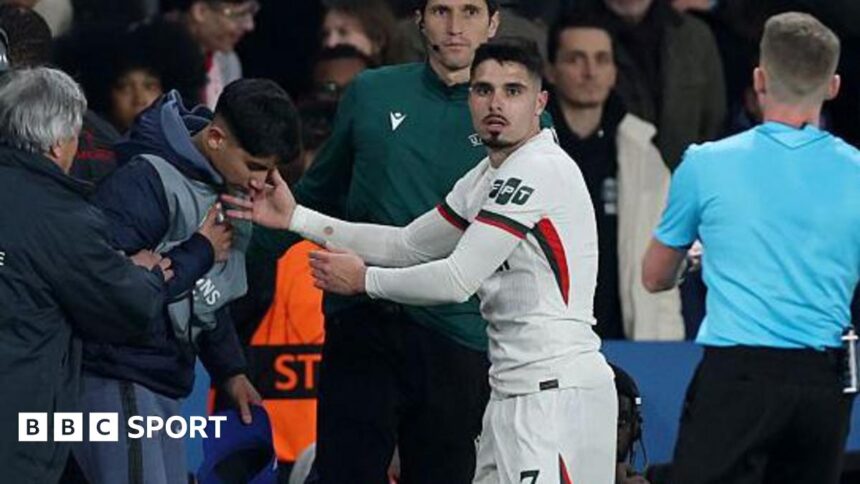
With Chelsea trailing 4-2 deep into stoppage time at the Parc des Princes, the match was already lost. Yet, as PSG players celebrated their fourth goal, a separate drama unfolded by the touchline. Eager to restart play quickly, Pedro Neto approached a young ball boy holding the match ball. What happened next was captured in damning clarity: Neto placed two hands on the boy’s chest and shoved him backward, causing him to stumble and fall over a chair.
The immediate reaction was one of universal outrage. Chelsea’s own staff and players, including captain Reece James, rushed to intervene, with a mass altercation briefly erupting between both sets of personnel. The image of the shocked ball boy, an innocent party in a high-stakes professional contest, became the night’s defining and most troubling snapshot—overshadowing Kylian Mbappé’s hat-trick and Mauricio Pochettino’s tactical masterclass.
Neto’s Immediate Apology and the Question of “Emotion”
To his credit, Pedro Neto did not shy away from accountability in the immediate aftermath. Speaking to TNT Sports, the 26-year-old issued a public mea culpa. “I want to apologise to the ball boy. I have already spoken to him,” Neto stated. “We were losing and in the emotion of the game I wanted to get the ball fast and I gave him a little push.”
While the apology is a necessary first step, the explanation opens a complex debate familiar to football psychologists and pundits alike. Can the “emotion of the game” truly justify an act of physicality against a non-participant? This incident forces us to examine the immense psychological pressure cooker of elite sport, where multi-million pound stakes and intense scrutiny can fray the sharpest nerves.
- Frustration Boil-Over: Neto, a key creative outlet, was largely neutralized by PSG and witnessed his team capitulate defensively.
- Misdirected Aggression: The inability to affect the game on the pitch manifested in a moment of misdirected aggression off it.
- Professional Expectation: Regardless of provocation or time-wasting suspicions, the professional expectation for a player of Neto’s experience is to maintain control.
Historical precedent is not kind. The incident draws inevitable, if less severe, comparisons to Eden Hazard’s clash with a ball boy at Swansea in 2013, which resulted in a red card and a three-match ban. The court of public opinion often judges these moments more harshly than on-field transgressions, viewing them as a breach of the sport’s covenant with its supporters, especially the young.
Broader Implications: FA Scrutiny and Club Culture
The fallout extends beyond headlines and social media condemnation. The Football Association and UEFA will undoubtedly review the incident. While the referee did not take action during the match, governing bodies have the power to impose retrospective sanctions for “improper conduct.” A fine or a suspension for the second leg is a distinct possibility, further depleting a Chelsea squad already facing a mountainous task to overturn the three-goal deficit.
More significantly, this moment becomes a litmus test for Chelsea manager Mauricio Pochettino and the club’s leadership. How they handle Neto internally will speak volumes about the culture they are building. Pochettino, known for his man-management, must balance support for a player in a moment of profound regret with a firm reinforcement of standards. Will there be an internal fine? Community service? A public club condemnation? The response must be proportionate but clear: such actions are incompatible with representing Chelsea Football Club.
Club reputation is a fragile commodity. In an era where every action is magnified, clubs are judged not just on results but on their values. Chelsea’s swift action to facilitate Neto’s apology was a good start, but the narrative management must now be backed by substantive, private discipline.
Looking Ahead: A Lingering Shadow for Neto and Chelsea
As the focus reluctantly returns to football, the incident casts a long shadow. For Pedro Neto, this is now an indelible part of his career narrative. The path to redemption is straightforward but arduous: a model of conduct on and off the pitch for the foreseeable future. Every moment of frustration will now be scrutinized; his temperament will be under a microscope. This single act of poor judgment could define his season more than any assist or goal.
For Chelsea, the second leg at Stamford Bridge was already a monumental challenge. Now, it carries an additional, unwanted subplot. The pre-match headlines will revisit the push, not just the scoreline. The atmosphere, while undoubtedly supportive, will be tinged with a collective cringe at the memory. It is an unnecessary distraction from the near-impossible sporting mission they face.
Psychological resilience will be key. Can Neto and his teammates channel the embarrassment and criticism into a focused, disciplined performance? Or will the weight of the controversy contribute to another unraveling?
Conclusion: More Than Just a Push
Pedro Neto’s push was a physical act measured in inches and seconds, but its impact will be measured in weeks and column inches. It was a failure of professionalism in its most basic form—respect for those involved in the game, regardless of age or role. His swift apology mitigates but does not erase the act.
Ultimately, this incident serves as a potent reminder that in the high-stakes, high-pressure world of elite football, the true test of character often comes not in the triumphant goal but in the graceless moment of defeat. How Neto and Chelsea respond in the weeks to come will determine whether this moment is remembered as an isolated lapse or a symptomatic crack in the facade. The ball boy has accepted an apology; the wider football world will be far less forgiving, and the authorities may yet have their final say. The push is over, but the fallout has only just begun.
Source: Based on news from BBC Sport.