Chiefs Kingdom Shifts West: Franchise Announces Move to Kansas with New Domed Stadium by 2031
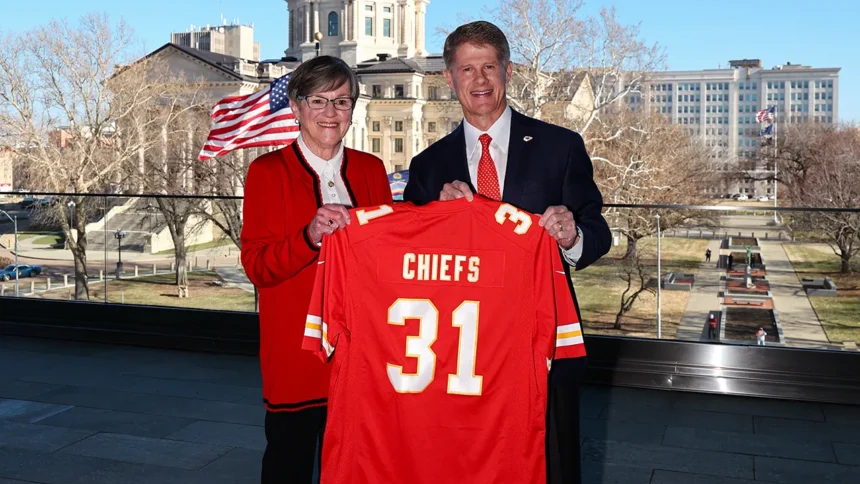
The landscape of the NFL is set for a seismic shift, one that will redraw a historic state line rivalry and redefine the home of one of the league’s most iconic franchises. In a move that echoes through the heart of the Midwest, the Kansas City Chiefs have officially announced their intention to relocate from Missouri to Kansas, with plans to open a new, state-of-the-art domed stadium in time for the 2031 NFL season. The announcement, delivered in a joint statement from owner Clark Hunt, Kansas Governor Laura Kelly, and NFL Commissioner Roger Goodell, marks the end of an era at Arrowhead Stadium and the beginning of a bold new chapter for Chiefs Kingdom.
A Monumental Agreement: Crossing the State Line
The decision, finalized following a meeting of the Kansas Legislative Coordinating Council, is not merely a change of address but a monumental business and political undertaking. For decades, the Chiefs and the MLB’s Kansas City Royals have been cornerstones of the Missouri side of the metropolitan area, with their Truman Sports Complex home serving as a hallowed ground for generations of fans. This move signifies a strategic pivot, leveraging significant public and private investment to secure the franchise’s long-term future.
Clark Hunt’s statement captured the gravity of the moment: “Today we are excited to take another momentous step for the future of the franchise. We have entered into an agreement with the State of Kansas to host Chiefs football beginning with the 2031 NFL season.” The agreement, undoubtedly involving complex financing plans, tax incentives, and infrastructure commitments, showcases Kansas’s aggressive pursuit of the economic and cultural engine that an NFL franchise represents. It also underscores the league’s continued trend toward domed stadium environments, which offer year-round usability, controlled climates for fans and players, and the ability to host mega-events like the Super Bowl and Final Four.
The End of the Arrowhead Era and the Dome Debate
The impending move casts a nostalgic shadow over Arrowhead Stadium, long celebrated as one of the loudest and most passionate outdoor venues in all of sports. The roar of the crowd on a frigid January playoff night has become part of the team’s identity. Replacing this open-air coliseum with a cutting-edge domed stadium presents both a practical upgrade and a philosophical shift.
- Economic & Event Potential: A dome guarantees the ability to host the NFL’s premier event, the Super Bowl, which brings hundreds of millions in economic impact. It also opens doors to major college sporting events, large-scale concerts, and conventions 365 days a year.
- Fan Experience: The debate between tradition and comfort is fierce. While purists may mourn the loss of the elements, a climate-controlled environment eliminates weather-related inconveniences, potentially broadening the game-day appeal to families and a wider demographic.
- Team Performance: The move indoors could subtly influence team construction and play-calling. A fast, consistent track benefits offensive schemes, potentially allowing the Chiefs’ high-powered attack to operate with even greater precision, regardless of Midwestern winter conditions.
As the NFL on FOX crew dissects the playoff picture and Patrick Mahomes’ recovery, this long-term stadium news forms the colossal backdrop against which all future football in Kansas City will be measured. The discussions around Sam Darnold’s QB status or a Rams’ Thursday night loss are immediate, but the stadium decision is a legacy-defining move that will impact the franchise for the next half-century.
Expert Analysis: The Ripple Effects Across the NFL and KC
This relocation is more than a real estate deal; it’s a tectonic plate shift in the region’s sports dynamics. The immediate question becomes the fate of the historic Arrowhead Stadium and the Truman Sports Complex. Will the Kansas City Royals follow suit, or will they remain and potentially redevelop the site? The move also ignites a direct economic competition between Kansas and Missouri, with millions in tax revenue and ancillary business set to migrate west.
From a league perspective, Commissioner Roger Goodell’s presence in the announcement signals full NFL endorsement. The league consistently encourages stadium modernization and solutions that ensure franchise stability and growth. This move could serve as a blueprint for other franchises in similar multi-state metropolitan areas, demonstrating the leverage teams can wield when their stadium leases near expiration.
For the fanbase, “Chiefs Kingdom” will now literally span two states with a new epicenter. Logistical challenges like season ticket holder transitions, parking, and transportation will be immense. However, the promise of a next-generation fan experience—with enhanced technology, premium amenities, and greater event versatility—is the compelling pitch from ownership. The emotional tie to Arrowhead is profound, but the organization is betting that a new, unparalleled venue will forge its own traditions.
Predictions for the 2031 Frontier and Beyond
Looking ahead to the 2031 season, the narrative is rich with possibility. The final game at Arrowhead Stadium, likely in the 2030 season, will be an emotional spectacle of celebration and farewell. The opening of the new Kansas dome in 2031 will be a week-long festival, almost certainly featuring a marquee opponent in a primetime slot.
We can predict several key developments:
- Super Bowl Bid: Kansas City will instantly become a top contender to host its first Super Bowl in the 2034-2035 timeframe, a massive coup for the region.
- Architectural Marvel: Expect the new stadium to feature revolutionary design, likely with a retractable roof or innovative translucent material, aiming to become an instant architectural icon.
- Real Estate Boom: The chosen site in Kansas City, Kansas, will trigger massive commercial and residential development, transforming the area into a new entertainment district.
- Continued Dominance: The move is designed to provide the financial resources to keep the Chiefs competitive. By 2031, the team’s roster will have turned over multiple times, but the expectation will be that the standard of excellence set by the Mahomes era continues under a new, fortified economic model.
Conclusion: A New Kingdom Rises
The announcement of the Kansas City Chiefs’ relocation to Kansas is a watershed moment, blending cold business calculus with the warm, passionate heart of a community. It closes the book on one of sports’ greatest venues while authoring a prologue for an ambitious future. While the roar of Arrowhead will one day fall silent, the goal is to engineer a new, deafening din under a dome in Kansas—a sound that will welcome a Super Bowl, host national championships, and, most importantly, cheer on the Chiefs for generations to come. The journey to 2031 begins now, and it will reshape not just a skyline, but the very identity of a franchise and its legendary kingdom.
Source: Based on news from Fox Sports.