Disgraceful Scenes as Toxicity Spills Over in Old Firm Cup Tie
The Old Firm derby is a fixture that promises fire, passion, and a narrative that consumes Scottish football. This latest Scottish Cup quarter-final clash delivered on that promise in the most corrosive and lamentable way imaginable. What unfolded at Ibrox was not a football match to be celebrated, but a grim spectacle of technical failure and human frailty, culminating in a post-match meltdown that saw police forced to form a cordon on the pitch itself. The beautiful game, in this corner of Glasgow, had turned profoundly ugly.
A Grisly Battle of Ineptitude
Forget any notion of a classic. The 120 minutes of regulation and extra time were a staggering exhibition of what football should not be. The match was defined not by moments of brilliance, but by a shared, palpable incompetence. The narrative of a tense, tactical battle is a generous fiction. This was a hair-on-fire panic attack of a game, devoid of rhythm, coherence, or even basic technical security.
Celtic’s progression was a statistical anomaly. They advanced to the semi-finals having registered just one shot on goal across two hours of football—and even that failed to hit the target. Their victory was a monument to survival, a testament to their ability to withstand not only their opponent but, more impressively, their own glaring shortcomings. Rangers, however, were an abomination in reply. Presented with a rival in disarray, they failed to land a meaningful blow, their own performance littered with poor decisions and a chronic lack of cutting edge. The penalty shootout felt less a test of nerve and more a merciful release from the torment of the preceding play.
The Post-Match Descent into Disgrace
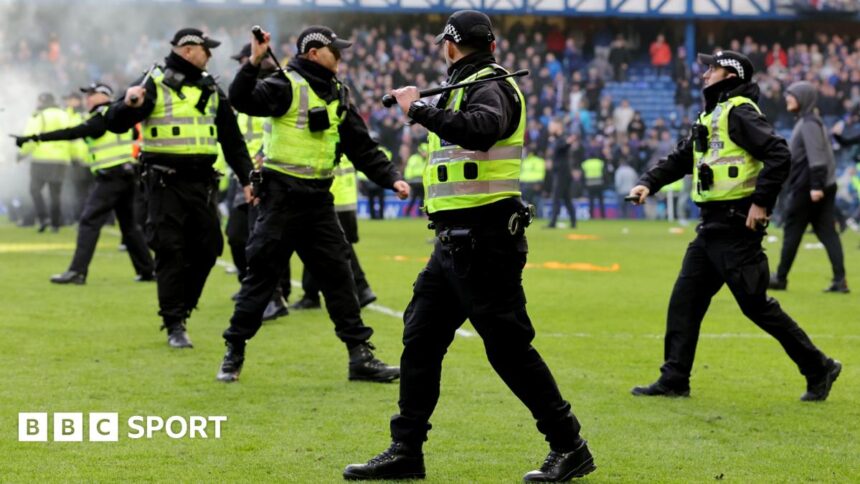
As if the ugliness of the football wasn’t enough, the true disgrace unfolded after the final whistle. The raw, uncontained toxicity that simmers beneath the surface of this rivalry boiled over. As Celtic players celebrated in front of their support, a surge of hostility from the Rangers end materialized. Missiles rained down from the stands, forcing a swift and shocking intervention.
In a scene that belongs in a bygone, darker era of the sport, police officers in high-visibility jackets were compelled to sprint onto the Ibrox turf. They formed a physical cordon, a line of neon yellow, to separate the factions and protect players and staff. It was a visceral, damning image: law enforcement becoming a necessary part of the pitch infrastructure to prevent a full-scale confrontation. This was not a few isolated incidents; it was a systemic failure of atmosphere and control.
- Police Intervention: Officers created a physical barrier on the playing surface.
- Projectiles Thrown: A dangerous hail of objects from the stands.
- Venue Security Breached: The sanctity of the pitch was violated.
- Player Safety Compromised: Individuals celebrating were put at direct risk.
Expert Analysis: The Roots of the Rot
To view these events in isolation is to misunderstand the Old Firm. The on-pitch ineptitude and the off-pitch chaos are branches of the same poisoned tree. The fixture carries a historical, sectarian, and societal weight that, when combined with the white-hot pressure of a cup tie, creates a volatile cocktail. The football often becomes secondary to the tribal war.
However, the abysmal quality of play cannot be excused by pressure alone. This was a failure of coaching and mentality. Both teams appeared gripped by a fear of losing so profound that it eradicated any will to win with creativity or courage. The technical regression was startling. When the primary footballing product is so poor, the negative energy in the stadium finds no positive outlet. Frustration festers and then explodes, as it did post-match. The authorities, both football and police, now face serious questions. Pitch invasions and fan confrontations are becoming a worrying trend in Scottish football, and this incident at the country’s showpiece fixture sets a dangerous new precedent.
Predictions and Repercussions: A Fork in the Road
The fallout from this debacle will be significant and multi-layered. The Scottish FA will launch a major investigation, with severe sanctions for both clubs—especially Rangers as the host venue—a near certainty. Fines will be levied, but more impactful could be discussions around stand closures or playing future matches behind closed doors. The police cordon on the pitch is an image that will hang over Scottish football for years to come.
For the teams, the path forward diverges. Celtic, somehow, stumble on with a treble still possible, but this performance was a glaring red flag. Their resilience is notable, but reliance on it is a flawed strategy. Rangers’ season is now in tatters, and the inquest will be brutal. The psychological blow of losing such a dire match, in such a manner, could define the remainder of their campaign and spark a summer of major upheaval.
Key predictions include:
- Substantial fines and potential partial stadium bans for Rangers.
- Increased police and security presence at all future Old Firm matches.
- A period of intense scrutiny on club statements and leadership from both boards.
- A lingering shadow that affects the spectacle and commercial appeal of the fixture.
Conclusion: More Than a Game Lost
The 2024 Scottish Cup quarter-final was a day where Scottish football lost. It lost face, it lost dignity, and it provided a global audience with a snapshot of its deepest flaws. The match was a grisly battle of incompetence, won by the side slightly less awful on the day. But that footballing failure was merely the prelude to the main event: a disgraceful display of fan toxicity that required police to take to the turf.
This was a stark reminder that for all the talk of modern football, the ancient, bitter animosities of the Old Firm remain, potent and dangerous. Until the clubs, the leagues, and the fan bases themselves find a way to genuinely address the culture that surrounds this fixture, the threat of history repeating itself—of disgraceful scenes overshadowing the sport itself—will remain the most predictable outcome of all. The final whistle at Ibrox didn’t end the chaos; it merely signaled a new, more troubling chapter in an old, old story.
Source: Based on news from BBC Sport.