Does ‘Class’ Captain Caroline Weir Hold the Key to Scotland’s World Cup Return?
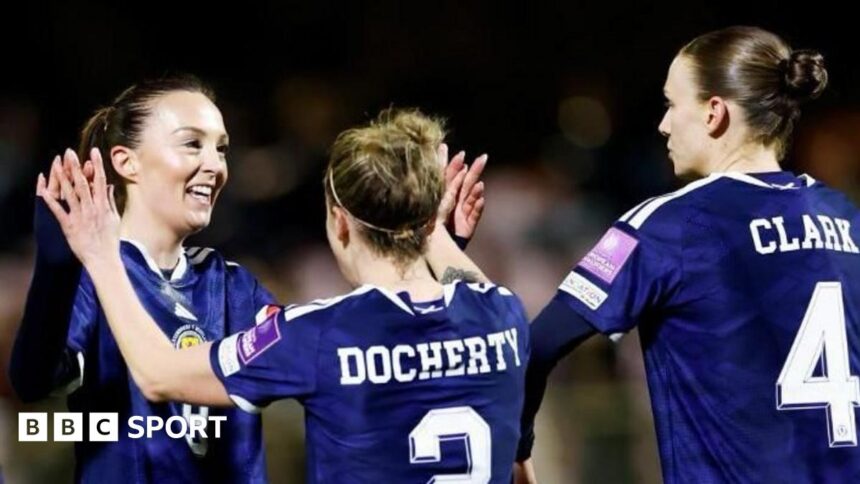
The armband felt different. Heavier, perhaps, but not with burden—with purpose. For Caroline Weir, Scotland’s newly anointed captain, the occasion demanded a statement. Ninety minutes and a sublime hat-trick later, the message was etched across the scoreboard and the faces of a jubilant squad: a new era has begun, and its leader is operating on a different plane. In a commanding 5-0 victory over Luxembourg, Weir didn’t just play; she authored a masterpiece, prompting head coach Melissa Andreatta to reach for the simplest, yet most profound, descriptor: “Class. She’s a classy person – and a classy player as well.” As Scotland embarks on the arduous road back to the World Cup stage, the question now is whether this class act holds the master key.
A Captaincy Born in Belief, Forged in Brilliance
Melissa Andreatta’s tenure as Scotland head coach is still measured in months, yet one of her most consequential decisions appears to be her easiest. Appointing Caroline Weir as permanent captain transcends mere recognition of seniority or talent. It is a strategic alignment of the team’s identity with its most technically gifted operator. Weir, with her wealth of experience at Manchester City, Real Madrid, and on the biggest stages in football, embodies the standard to which this Scotland squad must aspire.
Her debut as official skipper was a masterclass in leading by example. The hat-trick—a first in her international career—was a showcase of her complete arsenal:
- A deft, curled finish showcasing trademark technique.
- A powerful, driven strike demonstrating authority and intent.
- A composed, intelligent finish underlining her game-reading prowess.
This was not a captain shouting from the back; this was a conductor orchestrating from the center of the pitch, every touch a note in a symphony of dominance. Andreatta’s challenge, as she hinted, is finding new words for Weir’s influence. But actions, as they say, speak louder.
Beyond the Goals: Weir’s Tactical and Psychological Impact
While the headlines will rightly celebrate the match ball, Weir’s true value to Scotland’s World Cup qualifying campaign is woven into the fabric of every match. Her role is multidimensional, critical both tactically and psychologically for a nation seeking to banish the heartbreak of missing the 2023 tournament.
Tactically, Weir is Scotland’s creative nexus. Playing in an advanced midfield role, she is the link between industry and inspiration. Her ability to receive the ball under pressure, pivot away from danger, and deliver a defense-splitting pass is a weapon few nations possess. She dictates tempo, draws multiple markers, and creates space for teammates—a gravitational force that makes the entire team function at a higher level. Against more entrenched defensive sides in qualifying, this unlocking ability will be worth its weight in gold.
Psychologically, her presence is equally vital. Wearing the armband of Real Madrid has fortified her with a winning mentality from one of the world’s most demanding clubs. She carries that aura onto the pitch for Scotland. For a younger generation of players, seeing their captain execute with such calm, world-class assurance is a powerful motivator. It breeds belief. It transmits a quiet confidence that Scotland can not only compete with Europe’s best but outplay them. In the pressure-cooker of a must-win qualifier, this calming leadership could be the difference between panic and poise.
The Road Ahead: Challenges and Opportunities for Weir’s Scotland
The Luxembourg result is a promising foundation, but the path to the 2027 World Cup is a marathon, not a sprint. Weir’s captaincy will be tested in fire far hotter than a friendly can provide. The upcoming Nations League and subsequent European qualifiers will pit Scotland against nations with similar, if not greater, individual talent pools.
The key for Andreatta is building a system that maximizes Weir’s genius without creating over-reliance. The squad must be structured so that when opponents inevitably look to nullify Scotland’s star player, others can step into the void. This means:
- Developing consistent secondary scoring threats to capitalize on the space Weir creates.
- Establishing robust midfield partnerships that provide her the freedom to roam and create.
- Building defensive solidity to provide a platform from which Weir can work her magic.
Furthermore, managing Weir’s load will be crucial. With a demanding club schedule at Real Madrid, ensuring her peak availability for critical international windows is a logistical and medical challenge the Scottish FA must navigate with care.
Verdict: The Cornerstone of a New Dawn
So, does Caroline Weir hold the key to Scotland’s World Cup return? The evidence points compellingly towards yes. She is not just a key; she is the cornerstone upon which this qualifying campaign must be built. Her technical class elevates the team’s ceiling. Her new-found captaincy provides a focal point for leadership and identity. Her big-game experience offers a roadmap for navigating high-stakes matches.
However, a single player, no matter how exceptional, cannot shoulder the burden alone. Football remains the ultimate team sport. Weir’s true power will be in her ability to elevate those around her, to instill her class into the collective spirit of the squad. Melissa Andreatta’s task is to construct a team that is greater than the sum of its parts, with her magnificent captain as the central, unifying component.
The journey back to the World Cup is long and fraught with challenge. But for Scotland, there is now a palpable sense of direction. With a world-class operator wearing the armband and a coach who believes in her implicitly, Scotland has its compass. The night against Luxembourg was not just a celebration of a new captain’s first goals; it was a declaration of intent. Under the guidance of their classy leader, Caroline Weir, Scotland’s return to the world stage is not just a hope—it’s a distinct and thrilling possibility.
Source: Based on news from BBC Sport.