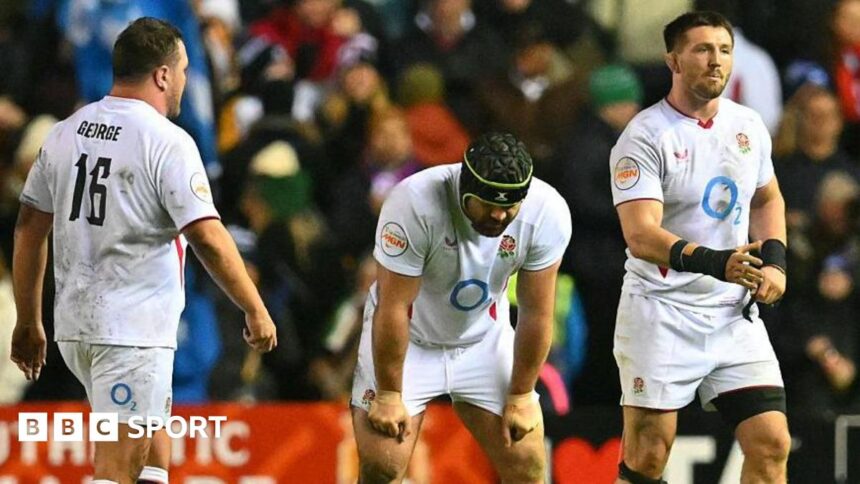
England’s Roman Crucible: Can Borthwick’s Men End the Away-Day Agony Against Italy?
The image was as jarring as the results: the Six Nations trophy itself, engulfed in flames during a promotional event after round three. For England fans, it served as a painfully apt metaphor. The title aspirations of one of the pre-tournament favourites, tipped by many for Grand Slam glory, had gone up in smoke well before the end of February. The journey from hopeful ignition to charred reality has been brutally swift. Mauled at Murrayfield. Terrorised at Twickenham by Ireland’s green machine. Now, Steve Borthwick’s squad travels to Rome not in pursuit of silverware, but in search of salvation. The question is no longer about championships, but character: can a wounded England salvage pride against an Italy side for whom victory would represent a historic, era-defining triumph?
- A Dire Away Record: England’s Travel Sickness Laid Bare
- The Azzurri Evolution: No Longer the Eternal Underdogs The narrative surrounding Italy has fundamentally shifted. Gone are the days of viewing them as a guaranteed five-point fixture. Under Gonzalo Quesada, they have traded chaotic ambition for a disciplined, pragmatic, and fiercely competitive structure. Their performance in a narrow loss to Ireland and a gutsy draw in France are not moral victories—they are proof of tangible progress. They possess a spine of world-class talent and a collective grit that was previously missing. Ange Capuozzo’s Magic: The full-back remains a game-breaking threat from anywhere on the pitch. Tommaso Menoncello’s Power: The centre is arguably the form midfielder of the entire championship. Set-Piece Solidarity: Their scrum and maul defence have become obdurate, no longer a soft touch. Quesada has instilled a killer instinct and game management previously absent. They will target England’s lineout, attack the channel around the breakdown, and look to frustrate. For Italy, this match is not about being plucky losers. It is about seizing a moment they have waited a generation for, against an opponent palpably lacking confidence. England’s Identity Crisis: What is the Plan?
- Prediction: A Tense Battle Where History Hangs in the Balance
- Conclusion: More Than a Game, A Reckoning
A Dire Away Record: England’s Travel Sickness Laid Bare
To understand the magnitude of the challenge in Rome, one must first confront England’s stark away-day blues. The Murrayfield massacre was not an anomaly; it was the latest chapter in a sustained period of travel sickness. Since their last Six Nations title in 2020, England’s record on the road in the tournament makes for grim reading. Their win in Rome two years ago is their sole away victory in their last seven Six Nations away fixtures. They have been beaten in Dublin, Cardiff, Edinburgh, and Paris, often looking tactically brittle and mentally fragile.
This isn’t just a blip; it’s a systemic issue. The fortress Twickenham aura has diminished, but the problems are magnified abroad. The team appears shackled by pressure, struggling to adapt to hostile environments and impose their game plan. The fluency and aggression shown in patches against Ireland last weekend came too late, from a deep deficit. Replicating that intensity from the first whistle in the Stadio Olimpico, against an Italian side fuelled by fervent home support and growing belief, is a non-negotiable requirement. History may show England have never lost to Italy, but recent history shows England are chronically vulnerable anywhere but home.
The Azzurri Evolution: No Longer the Eternal Underdogs
Steve Borthwick faces a selection and philosophical conundrum. The experiment of deploying Marcus Smith at full-back produced thrilling attacking moments against Ireland but also defensive vulnerabilities. Does he double down on that creative gamble, or revert to a more conservative, territorial structure with George Furbank? The pack, so dominant against Ireland in the final quarter, must find that physicality from the outset. The absence of the injured Ollie Chessum is a significant blow to the engine room.
Critically, England must decide what they are. Are they a kick-pressure team, a power-based side, or a new hybrid? The lack of a coherent identity has been their undoing. In Rome, they need clarity. They must leverage their undeniable power advantage, use the bench intelligently, and crucially, match Italy’s likely superior passion with a cold, professional ruthlessness. Leadership from figures like Jamie George and Maro Itoje will be paramount; their legacies are, in a small way, on the line.
Prediction: A Tense Battle Where History Hangs in the Balance
This will not be a coronation. It will be a brutal, tense, and emotionally charged arm-wrestle. Italy will believe, with every fibre, that this is their time. The Stadio Olimpico will be a cauldron, and England’s mental resilience will be tested as severely as their defensive line.
England’s superior depth and individual power should, in theory, tell over 80 minutes. The return of players like Alex Mitchell at scrum-half should bring sharper service. However, theory has often crumbled in the face of England’s away-day reality. Expect a ferocious Italian start, scores level or close at the hour mark, and a finale fraught with nerve-shredding tension.
The prediction here is that England, stung by criticism and aware of the abyss a loss would represent, find a way. It will be ugly, it will be unconvincing, and it will do little to silence the deeper concerns about the project under Borthwick. But they will escape Rome with a narrow win, perhaps by a score of 26-23. The victory will feel less like a triumph and more like a reprieve.
Conclusion: More Than a Game, A Reckoning
The trip to Rome transcends a mere fourth-round Six Nations fixture. For Italy, it is a referendum on their arrival as a true competitive force. For England, it is a reckoning with their recent past and a pivotal moment for their immediate future. A win papers over the glaring cracks of a failed campaign. A loss—a first ever to Italy—would be cataclysmic, triggering an inquest of seismic proportions and leaving the Borthwick era in crisis.
The burning trophy was a symbol of lost hopes. In the Eternal City, England play to avoid an inferno of their own making. The away-day blues must end here, not with a fanfare, but with a grim, determined grind. Whether they can muster even that is the question that will define this weekend, and perhaps their entire season.
Source: Based on news from BBC Sport.