‘Everybody Wants to Fire Me’: Pep Guardiola’s Fiery Retort and the Unrelenting Pressure at Manchester City
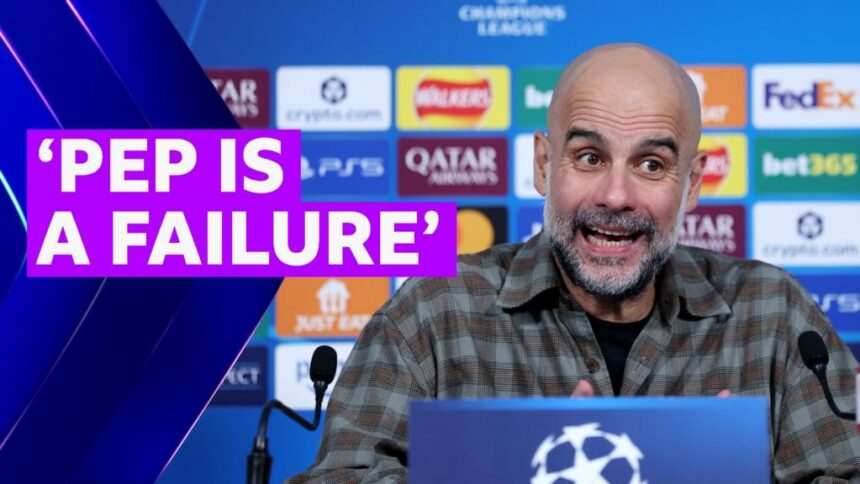
The Etihad Stadium was cloaked in a rare, stunned silence. The final whistle had confirmed the unthinkable: Manchester City, the reigning champions of Europe, had been dethroned, eliminated from the Champions League by a relentless Real Madrid. As the football world scrambled for narratives, the focus turned not just to the pitch, but to the post-match press conference. There, a visibly frustrated Pep Guardiola, facing a question about his perceived European “failures,” delivered a line that cut through the noise and laid bare the exhausting reality of modern football’s elite: “Everybody wants to fire me.” This was more than a soundbite; it was a window into the immense, often irrational pressure cooker that even the most successful managers inhabit.
The Catalyst: A European Dream Deferred
The context is crucial. City’s exit was not a meek surrender but a brutal, tactical war of attrition that ended in a penalty shootout defeat after a 1-1 draw (1-4 on aggregate). For 120 minutes, City had dominated possession, peppered the Madrid goal, and seen a miraculous save from Andriy Lunin deny them victory. Yet, in the cold binary of knockout football, it was Carlo Ancelotti’s seasoned veterans who held their nerve. The match report—Man City 1-2 Real Madrid (1-5 Agg)—tells a story of statistical dominance undone by clinical efficiency and psychological fortitude. It was this latest chapter in City’s complex European saga that prompted the fateful journalist’s query, framing the narrative around Guardiola’s “failures” despite his 2023 triumph.
Deconstructing Guardiola’s Defense: More Than Just a Soundbite
Guardiola’s retort was a masterclass in deflection and raw honesty. The phrase “Everybody wants to fire me” is a hyperbolic shield, but it underscores a fundamental truth about the industry. His response served multiple purposes:
- Reframing the Narrative: It shifted focus from a specific footballing failure to the broader, fickle nature of external judgment. Guardiola implicitly argued that the standards at City are so astronomically high that even consistent domestic dominance is seen as a prelude to, not a replacement for, European glory.
- Highlighting Absurdity: The statement mockingly points to the absurdity of questioning the job security of a manager who has delivered five Premier League titles in seven seasons and a historic treble just one year prior. It’s a critique of a “what have you done for me lately?” culture that has reached fever pitch.
- Psychological Armor: For his players and staff, it was a classic Guardiola move—absorbing the brunt of the criticism, making himself the story, and protecting his squad from the harshest post-mortems. He became the lightning rod.
This incident reveals the psychological toll of sustained excellence. At clubs like Manchester City, success is not celebrated long-term; it is instantly converted into expectation. The Champions League exit, therefore, isn’t just a loss—it’s framed as a deviation from a mandatory script.
Expert Analysis: The Impossible Standard of Perpetual Victory
From a tactical perspective, Guardiola’s approach was not the failure it was painted to be. City created more than enough chances to win the tie over two legs. The margins were infinitesimal: a missed finish here, a world-class save there, the lottery of penalties. To attribute this to a managerial flaw is to misunderstand the sport. Ancelotti’s Real Madrid are the ultimate tournament team, specializing in surviving such onslaughts.
The deeper analysis lies in the project’s lifecycle. Guardiola has built a machine so refined that its occasional stutter is treated as a catastrophic systems failure. The demand is for perpetual, flawless victory—a demand that ignores the inherent randomness and competitive nature of the Champions League knockout stages. Furthermore, this pressure exists in a unique ecosystem for City, where domestic success is almost expected, leaving Europe as the sole barometer for many. This creates a distorted lens through which every season is viewed.
Predictions: What’s Next for Guardiola and Manchester City?
So, where does this leave Guardiola and City? Contrary to his quip, his position is under no legitimate threat. The project is too aligned, the domestic dominance too complete. The immediate future points to a familiar pattern:
- Domestic Redoubling: Expect a fiercely motivated City to channel this frustration into the Premier League run-in. The Champions League exit often unleashes a “domestic monster” version of Guardiola’s teams.
- Squad Evolution: The summer transfer window will likely see targeted reinforcements, particularly in areas that can add a new dimension for next season’s European campaign. The quest for a different kind of “game-changer” for those tight knockout nights will intensify.
- Psychological Reset: Guardiola will use this experience, and the reaction to it, to fuel the squad’s hunger. The “nobody believes in us” or “everyone is against us” mentality, however fabricated, is a powerful tool.
The long-term question remains Guardiola’s own motivation. His contract runs until 2025, and while he shows no signs of weariness, these moments of public frustration hint at the emotional expenditure required. The club’s challenge is to continue providing him with the tools and support to navigate this unique pressure.
Conclusion: The Price of Greatness in the Modern Game
Pep Guardiola’s “Everybody wants to fire me” comment will be remembered not as a moment of insecurity, but as a stark manifesto on the conditions of success at football’s summit. It was a reminder that in an era of hot takes and relentless scrutiny, legacy is not banked; it is constantly being renegotiated after every result. The defeat to Real Madrid was a football match decided by fine margins. The reaction to it, and Guardiola’s fiery response, illustrates a far broader contest: the struggle between sustained project-building and the insatiable demand for immediate, continuous glory. For Guardiola and Manchester City, the pursuit of that glory continues, but his words serve as a poignant footnote on the exhausting, often thankless, price of being the team everyone aims to beat.
Source: Based on news from BBC Sport.