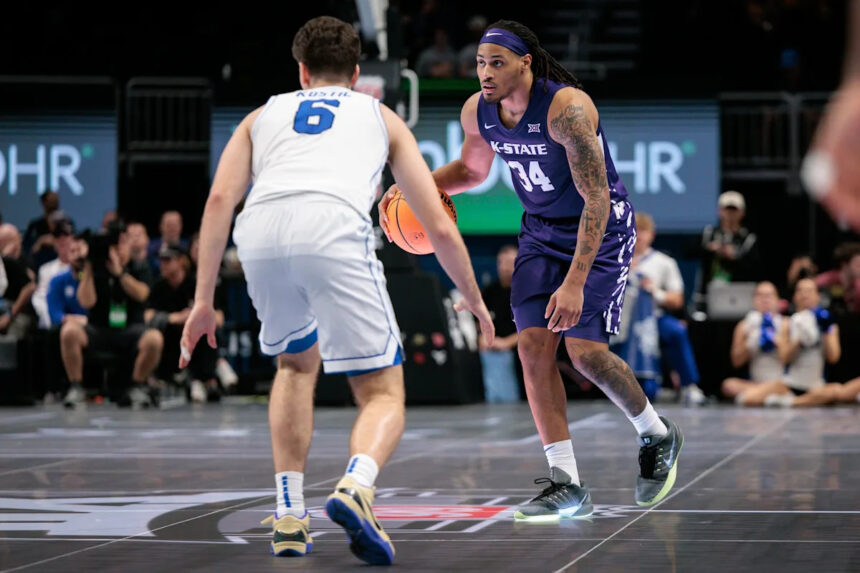
Fans Blast Big 12’s Glass Court Reversal as a Glaring Double Standard
The Big 12 Conference arrived at its basketball tournaments this month with a vision of the future. It departed with a public relations nightmare, a trail of slippery players, and a firestorm of criticism over its perceived treatment of men’s and women’s athletics. The league’s decision to debut—and then abruptly scrap—a revolutionary LED glass court for its postseason has sparked a fierce debate about innovation, player safety, and equality, leaving fans and analysts questioning the conference’s priorities.
A Slippery Slope: The Ill-Fated Debut of the Glass Court
In an effort to stand out in a crowded postseason landscape, the Big 12 unveiled a state-of-the-art, full-LED court for its conference tournaments. The transparent surface, capable of dynamic animations and graphics, was marketed as a groundbreaking step forward for fan engagement and broadcast presentation. The reality, however, was far less glamorous.
Almost immediately, players from both the men’s and women’s tournaments reported significant issues. The primary complaint was a lack of traction. The glass surface, especially when dust accumulated, became perilously slick, robbing players of their explosive first step and compromising their ability to make sharp cuts. Beyond the footing, visual problems plagued the games. The vibrant, shifting graphics made it difficult for players to consistently identify key court markings like the three-point line and the boundary lines. The issues culminated in a concerning health report, as Kansas State forward Taj Manning stated the floor gave a teammate a migraine.
The court was not just a novelty; it was an active impediment to the competition. Social media filled with clips of players sliding uncontrollably, and coaches voiced their frustrations. The innovation meant to elevate the tournament was instead undermining the very integrity of the play.
The Pivot: A Decision That Sparked Outrage
Following the quarterfinal rounds of the men’s tournament, the Big 12 Conference made a decisive call. It announced it would axe the glass court for the remainder of the men’s event, reverting to a traditional hardwood surface for the high-profile semifinals and championship game. The conference cited “feedback from players and schools” as the reason, framing it as a move to prioritize competitive fairness.
While this was likely a relief for the men’s teams still competing, it acted as a lightning rod for criticism. The women’s tournament had concluded days earlier, played in its entirety on the problematic surface. Similar complaints about slipperiness and visual confusion had been voiced throughout the women’s event, yet no mid-tournament change was made. This discrepancy did not go unnoticed.
Fans, journalists, and advocates immediately called out a glaring double standard. The central, furious question became: If player safety and competitive integrity were urgent enough concerns to warrant a dramatic mid-tournament change for the men, why were those same concerns not urgent enough for the women?
- Timing & Prestige: The men’s semifinals and championship command larger TV audiences and greater revenue. Critics argue the conference protected its marquee product while leaving the women’s event as a full-scale beta test.
- Player Welfare: The risk of injury from poor traction was identical for all athletes. By allowing the women to finish on the glass, the league opened itself to accusations that it valued the well-being of its male athletes more highly.
- Competitive Legacy: The women’s champion was crowned and its all-tournament team selected under conditions deemed unfit for the men’s final stages, potentially tainting those achievements.
Expert Analysis: More Than a Bad Court, A Systemic Blind Spot
This incident transcends a simple failed experiment in court technology. It touches on deep, systemic issues within athletic administration. “This is a classic case of unconscious bias in action,” says Dr. Laura Burton, a sports management professor specializing in gender equity. “The decision-making process likely wasn’t overtly malicious, but it was flawed. The concerns during the women’s tournament were likely seen as ‘feedback to note for next year.’ When the same concerns arose during the men’s tournament, they suddenly became an ‘urgent crisis to solve now.’ That discrepancy in response time is the heart of the problem.”
The backlash is amplified by the current cultural moment in sports. Following the monumental success and spotlight on NCAA women’s basketball in recent years, fueled by stars like Caitlin Clark and Angel Reese, fans are more attuned than ever to disparities in treatment. The Big 12’s misstep is viewed not as an isolated error, but as a symptom of an older mindset that has yet to fully evolve.
Furthermore, the logistical argument that changing the court mid-women’s tournament was too difficult rings hollow to many. “If you can source, transport, and install a replacement hardwood court in under 24 hours for the men, you could have developed a contingency plan for the women,” notes veteran sports broadcaster and analyst, Michael Smith. “The lack of a contingency plan for the women’s event is, in itself, a telling oversight.”
Predictions & Repercussions: What Comes Next for the Big 12?
The fallout from this decision will likely shape Big 12 policies and public perception for years to come. Here’s what to expect:
Immediate Damage Control: The conference will need to issue a more substantive statement addressing the double-standard allegations directly. Silence or generic apologies will only fuel the fire. They may commission an internal review of the decision-making timeline.
Future Innovation, With Caution: The league’s appetite for flashy, untested technology will be severely diminished. Any future innovations will undergo far more rigorous testing with athlete input, likely in low-stakes environments long before tournament play.
Strengthened Protocols: We predict the conference will establish a formal, gender-neutral protocol for addressing equipment or facility issues during tournaments. This will ensure that any future changes are triggered by the problem itself, not by which gender is competing.
Recruiting Impact: This incident will be used against the Big 12 on the recruiting trail. Competing conferences can point to it as evidence that the league may not prioritize the experience and safety of its women’s basketball players equally.
Conclusion: A Costly Lesson in Equality and Execution
The Big 12’s glass court was meant to be a shining beacon of progress. Instead, it became a transparent lens focusing a harsh light on the conference’s flawed decision-making. The failure of the technology is forgivable; experimentation sometimes falters. The failure to apply an equal standard of care is not.
This episode serves as a stark reminder that in the modern era of sports, perception is reality. The message sent by switching courts for the men and not the women is potent and damaging. It undermines the conference’s stated commitments to equity and forces a reevaluation of whose competition is deemed most sacred. For the Big 12, repairing the court was easy. Repairing its reputation will require a sustained, demonstrable commitment to ensuring that “player feedback” is heard equally, and acted upon with equal urgency, no matter who is on the floor.
Source: Based on news from Yahoo Sports.