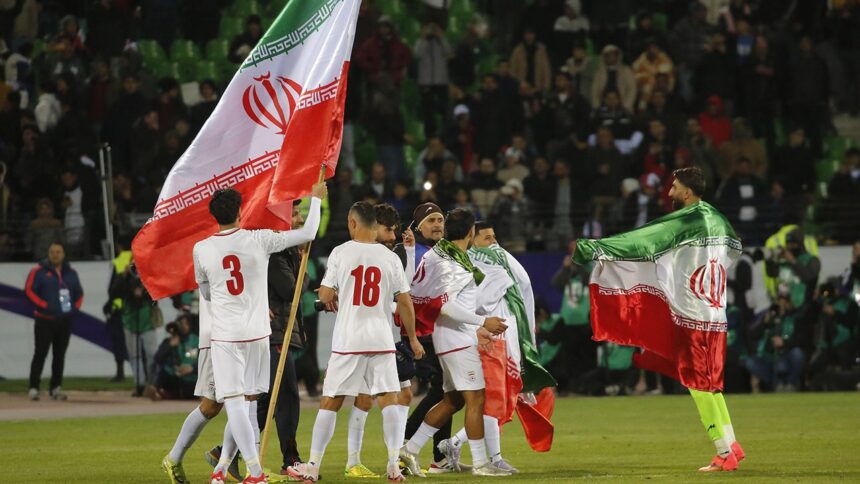
FIFA Stands Firm: Iran’s Push to Move World Cup Matches from U.S. to Mexico Rejected
The road to the 2026 FIFA World Cup, the first ever 48-team spectacle, has hit its first significant geopolitical speed bump. In a decisive move, world football’s governing body has formally rejected a public push from Iran to relocate its group-stage matches out of the United States. This development follows claims from Iranian diplomats in Mexico City that negotiations were underway for such a move, a narrative FIFA has now definitively shut down. The incident underscores the complex interplay of international sports, politics, and logistics that will define the unprecedented North American tournament.
The Diplomatic Gambit and FIFA’s Unequivocal Response
Earlier this week, reports surfaced citing the Iranian ambassador to Mexico, Mojtaba Ferdosipour, stating that Iran was in talks with FIFA to have its three first-round matches played in Mexico instead of the United States. The ambassador cited “security concerns” and the “current political situation” as driving factors. Given the decades-long strained relations between the U.S. and Iranian governments, the request, while politically charged, was not entirely unexpected by tournament organizers.
However, FIFA’s response was swift and left no room for interpretation. In a statement obtained by The Associated Press, the organization clarified its position while adhering to diplomatic protocol:
- FIFA is in regular contact with all participating nations, including Iran, for planning purposes.
- The match schedule announced on 6 December 2025 is definitive.
- FIFA “is looking forward to all participating teams competing as per” that schedule.
This firm rejection highlights a core principle for FIFA in organizing this sprawling event: the integrity and immutability of the sporting calendar. With matches spread across 16 cities in three countries, any unilateral change for one team would create a logistical domino effect, disrupting travel, venue bookings, security plans, and ticket sales for multiple nations and host cities.
Expert Analysis: Beyond Politics, a Logistical Impossibility
From a pure sports management perspective, FIFA’s decision was the only viable one. “The 2026 World Cup is the most complex sporting event ever attempted,” notes Dr. Elena Rodriguez, a professor of international sports management. “The matrix of team bases, training sites, flight paths, and hotel blocks is a meticulously balanced ecosystem. Granting Iran’s request wouldn’t just be a political concession; it would be an operational nightmare.”
The 2026 World Cup match schedule is designed to minimize travel and maximize recovery time for athletes. Moving one team’s entire group stage to another country would:
- Disadvantage Iran’s Group A opponents, forcing them into unnecessary international travel.
- Compromise the competitive integrity of the group, as conditions and travel fatigue would no longer be equal.
- Create a costly precedent, opening the door for other nations to make similar requests based on political affiliations.
Furthermore, the Iranian team, spearheaded by stars like Porto’s Mehdi Taremi, is one of Asia’s strongest. Their matches are likely to be high-draw events for which U.S. host cities have already begun planning. FIFA’s statement, emphasizing “regular contact,” suggests the body is willing to listen to and address specific security concerns on a operational level, but not to alter the fundamental framework of the tournament.
Historical Context and the Shadow of Qatar 2022
This is not the first time World Cup planning has intersected with international tensions. The 2022 tournament in Qatar faced numerous calls for boycotts and protests related to human rights issues. However, the request to physically move matches is a newer phenomenon. The situation echoes, albeit on a smaller scale, the consistent calls from some groups for FIFA to suspend Russia or Israel from competitions, decisions the body weighs with extreme caution.
For Iran, sports and politics are deeply intertwined. The country has a history of navigating competitions in adversary nations. Their football team participated in the 1998 World Cup in France while facing U.S. sanctions, and more recently, they competed in the 2022 World Cup in Qatar alongside the United States in Group B. The key difference for 2026 is the tournament’s primary staging ground being on American soil itself. The Iranian federation’s public lobbying via its Mexican embassy appears to be a political statement as much as a practical request, signaling its discomfort to a domestic audience while testing FIFA’s boundaries.
Predictions: How This Plays Out for Team Melli and Beyond
With the door to relocation firmly closed, the focus now shifts to practical preparations. Here’s what to expect in the lead-up to 2026:
Heightened Security and Diplomatic Protocols: Expect discreet but intense planning between FIFA, U.S. Soccer, State Department officials, and Iranian federation representatives. Iran’s team base camp, likely in a major city with significant security infrastructure and diplomatic resources, will be chosen with extreme care. Vetting of venues, transport routes, and hotel security will be paramount.
A Focus on Football: For players like Mehdi Taremi and Sardar Azmoun, this decision ultimately removes a cloud of uncertainty. Their mission is now clear: prepare to compete in the United States. The narrative will slowly shift from political posturing to athletic preparation, a relief for the squad seeking to improve on their historic run to the 2022 World Cup knockout stages.
A Template for Future Disputes: FIFA’s firm stance sets a powerful precedent. For the 2030 or 2034 World Cups, nations with bilateral tensions may think twice before requesting match relocations, understanding that the sporting calendar is effectively sacrosanct once drawn. The message is that football diplomacy works within the confines of the game’s operational reality.
Conclusion: The Beautiful Game in a Complicated World
FIFA’s rejection of Iran’s request reaffirms a central, if often challenged, tenet of global sport: the field of play must remain a neutral ground. While geopolitics will always swirl around mega-events like the World Cup, the governing body’s primary duty is to ensure a fair and logistically coherent tournament for all 48 participating nations. By upholding the published schedule, FIFA has prioritized competitive integrity and operational sanity over political accommodation.
The coming months will test the organization’s ability to facilitate a safe and successful environment for the Iranian national team and its fans. The world will be watching not just the football, but how this intricate dance of diplomacy and sport is managed. For Team Melli, the path is now unequivocal. Their quest for World Cup glory will run through the United States, a testament to the enduring, if complicated, power of the beautiful game to bring the world’s nations—however reluctantly—to the same pitch.
Source: Based on news from Fox Sports.