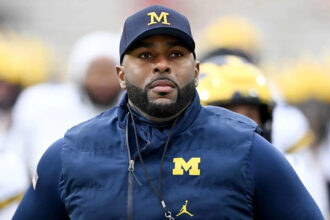
Sherrone Moore’s Legal Saga Ends: Fired Michigan Coach Accepts Plea Deal in Home Invasion Case
The turbulent off-field saga surrounding former University of Michigan assistant football coach Sherrone Moore reached a pivotal, if anticlimactic, conclusion this week. In a swift courtroom maneuver, Moore pleaded no contest to two misdemeanor charges, effectively resolving a felony home invasion case that had cast a long shadow over his career and personal life. The deal was finalized on the very day a judge was set to hear a challenge to the legality of his December arrest, closing a chapter of legal uncertainty but opening profound questions about accountability, reputation, and the road ahead for the once-rising coaching star.
A Swift Resolution on the Courthouse Steps
The legal proceedings took a dramatic turn as the clock ticked down toward a pre-trial hearing. Moore’s defense team was prepared to argue that his arrest last December was fundamentally flawed, potentially leading to a dismissal of charges. Instead, prosecutors offered a deal that Moore accepted. By pleading no contest to two misdemeanors—typically trespass and a related minor offense—the more serious felony home invasion case was dismissed. A no contest plea is not an admission of guilt but is treated as such for sentencing purposes.
This strategic resolution avoids the risk of a protracted and public trial for both sides. For the prosecution, it guarantees a conviction without the uncertainty of a legal challenge to the arrest. For Moore, it eliminates the existential threat of a felony conviction, which would have carried severe penalties and permanently altered his life. However, the misdemeanor convictions remain a permanent stain on his record and represent a formal finding of wrongdoing by the court.
- Charges Resolved: Felony home invasion dismissed; two misdemeanors sustained via no contest plea.
- Timing: Deal struck hours before a critical hearing challenging the legality of the December arrest.
- Immediate Outcome: Avoids a public trial, but results in criminal convictions.
Unpacking the Case: From Felony Arrest to Misdemeanor Plea
The incident that unraveled Moore’s tenure at Michigan occurred in early December. According to police reports, Moore was arrested after an altercation at the home of a former acquaintance. Initial reports suggested a complex, emotionally charged situation, leading authorities to pursue the serious felony home invasion charge. The University of Michigan, with its football program still basking in the glow of a national championship but sensitive to off-field conduct, acted swiftly. Moore was fired by Michigan within days, a clear signal that the institution would not tolerate such alleged conduct from a high-profile staff member.
The case’s pivot point was the planned challenge to Moore’s arrest. Defense attorneys were poised to argue that police lacked probable cause or made procedural errors during the December encounter. If successful, the entire case could have been thrown out. The prosecution’s offer of a misdemeanor plea deal can be seen as an acknowledgment of potential weaknesses in their evidence or procedure. It represents a classic legal compromise: the state secures a conviction, and the defendant avoids the most severe consequences, albeit at a significant cost.
“This is the justice system’s version of a negotiated settlement,” notes a veteran legal analyst familiar with high-profile sports cases. “The prosecution gets a win on the books, and Moore walks away without prison time or a felony record. But don’t mistake this for vindication. A plea deal, especially on the eve of a critical hearing, often indicates both sides saw substantial risk in moving forward. For Moore, the damage to his career and reputation was already cemented the moment he was fired.”
Career in Crossroads: Analysis of Fallout and Future
Sherrone Moore was not a head coach, but as a key offensive assistant at a premier program like Michigan, he occupied a coveted position with a bright future. The fallout from his arrest and subsequent firing by Michigan is a career-altering event. In the hyper-competitive, image-conscious world of college football, a misdemeanor conviction related to a domestic incident is a formidable barrier to re-employment, especially at the Power Five level.
Expert analysis suggests Moore’s path back to coaching will be arduous and incremental. The timeline for a potential return involves several painful steps:
- Reputation Rehabilitation: Moore must demonstrate genuine contrition and personal growth, likely through counseling or community service, to even begin mending his public image.
- The Lower-Tier Route: His next opportunity, if one comes, will almost certainly be at a lower-division school (FCS, Division II) or perhaps in a limited off-field role, far from the spotlight of the Big Ten.
- The “Second Chance” Calculus: Athletic directors are notoriously risk-averse. Hiring Moore will require a passionate advocate willing to withstand public scrutiny, a scenario more plausible at a program desperate for his specific offensive acumen.
“The college football coaching carousel is brutal, but it also has a long memory for off-field trouble,” observes a national college football columnist. “Moore’s X’s and O’s expertise might eventually open a door, but it will be a back door, and it will be years from now. He must now become a model citizen first, and a coach second. The plea deal closes the legal case, but the professional trial is just beginning.”
Predictions and Lasting Implications
Looking forward, the ramifications of this case extend beyond Sherrone Moore’s individual career. For the University of Michigan, the swift termination validated their internal conduct policies but also robbed the team of a respected offensive mind. The program moves on, but the episode serves as another reminder of the fragile line between institutional success and personal scandal.
For the coaching profession, this is a stark case study in how quickly a promising career can derail. Predictions for Moore’s trajectory are cautious at best:
- Short-Term (1-2 years): Moore will likely remain out of coaching, focusing on fulfilling any court-mandated obligations and maintaining a low profile.
- Medium-Term (3-5 years): If he successfully stays out of trouble, consultative or analyst roles, possibly in professional football, could emerge. A return to a college staff at a non-Power Five school is possible.
- Long-Term: A full rehabilitation to a major conference coaching role is improbable but not impossible. History shows the road is exceptionally long and requires flawless conduct and powerful allies.
The plea deal itself, while ending the criminal uncertainty, creates a definitive narrative: Sherrone Moore was convicted of crimes stemming from a home invasion incident. That is the headline that will follow him in every future job search, a digital-age scarlet letter no legal technicality can erase.
Conclusion: A Case Closed, A Career Forever Altered
The legal case of Sherrone Moore is now officially resolved. The felony home invasion case was dismissed, but in its place stands a guilty plea to misdemeanors, a trade-off that defines the often-unsatisfying nature of plea bargains. While Moore avoids prison, he has not escaped consequence. Being fired by Michigan and convicted of a crime represents a profound personal and professional collapse.
This story transcends a simple legal outcome. It is a parable about the speed of a fall from grace in modern sports, the severe personal standards applied to those in leadership roles, and the difficult, uncertain path of redemption. The judge’s gavel may have sounded on the case, but the final judgment on Sherrone Moore’s future will be rendered over the coming years, not in a courtroom, but in the court of public opinion and the closed-door meetings of athletic directors. His plea deal brought closure to the law, but for his career, the hardest chapters may still be unwritten.
Source: Based on news from ESPN.
Image: CC licensed via ky.ng.mil