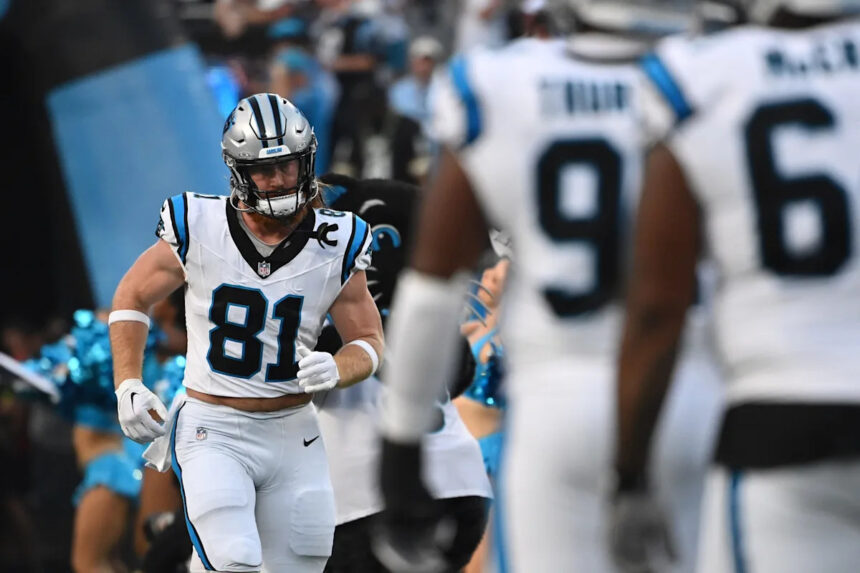
Hayden Hurst Announces Retirement: A Sudden End to a Resilient NFL Journey
The NFL offseason is often a time of transition, but some announcements carry a heavier weight than others. On Monday, the football world received news that resonated with a tone of both finality and reflection, as former Carolina Panthers tight end Hayden Hurst declared his retirement from professional football at the age of 32. The decision, shared via an emotional Instagram post, closes the book on a seven-year career defined by remarkable perseverance, a high-profile draft pedigree, and an unwavering public battle with mental health that ultimately shaped his legacy far beyond the gridiron.
From the Diamond to the End Zone: A Career Forged in Change
Hayden Hurst’s path to the NFL was anything but conventional. Long before he became a first-round pick, Hurst was a promising professional baseball prospect in the Pittsburgh Pirates organization. After stepping away from the diamond, he walked on at the University of South Carolina, quickly transforming himself into one of the nation’s most reliable tight ends. His rapid ascent culminated in the Baltimore Ravens selecting him with the 25th overall pick in the 2018 NFL Draft, a move that placed immense expectations on his shoulders from day one.
His professional journey, however, became a tour of the league. After two seasons in Baltimore, he was traded to the Atlanta Falcons, where he had his most productive statistical year in 2020. A subsequent stint with the Cincinnati Bengals in 2022 saw him catch a career-high 52 passes and become a trusted target for Joe Burrow during a run to the AFC Championship Game. This period of his career highlighted his key strengths:
- Reliable Hands: Hurst was known for his secure catching ability, a trait that made him a dependable safety valve.
- Versatile Blocker: He developed into a capable in-line blocker, adding value beyond the passing game.
- High Football IQ: His understanding of schemes allowed him to adapt quickly to multiple offensive systems.
Yet, his final chapters in Carolina and Los Angeles were marred by the unforgiving physical toll of the sport.
A Panther’s Promise Cut Short: The Concussion That Changed Everything
Hayden Hurst’s signing with the Carolina Panthers in 2023 was meant to be a homecoming of sorts, bringing a veteran presence to a young offense and rookie quarterback Bryce Young. For nine games, he provided exactly that, starting eight and contributing 18 receptions for 182 yards and a touchdown. His leadership in the locker room was often cited as a bright spot during a difficult season. However, the trajectory of his career—and life—was irrevocably altered in a Week 10 loss to the Chicago Bears.
Sustaining a severe concussion on the field, Hurst’s 2023 season ended abruptly. The injury was serious enough that he later revealed he had no memory of the subsequent month, a harrowing detail that underscores the violent reality of professional football. This was not just another injury; it was a neurological event significant enough to force a profound personal reckoning. The Panthers released him in the offseason, and while he latched on with the Los Angeles Chargers for 2024, his time there was limited. It became clear the physical and mental risks had begun to outweigh the rewards.
The Legacy Beyond the Stats: Mental Health Advocacy
To discuss Hayden Hurst’s career solely through statistics and team changes is to miss his most impactful contribution. In 2021, Hurst bravely went public with his longtime struggle with anxiety and depression, revealing he had attempted suicide while in college. He spoke candidly about being diagnosed with ADHD and how untreated mental health issues nearly derailed his life before it began.
This vulnerability transformed him. He established The Hayden Hurst Family Foundation, with a core mission focused on mental health awareness and support for youth, particularly in underprivileged communities. He became a vocal advocate, using his platform to destigmatize therapy and encourage others to seek help. In this arena, Hurst wasn’t just a player; he was a lifeline. His advocacy work created a legacy of hope and understanding that will endure long after his final stat line is forgotten. This aspect of his story provides crucial context for his retirement decision—a choice prioritizing long-term health and well-being over the game he loved.
What’s Next for Hurst and the Panthers’ Tight End Future?
Hayden Hurst steps away at 32, an age where many tight ends are still in their prime. His retirement signals a sobering recognition of the sport’s dangers, particularly regarding head trauma. Experts predict Hurst will likely channel his energy and experience fully into his foundation, potentially becoming a permanent voice in the NFL’s growing conversation around player mental health and post-career transition. His unique perspective as a high-draft pick who faced public struggles and a career-altering injury makes him a powerful advocate for future generations of athletes.
For the Carolina Panthers, Hurst’s retirement is a footnote to a larger question mark at the tight end position. His departure after just one season underscores the instability the team has faced there since Greg Olsen’s era. The Panthers now look to a group led by Tommy Tremble and Ian Thomas, but Hurst’s brief tenure is a reminder of the need for a dynamic, consistent pass-catching threat to aid quarterback Bryce Young’s development. His exit may accelerate the team’s efforts to address the position through the draft or free agency, seeking a player who can provide the veteran production they hoped Hurst would deliver.
A Final Whistle Blown on His Own Terms
Hayden Hurst’s retirement is not the story of a player who ran out of talent or desire. It is the story of a man who made a conscious, difficult choice for his future. His career arc—from baseball burnout to walk-on, to first-round pick, to journeyman, to advocate—is a uniquely American sports tale. While his time with the Carolina Panthers was brief and ended painfully, it served as the catalyst for a decision grounded in long-term health.
He leaves the game with 177 receptions, 1,718 yards, and 14 touchdowns—solid, if unspectacular, numbers. But his true stat line is measured in lives touched through his advocacy, in conversations started about mental health, and in the courage it took to walk away while still capable of playing. In announcing his retirement, Hayden Hurst didn’t just close a chapter on his NFL career; he opened a new one where his greatest impact is yet to come, proving that sometimes the most powerful catch a player can make is the one they make for themselves.
Source: Based on news from Yahoo Sports.