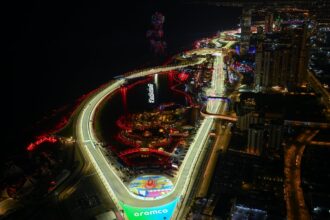
Formula 1 Makes Unprecedented Call: Bahrain and Saudi Arabian Grands Prix Cancelled Amid Regional Conflict
The high-octane world of Formula 1, a sport built on calculated risk and split-second decisions, has been forced into a sobering strategic retreat. In a stunning announcement made in Shanghai ahead of the Chinese Grand Prix, the sport’s leadership confirmed the cancellation of the 2026 Bahrain and Saudi Arabian Grands Prix. Citing escalating tensions and direct safety concerns stemming from the ongoing conflict between the United States and Iran, the decision leaves a glaring, two-race void in next season’s calendar and sends a powerful geopolitical shockwave through the paddock.
The move, described by F1 CEO Stefano Domenicali as “difficult” but “unavoidable,” marks one of the most significant calendar disruptions in the sport’s modern era not related to a global pandemic. It underscores the fragile intersection where global sport meets hard geopolitical reality, forcing the multi-billion dollar travelling circus to reroute its ambitions. For a sport that has aggressively expanded into the Middle East, the cancellation of its two April fixtures is a profound statement on the current state of regional instability.
A Difficult Decision Driven by Inescapable Realities
The announcement, delivered early Sunday in China, was not made lightly. The Bahrain International Circuit in Sakhir and the Jeddah Corniche Circuit in Saudi Arabia have become cornerstone events of the F1 calendar, representing not just racing but deep financial partnerships and long-term strategic visions for the sport. Bahrain has been a mainstay since 2004, while Saudi Arabia’s night race has quickly established itself as one of the calendar’s most dramatic and lucrative events.
However, the safety concerns cited by both Formula 1 and the FIA became impossible to ignore. The logistics of an F1 event are a monumental undertaking, involving the transport of thousands of personnel, hundreds of tons of sensitive equipment, and the world’s most high-profile drivers and team principals across global borders. The potential for miscalculation or unintended escalation in a conflict zone presents an unacceptable risk profile.
“While this was a difficult decision to take, it is unfortunately the right one at this stage considering the current situation in the Middle East,” Domenicali stated. His sentiment was echoed by FIA President Mohammed Ben Sulayem, who emphasized the governing body’s paramount duty: “The safety of our drivers, teams, officials, and fans is non-negotiable. We have been monitoring the situation closely, and the current climate leaves us with no other responsible option.”
Immediate Fallout and Calendar Conundrum
The cancellation creates an immediate and significant logistical headache for the 2026 season. The early-April slot, typically marking the start of the Middle Eastern leg, now presents a sudden four-week gap between the scheduled Australian Grand Prix in late March and the subsequent Miami Grand Prix in early May.
The F1 calendar is a meticulously crafted puzzle, with freight routes, team operational rhythms, and commercial broadcasting slots locked in years in advance. A hole of this magnitude cannot simply be left empty. The F1 commercial rights holders and the FIA now face a complex set of options, each with its own challenges:
- Replacement Races: Securing a new venue on short notice is highly improbable. Traditional European circuits lack the necessary preparation time and may conflict with local regulations. A double-header at an existing venue, like Imola or Austin, is a more plausible but commercially fraught alternative.
- Calendar Reshuffle: Moving a later-season race forward is a possibility, but it would disrupt the second half of the season and face opposition from promoters whose planning is equally advanced.
- Extended Break: The most likely, albeit unsatisfying, outcome may be an extended gap in the schedule. This would impact competitive momentum, fan engagement, and team revenue streams tied to race hosting fees.
The financial implications are vast. Both Bahrain and Saudi Arabia pay substantial race promotion fees, reported to be among the highest on the calendar. The loss of these fees, alongside associated broadcast and sponsorship revenues linked to the events, will represent a significant hit to Liberty Media’s bottom line and team prize fund allocations.
Expert Analysis: The Geopolitical Pit Lane
This decision transcends sport. It is a stark acknowledgment that Formula 1’s globalized business model is vulnerable to international discord. The sport’s expansion into new frontiers over the past two decades—particularly in the Gulf region—has been a masterstroke in commercial growth, but it has inherently tied F1’s fortunes to the stability of those regions.
“Formula 1 has long operated on the principle that sport can be a neutral platform, separate from politics,” notes Dr. Anya Petrova, a senior fellow specializing in sport and geopolitics. “This cancellation is a clear admission that there is a threshold of instability where that principle no longer holds. The US-Iran war and its regional spillover have created a tangible threat environment that the sport cannot mitigate with its usual security protocols. This isn’t about taking a political stance; it’s a severe, operational risk assessment.”
The move also places the sport’s relationships with its Gulf partners under a unique strain. Both Bahrain and Saudi Arabia have used Formula 1 as a central pillar of their international branding and “soft power” strategies. The cancellation, while framed as a safety necessity, will be a diplomatic disappointment for the kingdoms, potentially prompting behind-the-scenes negotiations regarding future commitments and contractual obligations.
Predictions for the Future of F1’s Global Stage
Looking beyond the immediate crisis for the 2026 season, this episode will force a strategic recalibration within Formula 1’s headquarters. The assumption of perpetual stability in certain regions can no longer be taken for granted.
We can anticipate several potential long-term shifts:
- Enhanced Risk Modeling: F1’s future calendar planning will incorporate more sophisticated geopolitical risk analysis, potentially affecting how contracts with host nations are structured, including force majeure clauses.
- Diversification Pressure: While the Middle East remains crucial, this event may accelerate interest in securing flagship events in other stable, high-growth markets, possibly in Asia or the Americas, to provide a more balanced portfolio.
- The “Flyaway” Dilemma: The cancellation highlights the vulnerability of long-haul, “flyaway” races compared to the European heartland where races are closer together. This won’t reverse globalization, but it may reinforce the value of regional clustering of events for logistical security.
Most importantly, this establishes a precedent. The FIA president Mohammed Ben Sulayem and Stefano Domenicali have now demonstrated that when a clear and present danger is identified, commercial imperatives will be secondary to safety. This will redefine the boundaries of what is considered an acceptable risk for the championship.
Conclusion: A Championship Forced to Downshift
The cancellation of the Bahrain and Saudi Arabian Grands Prix is a watershed moment for 21st-century Formula 1. It is a humbling reminder that for all its technological marvels, financial power, and global appeal, the sport remains subject to the age-old forces of international conflict and instability. The roaring engines have been silenced not by mechanical failure, but by the grim calculus of modern warfare.
While the immediate focus will be on the practical scramble to salvage the rhythm of the 2026 season, the broader implications will resonate for years. Formula 1’s journey into new markets has been brilliantly successful, but it has now encountered a formidable roadblock—one that cannot be solved with aerodynamic upgrades or a clever pit strategy. The sport finds itself in a delicate position, needing to uphold its duty of care while navigating its deep commitments to host nations. How it manages this balance will define its trajectory long after the current conflict subsides. For now, the message from Shanghai is clear: even Formula 1 must sometimes yield to forces more powerful than horsepower.
Source: Based on news from India Today Sport.
Image: CC licensed via commons.wikimedia.org