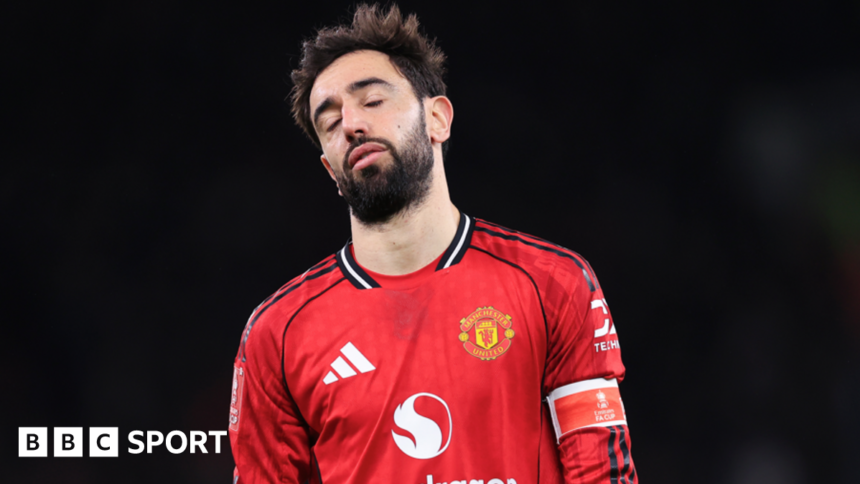
‘Fragile’ Manchester United Braced for Shortest Season in Over a Century
The final whistle at Wembley did not just signal Manchester United’s exit from the FA Cup. It marked the near-certainty of a statistical anomaly not seen at Old Trafford since the guns of the First World War began to roar. A meek 2-1 defeat to Brighton & Hove Albion, sealed by a clinical Danny Welbeck strike, has left Erik ten Hag’s squad staring at a barren, truncated run-in. With no cup finals to prepare for and European football next season a distant dream, United are now set to complete their fewest competitive fixtures in a single campaign since the 1914-15 season—a stark, sobering metric that encapsulates a year of profound failure.
The Speed of the Collapse: From Corner Turned to Crisis Renewed
Life moves at a breakneck, unforgiving pace at Manchester United. Rewind just eleven weeks to that Brighton visit to Old Trafford in February. A hard-fought 2-1 victory that day secured a third consecutive win across all competitions. The narrative was being forcefully written: United had turned a corner under their new manager, Ruben Amorim. The football was pragmatic but effective, the squad seemed unified, and a top-four finish felt within grasp.
Wind forward to the present day, and that momentum lies in shattered ruins. The collapse has been spectacular in its speed and comprehensiveness. The FA Cup semi-final was not just a loss; it was a performance that laid bare the chronic issues plaguing the squad. The fragile mentality resurfaced after conceding, the tactical structure dissolved under minimal pressure, and the gap to the Premier League’s elite was measured not just in points, but in cohesive idea and execution.
This rapid regression begs serious questions. It suggests that the brief revival was built on unstable foundations—perhaps individual moments of quality or fleeting adrenaline—rather than any sustainable systemic improvement installed by Amorim. When the pressure was truly on, with a cup final place at stake, the old, familiar cracks gaped wide open.
Anatomy of Fragility: Why United’s Season Unraveled
Labeling this Manchester United side as ‘fragile’ is not a media invention; it is a clinical diagnosis supported by evidence. This fragility manifests in three critical areas:
- Psychological Brittleness: The team’s performance is inversely proportional to the weight of the occasion. Setbacks, like going a goal down, are rarely met with a resilient response. Instead, they often trigger a cascade of errors, poor decision-making, and a visible drop in collective belief. This lack of on-pitch leadership and fortitude is a hallmark of a squad still lacking true core strength.
- Structural Instability: Despite multiple transfer windows and a managerial change, United still lack a defined, reliable way of playing. The defensive line looks perpetually unsettled, the midfield is often bypassed with ease, and the attack is disconnected. This isn’t just about player quality; it’s about a system that fails to provide security or clear patterns of play, leaving individuals exposed.
- Physical & Squad Depth Crisis: Injuries have been relentless, but they have also exposed a shocking lack of reliable depth. The drop-off in quality between the starting XI and the substitutes is arguably the largest among the supposed ‘top six’. This has created a cycle where key players are run into the ground, increasing injury risk, and their replacements cannot maintain performance levels, leading to dropped points and lost confidence.
The FA Cup exit to Brighton was a microcosm of all these flaws. They were out-thought, out-fought, and ultimately, out-lasted.
The Longest Summer: Consequences of a Short Season
Finishing a season early is not a blessing for a club of United’s stature; it is an indictment. The ramifications of this abbreviated campaign will echo throughout the summer and into next term.
Firstly, the financial impact is significant. Fewer games mean less matchday revenue, while the absence from European football entirely—a seeming certainty—will slash tens of millions from the budget. This comes at a time when the club desperately needs to invest in a squad overhaul, but will now have to do so with diminished resources and the continued leverage of Financial Fair Play regulations.
Secondly, it presents a massive challenge for Ruben Amorim. An extended pre-season with no continental distractions could be framed as a positive, allowing for uninterrupted tactical work. However, it also means his methods and new signings will be under the microscope from day one of the Premier League season, with no ‘less important’ games to ease in players or experiment. The pressure for a fast start in August will be immense.
Most damningly, the brand damage is profound. For over a century, United have been a constant in the latter stages of competitions. To be irrelevant by April, planning end-of-season tours while rivals fight for titles, is a jarring new reality. It cements their current status outside the elite, making the recruitment of top-tier talent—who crave Champions League football—an even steeper challenge.
1914-15 and Beyond: A Historical Crossroads
The comparison to the 1914-15 season is hauntingly symbolic. That was a campaign cut short and overshadowed by the onset of global conflict, a moment where normalcy ended and an uncertain future began. While the contexts are worlds apart, United now face their own stark crossroads.
The path forward is narrow and demanding. The club’s hierarchy must:
- Execute a ruthless and intelligent squad clear-out, moving on from players who embody the recent culture of mediocrity.
- Back Amorim with targeted, character-driven signings that address the glaring holes in the squad’s spine—a dominant centre-back, a world-class defensive midfielder, a prolific striker.
- Foster a culture of accountability and resilience from the academy up, rejecting the excuse-laden narrative that has festered for years.
Predictions for next season are fraught with difficulty. Amorim has a proven track record, but the Premier League is a unique beast. A realistic goal must be a return to the top four and a genuine title challenge; anything less will be deemed a failure. However, if the fragile core of the squad is not decisively changed, they risk being stuck in this cycle of false dawns and dramatic collapses.
Conclusion: More Than Just a Statistic
The fact that Manchester United will play their fewest games in 109 years is more than a quirky historical footnote. It is the ultimate symbol of a season where every promise was broken, every potential turning point led to a dead end, and every hope was extinguished with predictable haste. The fragility at the heart of the club has been quantified in the most brutal way possible: by an empty calendar.
The defeat to Brighton at Wembley was not just a loss of a game; it was the loss of a season’s purpose. The coming months represent the most critical period in the club’s recent history. They must decide whether this historic low is the painful bedrock of a genuine rebuild, or merely another depressing chapter in a prolonged decline. The length of the season may be a record, but the patience of the fans, and the football world, is shorter than ever.
Source: Based on news from BBC Sport.