From Earthquake Rubble to the Summit: The Unforgettable Journey of Haiti’s First Winter Paralympian
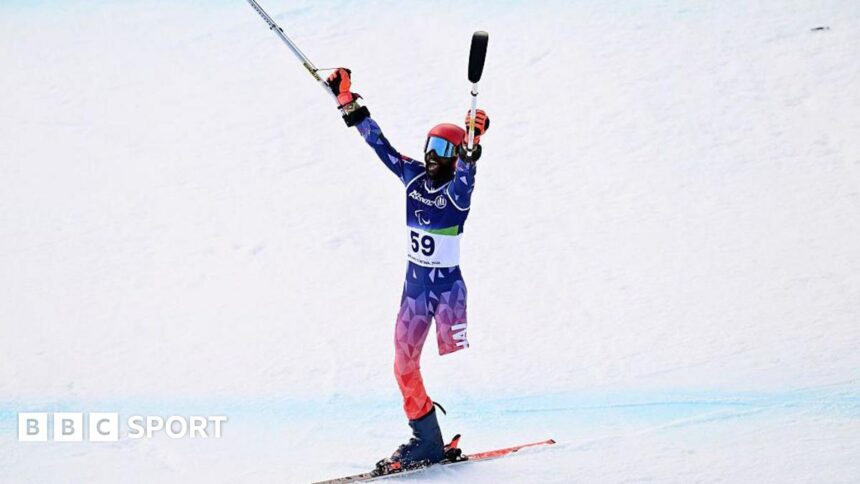
The air is thin, crisp, and biting at the peak of the Dolomites. For Ralf Etienne, each breath here is a stark, beautiful contrast to the thick dust and despair that once filled his lungs. On a world stage built on snow and ice, the man representing Haiti—a nation synonymous with tropical warmth—carves a path that defies every conceivable odd. His presence at the Winter Paralympics is not just a sporting achievement; it is a roaring testament to human resilience, a story of profound metamorphosis written not in ink, but in courage, service, and sheer will. This is the journey of a man who found his highest calling not on a mountain, but buried beneath the rubble of his fallen world.
Trapped in Darkness: A Pivot Point Beneath the Rubble
The narrative of Ralf Etienne cannot be understood without first descending into the darkness of January 12, 2010. A cataclysmic 7.0 magnitude earthquake shattered Haiti, claiming hundreds of thousands of lives and irrevocably altering millions more. Etienne was in a building that became a tomb. For eight agonizing hours, he waited, buried upside down, his left leg mercilessly pinned by concrete and rebar. The physical torment was unimaginable, but in that crucible of suffering, something extraordinary happened. His mind turned outward.
“I decided that if I survived this tragedy, I would live a life to serve people,” Etienne recalls. This pivotal moment is the bedrock of his entire saga. While trapped, his thoughts were not of his own impending death or lost future, but of a promise to dedicate any future he might have to others. Rescued and eventually undergoing an amputation of his left leg above the knee, Etienne didn’t see an end. He saw the difficult, painful beginning of a new purpose.
The Unlikely Path to the Paralympics: Service as a Catalyst
True to his word, Etienne immersed himself in service. He became deeply involved with humanitarian organizations, eventually working with the nonprofit Community Organized Relief Effort (CORE). This work in community rebuilding and disaster response forged his indomitable spirit but did not initially point toward elite sport. The connection was forged through another act of service: volunteering at the 2014 Sochi Winter Paralympics. Witnessing athletes with similar physical challenges compete at the highest level planted a seed.
That seed was nurtured by chance and relentless drive. Relocating to the United States for prosthetic care, he encountered adaptive sports programs in Colorado. On a whim, he tried a monoski. The feeling of freedom, speed, and control on snow was transformative. It married the physical mastery he was rebuilding with the inspirational platform he had witnessed in Sochi. His mission to serve people found a new, global arena: the ski slopes. He would represent Haiti, a nation with no winter sports tradition, to show the world—and his compatriots—what is possible.
His journey to qualification was a solo expedition against logistical and financial mountains:
- Self-Funded Dream: Without a National Paralympic Committee in Haiti for winter sports, Etienne financed his training, travel, and equipment himself, often relying on donated gear and community support.
- Symbolic Representation: He chose to compete in alpine skiing’s downhill and super-G events—the fastest, most daring disciplines—a metaphor for his own life’s trajectory.
- Training Grounds: Balancing his humanitarian work with grueling training sessions, he turned the mountains of Colorado and Europe into his proving grounds, a world away from the Caribbean sun.
Expert Analysis: More Than an Athlete, A Symbol of Global Resilience
From a sports analyst’s perspective, Etienne’s results on the timing sheet are one metric. But his true victory lies in the intangible columns of the ledger. Sports sociologists highlight that athletes like Etienne fundamentally expand the identity and perception of both the Paralympic movement and their home nations.
“He redefines what it means to represent a country,” notes one Paralympic historian. “He isn’t just representing Haiti in skiing; he is representing the spirit of every post-disaster community, every individual who has had to rebuild their body and soul. He carries the Haitian flag not as a claim to winter sports heritage, but as a banner of universal human potential.” His participation is a powerful narrative tool, challenging stereotypes about disability, climate, and opportunity.
Furthermore, his background in disaster response creates a unique profile. He isn’t an athlete who later became an activist; he is a humanitarian who channeled his ethos into sport. This flips the traditional athlete-story arc, making his Paralympic journey an extension of his service, using global media attention to spotlight messages of resilience and preparedness.
The Future Legacy: Predictions for Impact Beyond the Podium
Ralf Etienne’s story does not end at a finish line. His legacy is poised to unfold in multiple, impactful directions:
- Inspiration in Haiti and the Diaspora: He has already become a symbol of “posibilite” (possibility) for Haitians worldwide. His image on the world stage can ignite interest in adaptive sports and challenge perceptions of disability within Haitian culture.
- Advocacy for Disaster Survivors: Etienne is uniquely positioned to advocate for the long-term support of disaster survivors, particularly in accessing rehabilitation and adaptive sports programs as part of holistic recovery.
- Pathfinding for Other Nations: He paves the way for athletes from other non-traditional winter sports countries to pursue Paralympic dreams, potentially changing the face of the Games’ participation map.
- Humanitarian-Sports Nexus: His dual identity may inspire a new model for how athletes can engage in humanitarian work, and how humanitarian workers can utilize sport as a tool for healing and advocacy.
Conclusion: A Summit of the Human Spirit
When Ralf Etienne pushes out of the start gate, he carries with him the weight of a nation’s hopes and the silence of a thousand personal ruins. His race is against the clock, but his victory was secured years ago in the darkness, with a decision to serve. From the unimaginable confines of earthquake rubble to the expansive vistas of the world’s most majestic peaks, his journey traces the highest arc of the human spirit.
He is Haiti’s first Winter Paralympian, but he is also a global citizen of courage. His story teaches us that resilience is not just about rebuilding what was lost, but about constructing something entirely new and purposeful from the pieces. He did not just survive to ski; he survived to serve, and in serving, he found a way to inspire the world. The medals, in this context, are almost incidental. The true podium is the one he built for himself—and for all who witness him—at the summit of human potential, a view forged in perseverance and dedicated to others.
Source: Based on news from BBC Sport.