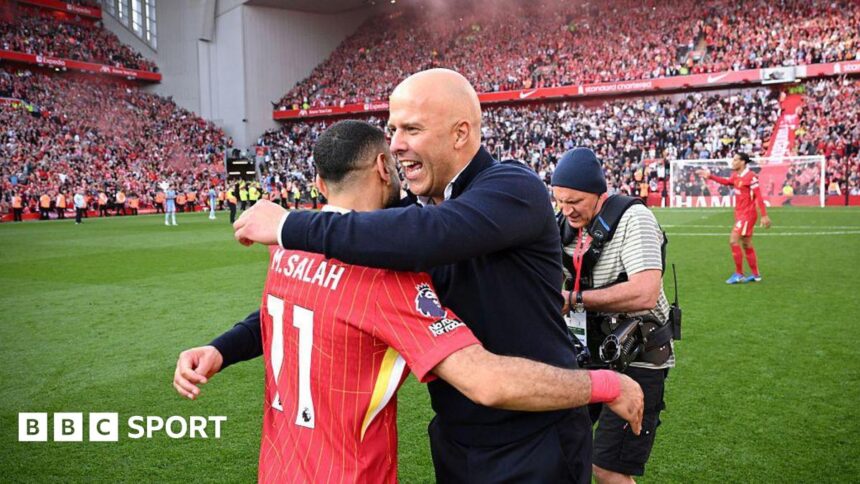
Has the Anfield Chaos Vanished? Examining Liverpool’s New Era Under Arne Slot
The roar at Anfield remains, but its timbre is shifting. For nearly a decade, the soundtrack to Liverpool Football Club was a symphony of orchestrated chaos: the blur of a gegenpressing red wave, the thunderous transition from defense to attack in three passes, the sheer, breathless intensity that overwhelmed rivals and etched itself into legend under Jurgen Klopp. This season, however, a new composition is being rehearsed. Under Arne Slot, Liverpool are still winning, but the method prompts a fundamental question: in trading the ‘heavy metal’ for a more controlled rhythm, have Liverpool lost the very chaotic edge that made them so feared?
The Klopp Legacy: Chaos as a Weapon
To understand the present, one must first appreciate the past. Klopp’s Liverpool was built on a foundation of controlled chaos. It was a psychological and physical blitz. The high line, the ferocious counter-press, the rapid verticality—it was a system designed to create and thrive in moments of pandemonium. Teams knew what was coming, but few could withstand it. This approach delivered every major trophy, including the Premier League and Champions League. Its cost, however, was a physical one. The style was notoriously demanding, leading to periods where the squad, stretched thin by injuries, would hit alarming dips in form. The chaos was both their superpower and their potential kryptonite.
Last season’s title challenge, which ultimately faded in the final weeks, felt like the final, exhausting crescendo of that era. The machine, while glorious, was showing the strain. When Klopp announced his departure, the assumption was that the club would seek a successor to maintain that unique energy. They did not.
The Slot Revolution: A Calculated Pivot
Liverpool’s decision to appoint Arne Slot was a deliberate strategic pivot, not a nostalgic homage. The Dutchman arrived from Feyenoord with a reputation for intelligent, possession-dominant football. His early tenure has confirmed a stark stylistic departure:
- Possession Over Pressure: Slot’s Liverpool prioritizes sustained control of the ball. Build-up is more patient, with a focus on probing and manipulating opposition shapes rather than immediately forcing turnovers through intense pressure.
- Structural Discipline: The famous front-three press has been recalibrated. The pressing triggers are more selective, aimed at maintaining a compact defensive shape rather than hunting the ball en masse at all times.
- Positional Play: There is a greater emphasis on specific positional roles within the system, reminiscent of the Dutch coaching school. This contrasts with the more fluid, role-interchanging freedom Klopp often encouraged.
This shift felt refreshingly new initially. Players like Alexis Mac Allister and Dominik Szoboszlai, technically gifted midfielders, seemed to thrive with more time on the ball. Winning games while expending seemingly less frantic energy was a novel sensation for fans accustomed to the weekly emotional rollercoaster.
The Trade-Off: Control vs. Cutting Edge
Yet, as the season progresses and the battle for Champions League qualification intensifies, the trade-offs of this new approach are becoming evident. The question is whether the gains in control are worth the dilution of a once-deadly identity.
The most glaring concern is the loss of the lethal transitional punch. Under Klopp, winning the ball high often led directly to a chance within seconds. Now, recovering possession often leads to a reset, a circulation of the ball, and a restart of the attacking sequence. The element of surprise—the chaotic moment that paralyzed defenses—has diminished.
Furthermore, the reduced physical burden, while a clear long-term benefit, may have inadvertently softened Liverpool’s psychological edge. Visiting teams at Anfield no longer face the same 90-minute hurricane. They face a sophisticated, but potentially more navigable, challenge. The fear factor, built on that relentless chaos, is under examination.
This is not to say Slot’s approach is inferior. It is different. Its appeal to Liverpool’s data-driven hierarchy is obvious. Notably, during the manager search, Slot ranked second among all candidates for keeping players fit, trailing only Ruben Amorim. In an era of packed schedules, a sustainable model that minimizes muscular injuries is a powerful asset. The gamble is whether this model can achieve the same peak results as its predecessor.
The Verdict and The Road Ahead
So, have Liverpool lost their chaotic edge? The evidence suggests yes, and it appears to be a conscious, strategic sacrifice. The anarchic waves that defined an era have receded, replaced by a more measured tide. The pressing question is whether this new version can be as successful.
Predicting the future of this project hinges on several key factors:
- Squad Evolution: Slot’s system may require a different profile of player. Does the current squad have the perfect technicians to break down low blocks consistently? The summer transfer window will be highly revealing.
- Big-Game Mentality: Can Slot’s controlled style dominate in the high-stakes, frantic atmospheres of Champions League knockouts or title-deciding derbies? This remains unproven.
- Hybrid Potential: The most exciting prospect is a fusion. The greatest teams can toggle between gears. Slot’s challenge is to instill his control while re-integrating a selective, potent chaos—the ability to suddenly shift into that old, devastating mode when a game demands it.
The transition was never going to be seamless. Klopp’s shadow is colossal, and his style was emotionally bonded to the club’s modern identity. Arne Slot is not here to be a tribute act; he is an architect building a new stadium on hallowed ground. The foundations are of stability and sustainability.
The conclusion is not that Liverpool are worse, but they are undoubtedly different. The chaotic edge that made them so uniquely feared has been sheathed, for now. In its place is a sharper, more calculated blade. Whether this blade can cut as deep, and win as much, will define the Slot era. The fear may have mutated from frenzy into a cold, relentless control. Only time will tell if that is a more formidable weapon. The revolution at Anfield is not being televised with screaming guitars; it’s being conducted with a metronome. The league, and Europe, are watching to see if the new rhythm can still bring the house down.
Source: Based on news from BBC Sport.