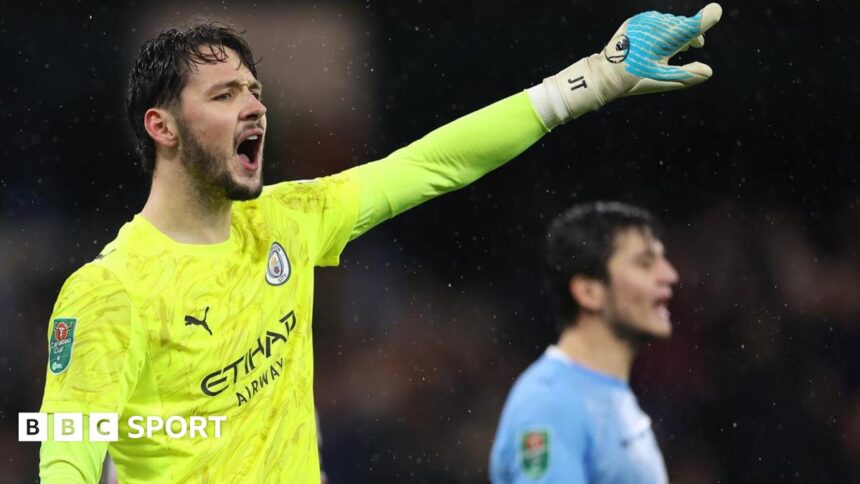
James Trafford at a Crossroads: Should the Man City Keeper Stick It Out or Seek a Move?
The life of a backup goalkeeper at an elite football club is a peculiar purgatory. One day, you’re preparing for a Carabao Cup quarter-final, the manager publicly affirming your place between the sticks. The next, you’re watching your rival polish a “FIFA Best” award, a stark monument to the immovable object now blocking your path. For James Trafford at Manchester City, this is the daily reality. After a promising start that saw him keep three clean sheets in seven games, his season has been recalibrated by the seismic arrival of Gianluigi Donnarumma. The question now echoing from the Etihad stands to the national press is blunt: should the highly-rated Englishman endure this high-profile apprenticeship, or is his future best served elsewhere?
The Promise and The Precipice: Trafford’s City Journey
James Trafford’s story is one of prodigious talent meeting almost absurdly steep competition. A product of City’s academy, he honed his craft on loans at Accrington Stanley, Bolton Wanderers, and Burnley, returning last summer with the aura of a player ready for the next step. With Ederson’s departure, the door creaked open. Trafford seized the initial opportunity, his three clean sheets in seven games a solid foundation upon which to build. His distribution, a non-negotiable in a Pep Guardiola side, looked assured; his shot-stopping, confident.
Yet, Manchester City operates in a stratosphere where “solid” is merely the entry fee. In Gianluigi Donnarumma, the club didn’t just sign a goalkeeper; they installed a global institution. A World Cup winner, European Championship hero, and now the holder of the game’s top individual goalkeeping honors, Donnarumma is the definitive modern elite keeper. Trafford’s demotion to the bench isn’t a reflection of failure, but of a club’s relentless pursuit of the absolute best. The dynamic shifted from a battle for the number one shirt to a master-and-understudy arrangement overnight.
The Case For Sticking It Out: Learning in the Crucible
There is a compelling argument for patience. Training daily under Guardiola’s meticulous eye, alongside the likes of Donnarumma, Rodri, and Kevin De Bruyne, is an education unavailable at 99% of clubs. This environment offers unique advantages:
- Elite Mentorship: Learning from Donnarumma’s commanding presence, shot-stopping technique, and big-game mentality is invaluable. It’s a masterclass in existing at the pinnacle.
- Tactical Immersion: Guardiola’s system demands a goalkeeper who is an 11th outfield player. Daily drilling in this philosophy sharpens Trafford’s most marketable skill for top clubs: his passing range and game intelligence.
- Premium Exposure: Cup games and the inevitable rotations in a marathon season will provide platforms. Performing in high-stakes cup knockouts, like the upcoming Brentford tie, is a powerful shop window.
- Inheriting the Throne: Donnarumma is 26. While a long-term fixture, football’s landscape changes rapidly. Being the ready-made, system-trained heir apparent is a strategic position.
As one former Premier League goalkeeper turned analyst noted, “A year in this City system, even as number two, can accelerate a keeper’s development more than two years of regular football in a chaotic, reactive side. The question is whether his career timeline can absorb that pause.”
The Case For a Move: The Clock is Ticking
Conversely, the fundamentals of a goalkeeper’s career scream for minutes. Trafford is 22—not a prodigy, but at the age where potential must crystallize into proven performance. The risks of stagnation are real.
- Stalled Momentum: He left Burnley with his stock high, returning to City as a starter. Losing that status can impact confidence and rhythm, intangible qualities crucial for a goalkeeper.
- International Ambitions: With Jordan Pickford’s grip on the England shirt firm but future challengers emerging, Trafford needs to play. Gareth Southgate’s selection history heavily favors regular starters.
- The “Out of Sight” Danger: Football’s memory is short. Emerging talents at other clubs will seize headlines while Trafford watches from the bench. His valuation and reputation risk plateauing.
- The Psychological Test: Accepting a clear backup role requires a specific mindset. For an ambitious young player who has been a starter, the mental adjustment is significant and not for everyone.
The precedent is also instructive. Look at Arsenal’s Aaron Ramsdale, whose career progression involved moving from Sheffield United to Bournemouth to Arsenal to become a starter, rather than waiting indefinitely at a super-club. Sometimes, a step back for playing time is a leap forward for career trajectory.
Expert Verdict and Future Predictions
So, what should James Trafford do? The optimal path likely lies in a nuanced middle ground—a committed short-term stay followed by a strategic decision.
The January window is likely too soon for a move. He should embrace the remainder of this season, attack every cup appearance, and absorb everything from Donnarumma and Guardiola. This period is an intensive finishing school. However, next summer becomes critical. If a clear pathway to reclaiming the number one spot at City appears implausible—and with Donnarumma’s age and pedigree, it likely will—then Trafford and his representatives must engineer a move.
The ideal destination would be a progressive Premier League side or a top European club where his ball-playing attributes are essential, not a luxury. Clubs like Brighton, Newcastle, or a Bundesliga side like Leipzig could be perfect fits. A well-negotiated deal could even include a buy-back or first-option clause for City, protecting their investment and giving Trafford a safety net.
Conclusion: A Defining Career Choice
James Trafford’s predicament encapsulates the modern footballer’s dilemma: the allure of elite glory versus the imperative of personal growth. He cannot play left-back; he cannot reinvent himself as an outfield player to find minutes. His position is uniquely binary—you play, or you don’t.
While “sticking it out” at the Etihad offers an unparalleled education, the ultimate purpose of that schooling is to play football at the highest level. For a goalkeeper of Trafford’s caliber and age, the bench, even a gilded one, is a place of temporary residence, not a home. The coming months should be treated as a final, intensive module of his development. Then, with the lessons learned from Pep and Gianluigi etched into his game, he must make the brave but necessary leap to become the main man elsewhere. His talent, and English football, will be better for it. The clean sheets he keeps must be his own, not just those he watches from the sidelines.
Source: Based on news from BBC Sport.