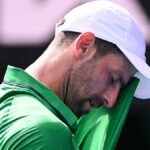
Djokovic’s Bizarre Path to Semis: Musetti’s Agony Halts Historic Upset Bid
The roar of the Rod Laver Arena crowd was not for a thunderous ace or a impossible passing shot. It was a collective, gut-wrenching gasp of sympathy and stunned disbelief. Lorenzo Musetti, two sets to the good and outplaying a legend, pulled up lame. Novak Djokovic’s quest for a historic 25th Grand Slam title remains alive, but it advanced to the Australian Open semi-finals not with a bang, but through a heartbreaking whimper. This was not a victory; it was a surreal survival, a narrative of sporting cruelty that left everyone—victor, vanquished, and spectator—feeling hollow.
A Tale of Two Matches: Musetti’s Brilliance, Djokovic’s Unraveling
For the first two sets, this was Lorenzo Musetti’s masterpiece. The Italian, seeded 25th, played with a fearless, artistic flair that completely disarmed the world number one. His single-handed backhand, a weapon of both grace and venom, painted lines and opened the court. Djokovic, in stark contrast, was a portrait of frustration. His groundstrokes lacked their trademark depth and precision, spraying uncharacteristic errors. He berated his team in the player’s box, his body language screaming irritation. The Novak Djokovic Grand Slam drought since the 2023 US Open seemed to weigh heavily, morphing into palpable pressure as Musetti’s confidence soared.
The statistics were damning. Djokovic’s serve was neutralized, his movement appeared a step slow, and Musetti’s variety—drop shots, topspin lobs, angled drives—kept the Serb perpetually off-balance. The Australian Open semi-finals, a stage Djokovic has owned with 10 titles, suddenly looked like a bridge too far. The crowd, initially neutral, began to rally behind the underdog’s scintillating play. The upset of the tournament was being authored in real time.
The Cruel Twist: A Dream Dashed by Physical Betrayal
Then, the pivot. Early in the third set, after a gruelling rally, Musetti’s movement changed. A slight hitch became a pronounced limp. The explosive spring in his step vanished. He called for the trainer and took a medical timeout for what was later revealed as a right adductor issue. When he returned, his serve was a shadow of its former self, his movement to his forehand side severely compromised. Djokovic, ever the predator, seized the opportunity, holding and then breaking to lead 3-1. The fight was gone from Musetti’s body. He walked to the net, offering a hand and a resigned smile. The Musetti injury retirement turned a potential career-defining win into a devastating “what if.”
This moment underscores the brutal physical demands of best-of-five-set tennis. Musetti was not just winning; he was dominating through a style that requires immense physicality. The very shots that built his lead—the explosive changes of direction, the lunging retrievals—may have exacted the ultimate cost. His retirement was a sobering reminder that in the gladiatorial arena of a Grand Slam, the body is as critical a weapon as the racket.
Expert Analysis: Djokovic’s Form and the Road Ahead
Djokovic’s post-match demeanor was one of relief, not celebration. “He was the better player for two sets,” he admitted. This admission is the most telling analysis of the match. For Djokovic, the questions now are more urgent than the answers.
- Physical Condition: Djokovic has been managing a wrist issue and appeared to struggle with his own movement and energy levels. Can his 36-year-old body recover in time for the semi-final?
- Mental Fortitude: The Djokovic scrapes into semis narrative is one of escape, not dominance. While his mental strength is legendary, playing from behind against in-form opponents like Jannik Sinner or Daniil Medvedev is a dangerous game.
- Level of Play: His game is currently riddled with unforced errors and a vulnerable serve. To win a 25th major, a significant and immediate elevation is required.
This match exposed a rare vulnerability. Opponents in the final four will have watched Musetti’s blueprint: attack the Djokovic forehand, use variety, and avoid extended backhand cross-court rallies. The invincible aura has been pierced, even if the result ultimately went his way.
Predictions: A Gifted Passage or a Poisoned Chalice?
Advancing in this manner is a double-edged sword. On one hand, Djokovic gains an extra day of rest, conserving energy for the final weekend. He avoided a draining five-set battle. On the other, he was denied the chance to battle through adversity on his own terms and find his rhythm. He enters the semi-final with his form a major question mark, not with momentum.
For Lorenzo Musetti, the future is bright despite the acute pain. He proved he can not only compete with, but outplay, the very best on the sport’s biggest stages. This performance will serve as a benchmark. If he can maintain this level and build physical resilience, he is a surefire future top-10 player and Grand Slam contender. The Musetti injury retirement is a setback, but his talent is now undeniable.
Conclusion: History Awaits, But the Path is Now Perilous
Novak Djokovic remains in the draw, his destiny of a standalone record 25th Grand Slam singles title still within reach. Yet, the journey to that milestone has become infinitely more complicated. His passage to the final four was gifted by circumstance, not seized by supremacy. The Musetti match revealed a champion searching for his best self, vulnerable to inspired and aggressive play.
The Australian Open 2024 will now be remembered for the surreal quarter-final where the winner was outplayed and the loser announced his arrival as a genuine force. Djokovic lives to fight another day, but the warning shots have been fired. The chase for 25 continues, but it is no longer a coronation march. It is now a gritty, precarious scramble, and the tennis world has seen that the king, for the moment, is beatable. The semi-finals will test not just his skill, but the very heart of his champion’s spirit.
Source: Based on news from BBC Sport.