The Six-Yard Scrum: How Football’s Lawmakers Can Fix Premier League Corner Chaos
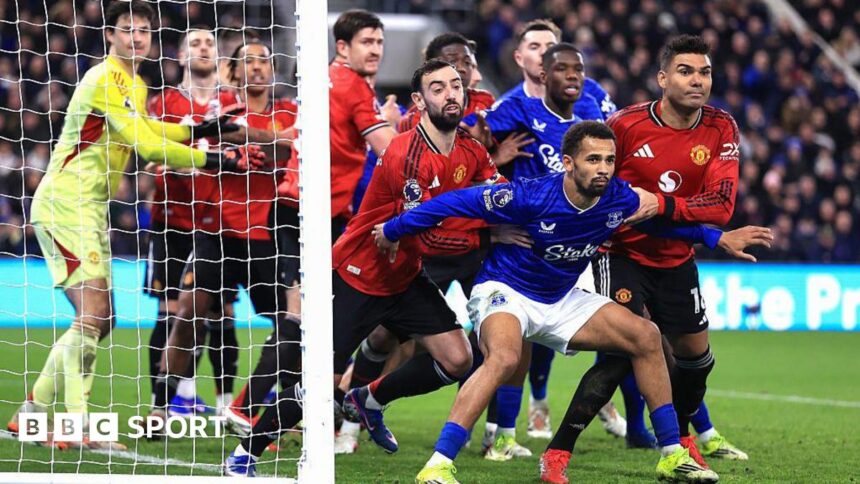
The scene has become a Premier League staple. As the taker strides towards the ball, the penalty area transforms not into a chessboard of strategic runs, but a rugby maul. Shirts are stretched, bodies are locked, and a frantic, clandestine battle of holding, shoving, and grappling unfolds. The recent clash between Everton and Manchester United was a prime example, with players from both sides camped permanently inside the six-yard box, engaged in a wrestling match that often overshadowed the football. While set-pieces are yielding more goals than ever, the means to those ends are verging on the farcical. As former Premier League assistant referee Darren Cann warned the BBC, “something needs to be done.” The question for football’s lawmakers at the International Football Association Board (IFAB) is not if, but how, to restore order from the corner chaos.
The Anatomy of the Box: Why Chaos Reigns
To understand the solution, we must first diagnose the problem. The current state of the corner kick is a perfect storm of tactical evolution, physical prowess, and perceived refereeing permissiveness. Defensive zonal marking has evolved into aggressive pre-emptive grappling. Defenders, tasked with guarding a zone, now feel compelled to initiate contact the moment an attacker enters their space, fearing a free run and a simple header. Conversely, attackers, particularly powerful target men, initiate their own obstruction, backing into defenders and using their strength to create a sliver of space.
The result is a mutual, often pre-meditated, breach of Law 12. The law is clear: impeding an opponent with contact is an offence. Yet, in the crowded, high-stakes environment of a Premier League corner, referees face an impossible calculus. To blow for a foul for every infringement would see a penalty awarded on almost every delivery, decimating the flow of the game and inviting accusations of inconsistency. This has created a de facto acceptance of a certain level of contact, a grey area that players and coaches have ruthlessly expanded. The psychological warfare begins long before the kick, with players jostling for position, testing the official’s tolerance. It’s a high-risk, high-reward strategy where the risk of a penalty call is often outweighed by the reward of neutralizing a lethal aerial threat.
Potential Solutions: From Simple Enforcement to Radical Overhauls
Fixing the corner chaos requires a multi-pronged approach, balancing immediate enforcement with potential long-term law changes. IFAB and refereeing bodies like PGMOL in England have several levers they can pull.
1. The “Zero-Tolerance” Directive & VAR Clarity
The most straightforward solution is a concerted crackdown, mandated from the top. A pre-season directive to match officials, backed by public communication, stating that pre-emptive holding and grappling will be penalized, could reset expectations. This must be coupled with a clear mandate for Video Assistant Referees (VAR). Currently, VAR rarely intervenes on penalty box grappling unless it is deemed “clear and obvious.” Changing that protocol to actively review and recommend checks for holding offences on corners would be a game-changer. The threat of a retrospective penalty, even after a goal is scored or cleared, would be a powerful deterrent.
2. The “Six-Yard Box Sanctuary” Rule
A more radical, but intriguing, proposal is to legislate specific areas. One idea is to make the six-yard box a offensive player-only zone until the ball is in play. Defenders would be required to station themselves outside this area, preventing the initial, congested scrum. This would give attackers a clear run for near-post deliveries and force defenders to attack the ball from a deeper starting position, prioritizing movement over obstruction. Alternatively, a rule could prevent any player, attacker or defender, from stationing themselves inside the six-yard box for more than three seconds before the kick is taken, forcing constant movement and breaking up static grappling.
3. The “Offensive Obstruction” Crackdown
Any solution must be even-handed. While defenders are often the initial culprits, attackers are equally guilty of initiating contact and blocking runs. A simultaneous crackdown on attackers who back into defenders, throw arms, or use their bodies as shields would legitimize the enforcement. This would clean up the entire phase of play, not just shift the advantage from one side to the other. Referees would need to be empowered to award free-kicks *out* for attacking obstruction, a currently rare occurrence.
- Key Enforcement Levers:
- Pre-Season Mandate: A clear, public directive from PGMOL/IFAB on tolerance levels.
- Proactive VAR Protocol: Instructing VAR to specifically review holding in the penalty area.
- Dual-Pronged Focus: Penalizing both defensive holding AND attacking obstruction equally.
- Strategic Positioning Rules: Exploring spatial restrictions (like the six-yard box) to break congestion.
The Ripple Effect: Tactical Evolution and Predictions
Any meaningful change will send shockwaves through tactical departments. A successful crackdown would likely see a shift away from pure zonal marking towards more dynamic, movement-based defending. Defenders would need to be more agile and better at reading the flight of the ball, rather than relying on physical suppression. We could see a renaissance of the clever, near-post flick-on and more inventive short-corner routines as teams look to bypass the congested middle entirely.
Conversely, if the “six-yard box sanctuary” rule were adopted, it would become a striker’s paradise, likely leading to an even greater emphasis on having a dominant aerial presence. The predictions are clear: the initial period after a clampdown would be messy, with a likely spike in penalty awards as players test the new boundaries. But after a short adjustment period, a new, cleaner meta would emerge. The spectacle would improve—goals would come from athletic leaps and clever movement, not from who best survived the hidden shirt-pull.
Conclusion: Restoring the Art of the Set-Piece
The corner kick chaos is not an insoluble problem; it is a failure of consistent application. The laws, as written, are sufficient. The challenge has been the collective willingness to enforce them in the game’s most pressurized moments. Darren Cann’s call to action is correct. The path forward requires courage from IFAB and refereeing bodies: the courage to issue a clear mandate, the courage to empower VAR to police the penalty box scrum, and the courage to withstand the inevitable early-season controversy.
The goal is not to sanitize football of its physicality, but to restore its integrity. A corner should be a test of aerial ability, timing, and tactical ingenuity, not a test of strength in illicit holding. By drawing a bright, enforceable line, lawmakers can reclaim the six-yard box from the wrestlers and return it to the footballers. The result would be a fairer, more dynamic, and ultimately more beautiful game—where the drama comes from the flight of the ball, not the fraying of a jersey.
Source: Based on news from BBC Sport.