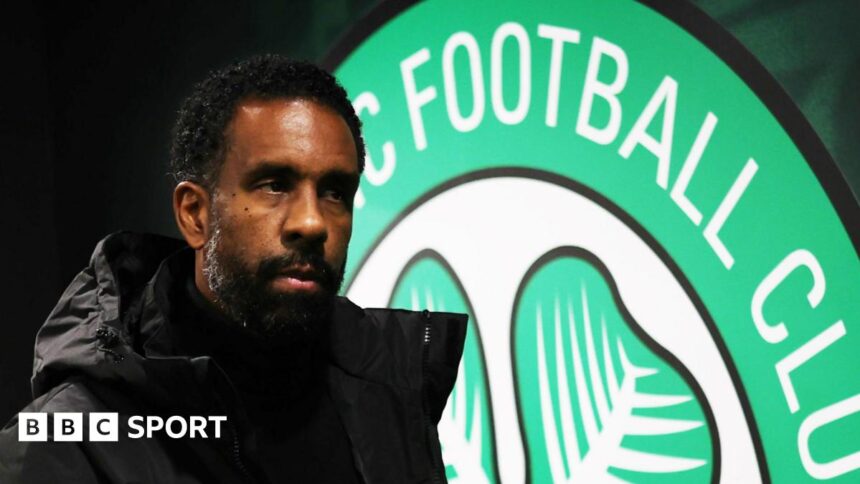
Wilfried Nancy at Celtic: The Anatomy of a 33-Day Calamity
The history of Celtic Football Club is etched with legendary managers who built dynasties, won European Cups, and became immortal in the eyes of the support. Now, it bears a new, stark entry: Wilfried Nancy, the manager whose tenure was so brief and so disastrous it redefines the concept of a false dawn. Lasting a mere 33 days and encompassing just eight matches, Nancy’s reign wasn’t just a failure; it was a spectacular, record-setting implosion that has left Scotland’s most successful club in a state of profound shock and introspection. This is the story of how a promising appointment from MLS unravelled with breathtaking speed.
A Bold Gamble That Backfired Instantly
When Celtic announced the appointment of Wilfried Nancy on a three-year deal, following the steadying interim spell of club legend Martin O’Neill, it was framed as a progressive, forward-thinking move. Here was the architect of Columbus Crew’s aesthetically pleasing MLS Cup-winning side, a coach lauded for his tactical intellect and modern methods. The Celtic board, seeking a long-term project after a turbulent season, saw a visionary.
Yet, the cracks appeared before the ink was dry. Nancy’s introductory press conference raised eyebrows, with his focus on complex philosophical concepts seeming detached from the immediate, trophy-demanding reality of Glasgow. While his passion was evident, a nagging question emerged: was this a project manager walking into a results business at its most ruthless? The answer would be delivered with brutal efficiency on the pitch.
The Unraveling: Eight Games of Chaos
Nancy’s philosophy, which worked so beautifully in MLS, translated as chaotic vulnerability in Scotland. His insistence on a hyper-expansive, possession-based system, with full-backs inverting into midfield and a high defensive line, was picked apart by opponents of all calibres. The squad, assembled by previous regimes, looked utterly alien to its core principles. The result was a statistical nightmare:
- Eight games in charge, yielding a solitary win against a lower-league side.
- Six defeats, including humiliations in the early domestic cup rounds.
- A defensive record that conceded 18 goals, showcasing a team perpetually caught in transition.
- The shortest managerial reign in the 136-year history of Celtic Football Club.
Beyond the results, the performances were alarmingly disjointed. Players appeared confused, with senior professionals publicly expressing bafflement at tactical instructions. The infamous image of Nancy using a mini-tactics board on the touchline during a 4-0 drubbing became a potent symbol of a coach unable to communicate or adapt his ideas in the heat of battle.
Off-Pitch Distractions and a Loss of the Dressing Room
As losses mounted, scrutiny intensified beyond the touchline. Nancy’s social media activity, where he liked posts critical of the club’s board and certain players, was seen as a catastrophic misstep, eroding trust at the very moment he needed unity. This digital indiscretion fueled a media firestorm and reportedly severed his relationship with key figures in the dressing room.
The contrast with his predecessor, Martin O’Neill, was devastating. Where O’Neill had simplified the message and instilled fight, Nancy’s complex ideas bred uncertainty. Where O’Neill understood the cultural weight of the jersey, Nancy’s project-speak felt academic. The loss of the Celtic dressing room was swift and total. When players stop believing, the end is inevitable. For Nancy, that point arrived barely a month after his arrival, culminating in a terse club statement that ended the briefest of eras.
Expert Analysis: What Went Wrong and What Comes Next?
From a tactical perspective, Nancy’s failure is a classic case of ideological stubbornness. His system requires specific, technically-gifted players in every position, particularly in defence. He attempted to implement it with a group not recruited for that purpose and with zero pre-season integration. In the relentless, physical, and error-punishing environment of Scottish football, it was a recipe for disaster.
The broader failure, however, was one of due diligence and cultural fit. Did the Celtic board truly vet how Nancy’s methods would translate? Did Nancy himself fully grasp the monumental, immediate expectations? The evidence suggests not. This was a catastrophic mismatch of timing, philosophy, and environment.
Looking ahead, Celtic’s next move is critical. The club cannot afford another project. The immediate need is for a stabiliser, a manager who can command respect, organise a shattered defence, and reconnect the team with a furious fanbase. Names like Roy Keane, despite his lack of recent experience, or a proven domestic operator like Derek McInnes, will be touted as they represent a known quantity of grit and organisation. The board’s credibility is on the line; they must now prioritise proven resilience over projected philosophy.
Conclusion: A Cautionary Tale for the Modern Game
Wilfried Nancy’s 33-day reign at Celtic will be remembered not as a blip, but as a blueprint for how not to execute a managerial appointment. It was a perfect storm of naive boardroom ambition, a manager’s tactical inflexibility, and a stark cultural clash. Nancy, a talented coach in the right context, was utterly consumed by the unique pressures of Glasgow.
His legacy is one of broken records and a club left more adrift than when he arrived. For Celtic, the inquest will be long and painful. For the wider football world, it serves as a stark reminder that the most sophisticated tactics are worthless without the foundational elements of man-management, adaptability, and an acute understanding of the club’s soul. The Nancy experiment is over. The daunting task of picking up the pieces has only just begun.
Source: Based on news from BBC Sport.