‘I Do What’s Best for the Team’: Guardiola’s Defiant Stance After Real Madrid Defeat
The glare of the Santiago Bernabéu is unforgiving. It exposes every flaw, magnifies every tactical gamble, and often, it demands an explanation. In the wake of Manchester City’s sobering 3-0 defeat to Real Madrid in the Champions League last-16 first leg, the spotlight turned not just on the players who struggled on the pitch, but on the architect who sent them out there. Pep Guardiola, a man whose team selections are usually lauded as preternaturally clever, found himself in a rare and defensive posture, his philosophy questioned after a bold rotation backfired spectacularly.
The Gamble in Madrid: Seven Changes and a Stark Consequence
Just days after a commanding FA Cup victory over Newcastle United, Guardiola reshuffled his deck for the ultimate club competition. He made seven changes to his starting line-up, a staggering number for a match of this magnitude. In came the likes of Stefan Ortega, Manuel Akanji, and Rico Lewis, while key figures were rested or deployed in unfamiliar roles. The intention, as any follower of Guardiola’s career will attest, was rooted in his deep belief in the collective and in managing a grueling schedule.
Yet, at the Bernabéu, the plan unraveled. City lacked their typical rhythmic control, appearing uncharacteristically disjointed and vulnerable to Madrid’s devastating transitions. The 3-0 scoreline, built on goals from Rodrygo and a Joselu brace, was not a fluke; it was a systematic dismantling of a City side that seemed unsure of itself. The post-match narrative was set: had Guardiola’s rotation cost his team their Champions League crown?
A Tense Exchange: Guardiola’s Unwavering Defense
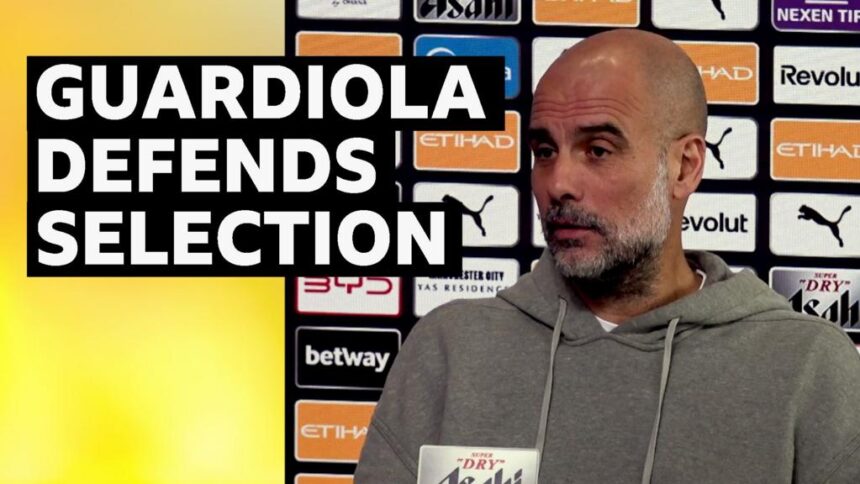
The question was inevitable, and it came days later before City’s Premier League trip to West Ham. When a reporter probed if he was happy with his team selection in Spain, Guardiola’s response was swift and pointed, revealing the tension beneath his usually calm exterior.
“I do what’s best for the team,” he stated, his tone leaving little room for debate. He expanded, framing the decision within the relentless context of the modern football calendar. For Guardiola, the match in Madrid was not an isolated event but the second of three brutal away games in a week. His calculus involved the physical preservation of his squad for the entirety of the campaign, not just one legendary venue.
This tense exchange with a reporter was more than just a touchy press conference moment. It was a fundamental clash of perspectives:
- The Journalist’s View: The Champions League knockout stages are sacrosanct; you must always field your absolute strongest XI.
- Guardiola’s View: The team is a living organism that must be managed over 60+ games; trust in the entire squad is non-negotiable.
Guardiola’s irritation stemmed from what he perceives as an oversimplification. He sees the marathon where others fixate on the sprint.
Expert Analysis: Deconstructing the “Pep Roulette”
To dismiss Guardiola’s strategy as mere arrogance is to misunderstand his core coaching identity. His team selection in Spain was a high-stakes iteration of his famous “Pep Roulette,” driven by several factors:
Physical Preservation: The data from City’s sports scientists is paramount. Players like Kevin De Bruyne and Erling Haaland carry immense load, and Guardiola has long believed that a slightly freser, 95%-fit elite player is more valuable over a season than an exhausted 100%-fit one.
Tactical Overthink or Foresight? Critics will label it overcomplication. Supporters will argue he saw a specific tactical battle where energy and specific defensive attributes (like Rico Lewis’s inversion) were crucial. While the result suggests a miscalculation, Guardiola’s successes are built on these very risks.
The Cult of the Squad: Guardiola’s method requires every player to feel essential. By showing faith in Akanji, Lewis, and Ortega in such a game, he reinforces a squad ethos that pays dividends in the dogged days of an April title race. The message is clear: “I trust you all.” This psychological contract, though costly in Madrid, is vital for the long haul.
The Road Ahead: Implications and Predictions for City’s Season
The defeat leaves Manchester City with a monumental, though not impossible, task in the second leg at the Etihad. A 3-0 deficit against the 14-time European champions is a dire situation, but this City side is capable of historic performances at home.
Prediction for the Return Leg: Expect a ferocious, possessed Manchester City from the first whistle. Guardiola will undoubtedly revert to his most proven big-game XI. The key will be an early goal to ignite belief and unsettle Real’s calm. However, Madrid’s counter-attacking threat will be even more potent with space to exploit. The prediction is a valiant City victory on the night, but one that may fall agonizingly short of overturning the aggregate deficit, leading to a heartbreaking exit.
Impact on the Premier League Title Race: Ironically, Guardiola’s controversial rotation could yet yield its intended benefit. With fresher legs for the clash at West Ham and beyond, City may find the sharpness needed to overhaul Arsenal and Liverpool in a tight title race. The gamble may have been for the Premier League crown all along.
Conclusion: The Unshakeable Philosophy of Pep
The debate surrounding Pep Guardiola’s Champions League defeat by Real Madrid cuts to the heart of modern football management. In an era of instant reaction and result-based analysis, Guardiola operates on a different plane, one of process, faith, and holistic season management. His terse defense, “I do what’s best for the team,” is not a deflection but a manifesto.
While the scoreline at the Bernabéu stands as a stark indictment of the gamble’s immediate failure, the final chapter of this season remains unwritten. If City, fueled by the fury of that night and with a healthier squad, storms to a fourth consecutive Premier League title, Guardiola will view his decision as a painful but necessary step in that journey. The defeat in Madrid may be a catastrophic error or a costly but calculated sacrifice in a wider war. For Pep Guardiola, a man forever playing the long game, only the final trophy count will provide the definitive answer. His philosophy, for better or worse, remains unshakeable.
Source: Based on news from BBC Sport.