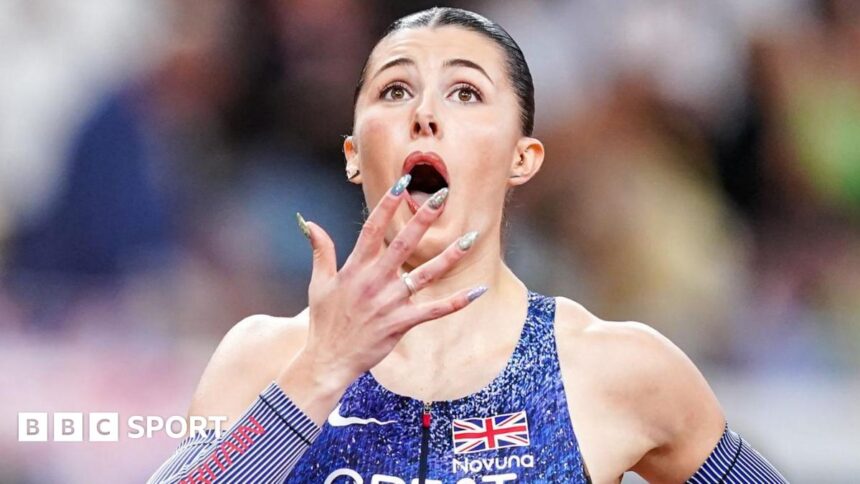
‘I thought I’d be bleeped by BBC’ – How Amy Hunt’s ‘Academic Badass’ Mantra Redefined the Game
The moment a world-class athlete crosses the line, a lifetime of sacrifice, discipline, and singular focus crystallizes into raw, unfiltered emotion. For Amy Hunt, that moment arrived on a Tokyo track, the silver medal around her neck finally validating a journey far more complex than the 200-meter straight. But it wasn’t the gleaming metal that sparked a conversation. It was the spontaneous, adrenaline-fuelled declaration that followed—a quote she worried would be “bleeped” by the BBC. “You can be an academic badass and a track goddess,” she proclaimed, beaming into the camera. In one brilliant, unscripted line, Hunt didn’t just summarize her path; she shattered a pervasive, limiting myth in elite sport.
The Weight of a World Record and a Worry
Long before global silver, Amy Hunt was a prodigy. As a junior, she shattered the under-18 200m world record, a feat that instantly stamped her as Britain’s next sprinting hope. Yet, even then, a dual identity was at play. Hunt was not just a runner; she was a dedicated student, her intellect burning as brightly as her speed. The pressure to conform to a single, easily-defined narrative—the full-time athlete—is immense in the high-stakes world of track and field. For years, Hunt navigated this tension, often feeling she occupied two separate worlds that the sporting ecosystem struggled to reconcile.
The now-iconic quote was born from this duality. Printed on a T-shirt given to her by her mother, the phrase “academic badass and track goddess” was a private source of motivation. Yet, voicing it on national television felt risky. “I thought I’d be bleeped by the BBC,” Hunt later admitted, revealing an ingrained expectation that such a multifaceted message might be too unconventional, too disruptive to the traditional athlete archetype. Her worry speaks volumes about the boxes we still place athletes in, where intellectual prowess is often seen as a secondary storyline, if mentioned at all.
Beyond the Podium: The Sacrifice of the Shirt
In a poignant twist, Hunt has revealed she may no longer feel able to wear the physical T-shirt that bore the mantra. Its message, now public property and etched into her legacy, carries a weight that perhaps changes its personal meaning. The shirt’s retirement symbolizes a sacrifice—the relinquishing of a private totem for a public cause. But as Hunt’s words reverberated across social media and sports commentary, it became undeniably clear: the impact was worth the sacrifice.
The resonance was immediate and profound. The quote did more than describe Hunt’s Cambridge University graduate status alongside her world-class speed. It served as a permission slip for a generation of young girls and boys. It challenged the false choice between the library and the track, between the mind and the body. In an era where young athletes are often pressured to specialize early and sacrifice holistic development, Hunt’s success became a powerful case study in the synergy of diverse passions.
- Redefining “Full-Time Athlete”: Hunt proved that dedication to sport does not require intellectual compromise.
- Mental Fortitude from Diverse Pursuits: The discipline of academia likely fortified the resilience needed to overcome years of injury setbacks.
- A Holistic Blueprint for Success: Her path offers a sustainable, identity-rich alternative to the burnout-prone, single-focus model.
Expert Analysis: Why This Message Matters Now
From a sports journalism and development perspective, Hunt’s statement is more than a soundbite; it’s a watershed moment. For decades, the narrative in many sports, particularly women’s sports, has often leaned on simplistic tropes. Hunt’s world 200m silver in Tokyo was earned not in spite of her academic rigour, but arguably because of the structure, perspective, and cognitive strength it cultivated.
“What Hunt has done is critically important for the future of athlete welfare and performance,” says Dr. Sarah Jones, a sports psychologist specializing in dual-career athletes. “She has publicly validated a model of development that fosters a robust sense of self beyond sport. This is a key protective factor against the mental health crises we see when athletic identity is all-consuming. Her ‘corny’ quote is, in fact, a profoundly sophisticated manifesto for a healthier, more resilient sporting culture.”
Furthermore, in the commercial landscape, Hunt’s persona breaks the mold. Brands now have an authentic, multi-dimensional figure to champion—one who appeals not just to sports fans, but to educators, parents, and young people navigating their own multifaceted lives. She represents a new kind of role model for young girls, one whose authority comes from her intellect as powerfully as it does from her podium finishes.
Predictions: The Legacy of the “Academic Badass”
The ripple effects of Hunt’s Tokyo declaration will be felt for years. We can anticipate several key shifts:
1. The Rise of the Dual-Career Narrative: Expect more athletes to openly pursue and champion parallel paths in education, business, and the arts without fear of being seen as less committed. Sporting federations will face increasing pressure to support, not just tolerate, these pursuits.
2. A New Marketing Archetype: The “Track Goddess” who is also a “Badass” in other fields will become a powerful and sought-after brand image, moving beyond traditional endorsements into spaces like tech, literature, and leadership.
3. Impact on Grassroots Participation: For parents and coaches, Hunt’s journey provides a compelling argument against early specialization. Her story will be used to encourage young athletes to maintain broad interests, protecting their long-term development and well-being.
For Hunt personally, this philosophy may be her greatest weapon moving forward. The demanding path to a global podium is fraught with physical and mental challenges. Having an identity and a future firmly rooted beyond the track provides an invaluable stability, a north star when the storms of injury or form inevitably hit.
Conclusion: More Than a Medal, A Movement
Amy Hunt’s silver medal will forever be listed in the record books. But her true legacy was captured in the seconds after the race, in a quote born from a personal T-shirt and a lifetime of defying categories. By fearing she’d be “bleeped,” she accidentally highlighted the very limitation she was breaking. Her words resonated because they were desperately needed.
In declaring you can be an “academic badass and a track goddess,” Hunt did more than summarize her own comeback. She issued an invitation and a challenge to the sporting world. She invited young athletes to bring their whole selves to the track, and she challenged the institutions around them to make space for that wholeness. The T-shirt may be retired, but the message is now emblazoned on her career. Amy Hunt didn’t just win a medal in Tokyo; she won the argument, and in doing so, she redefined what it means to be a champion for the next generation.
Source: Based on news from BBC Sport.