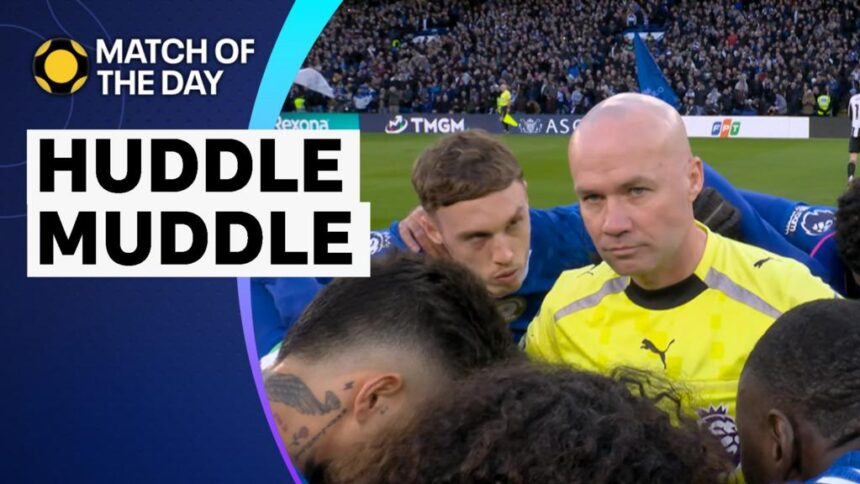
‘I’m as confused as Cole Palmer’: The Curious Case of the Centre-Spot Huddle Intrusion
In the grand theatre of the Premier League, where narratives are forged in goals, gaffes, and glory, a new, utterly bizarre subplot emerged before a ball was even kicked. As Chelsea prepared to face Newcastle at Stamford Bridge, a peculiar pre-match ritual was interrupted not by an opponent, but by the man in black. Referee Paul Tierney’s decision to stand guard over the match ball, placing himself squarely inside Chelsea’s team huddle, has left pundits, players, and fans scratching their heads. The incident, dissected on Match of the Day, has sparked a debate that stretches far beyond the touchline, questioning the very boundaries of a referee’s role.
A Puzzling Prematch: The Incident That Baffled MOTD
The scene was set for a crucial Premier League clash. Chelsea’s players gathered in their final pre-match huddle on the centre circle, a routine act of unity and tactical finalisation. Yet, as they closed ranks, referee Paul Tierney remained rooted to the spot, the official match ball at his feet, physically embedded within the circle of blue shirts. The resulting image was surreal: a referee appearing to be an uninvited participant in a private team moment.
On BBC’s Match of the Day, the confusion was palpable. Former Wales captain Ashley Williams summed up the national sentiment, stating, “I’m as confused as Cole Palmer was.” Ex-England goalkeeper Joe Hart echoed the bewilderment, questioning the logic behind Tierney’s actions. The pundits were united in their perplexity, unable to decipher a legitimate sporting reason for the official’s intrusive stance. Was he protecting the ball’s integrity? Preventing a clandestine switch? The explanations seemed flimsier than a poorly constructed defensive wall.
Expert Analysis: Protocol, Psychology, or Overstep?
To understand the fallout, we must analyse the incident through multiple lenses: protocol, gamesmanship, and sports psychology.
- Refereeing Protocol: There is no known law or directive that mandates a referee to stand within a team huddle pre-kickoff. Their standard duties involve checking player equipment, conducting the coin toss, and ensuring a timely start. Tierney’s action was, therefore, a discretionary one—a personal interpretation of his role that veered into unprecedented territory.
- The Gamesmanship Angle: Some have theorised about potential pre-match mind games. Could Tierney have been acting on a suspicion, however unlikely, of ball tampering? Or was it a pre-emptive strike to assert authority and curb any potential dissent from the first whistle? If so, the move arguably backfired, creating an immediate focal point of tension and confusion rather than calm control.
- Sports Psychology Impact: The team huddle is a sacred space. It’s the final bastion of privacy before the public battle commences. A referee’s presence in that circle fundamentally alters its dynamic. As Liam Rosenior pointed out, it represents a significant refereeing overstep. It disrupts a team’s concentration, their final tactical reminders, and their emotional priming. The intrusion turns a unifying ritual into a public spectacle.
The core of Rosenior’s argument—that the referee should focus on officiating the game, not monitoring huddles—resonates deeply. It highlights a worrying trend of officials potentially over-complicating their remit, seeking to control uncontrollable elements rather than mastering the application of the laws during active play.
Broader Implications: A Slippery Slope for Officiating?
This incident, while seemingly minor, sets a concerning precedent. If referees begin to see their role as encompassing the monitoring of pre-match routines, where does it end? Will officials listen in on tactical instructions during water breaks? Should they patrol the tunnel to overhear team talks?
The MOTD pundit reaction from Williams and Hart is crucial because it reflects fan sentiment. When experts and former pros are left genuinely baffled by an official’s action, it widens the perceived disconnect between match officials and the football culture they serve. It fuels the narrative of referees as distant, unpredictable figures, which in turn can erode respect and amplify hostility during the 90 minutes that follow.
Furthermore, it inadvertently places the referee at the centre of the story—a position they should inherently avoid. The best officiating is often invisible, allowing the players and the game to shine. Tierney, perhaps unintentionally, made himself the headline before a second had ticked on the clock.
Predictions and The Path Forward
So, what happens next? We can anticipate several developments stemming from this curious episode.
- Clarification from PGMOL: The Professional Game Match Officials Limited will likely be pressed for comment. They may issue internal guidance to referees, clarifying that such intrusions are unnecessary and to be avoided, effectively drawing a line under the practice.
- Team Pushback: Managers and captains may become more assertive in politely but firmly asking the referee to step aside before future huddles. This could become a new, albeit unwelcome, part of the pre-match choreography.
- A Lasting Symbol: The image of Tierney in the huddle will endure as an internet meme and a shorthand for refereeing overreach. It will be replayed whenever discussions about official interference arise.
- Focus on the Real Issues: The hope is that this incident refocuses attention on the areas where refereeing clarity is desperately needed: the consistency of VAR interventions, the interpretation of physical contact, and the management of on-field dissent. These are the battlegrounds where officiating credibility is truly won and lost.
Conclusion: Let the Huddle Be
Football thrives on passion, tradition, and moments of collective spirit. The pre-match huddle is a modern embodiment of that. Paul Tierney’s well-intentioned but misguided vigil over a football in the centre of Chelsea’s circle was a solution in search of a problem. As Ashley Williams and Joe Hart rightly highlighted, it created confusion where none needed to exist.
The lesson for officials is clear: trust the protocols, trust the players, and focus on the immensely difficult task of refereeing the game itself. The ball, once the whistle blows, will be in constant motion and subject to far greater threats than any it might face in a pre-game huddle. Respecting the game’s rituals is part of respecting the game. The huddle is for the players. The whistle, the laws, and the match ball once it is in play—that is firmly, and solely, the domain of the referee.
Source: Based on news from BBC Sport.