Iran’s Women’s Football Team: From Silent Protest to Saluting Heroes in a Nation’s Storm
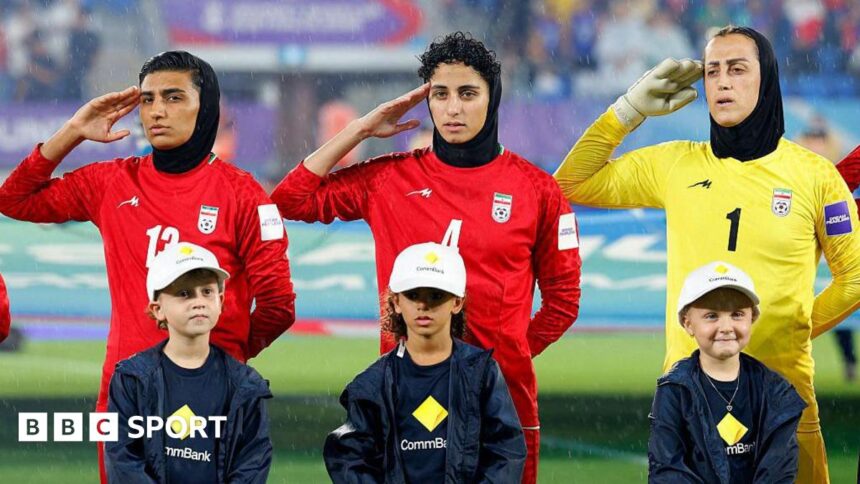
The roar of a football stadium is often a sound of unified national pride. But sometimes, the most powerful statement is made in silence. In early March, the world watched as the Iranian women’s national football team stood, shoulders back and faces solemn, refusing to sing their country’s national anthem before their Asian Cup opener against South Korea. In that quiet defiance, amplified by a backdrop of regional war and domestic turmoil, they embodied a desperate cry for freedom from within. Their subsequent, poignant salute before later matches is not a retreat, but a deeper, more complex chapter in their heroic struggle. This is the story of athletes navigating a political minefield, where a simple gesture transforms them into symbols of a nation’s conscience.
The Weight of Silence: A Protest Heard Around the World
On March 2nd, the Iranian women’s team took the field under a global spotlight that extended far beyond football. Their silent protest was a deliberate and courageous act, directly tied to escalating violence in their homeland. In the days prior, the United States and Israel had conducted strikes on Iranian-linked targets. Iran responded by launching missiles and drones toward Israel and four Gulf Arab states—Bahrain, Kuwait, Qatar, and the United Arab Emirates—countries hosting U.S. military bases.
This geopolitical storm provided the immediate context, but the roots of the protest dig much deeper. The players’ silence echoed the cries of their compatriots during the unprecedented crackdown on anti-government protests just months earlier in December and January. Human rights groups reported a staggering toll: at least 7,000 protesters killed by security forces. For the players, many of whom have large public followings, the anthem had become a symbol they could not, in good conscience, endorse.
“Iran’s women’s football team became ‘heroes’ when they declined to sing the country’s national anthem,” affirmed Afshin Ghotbi, the former head coach of Iran’s men’s national team. His analysis cuts to the core. “In that moment, they were not just athletes; they were the voice of millions of Iranian women and men who seek change,” Ghotbi noted, highlighting how their action transcended sport.
The Salute: Complexity, Pressure, and Unbroken Spirit
The narrative took a nuanced turn in the team’s following matches against Australia and the Philippines. The players sang and saluted during the anthem. Superficial readings might label this a capitulation. In reality, it reveals the immense pressure these women face and the sophisticated tightrope they walk.
The potential consequences for them and their families back in Iran are severe and real. The salute can be seen as a tactical, perhaps enforced, compliance to ensure their safety and their continued presence on the world stage—a platform they desperately need. Their heroism is not diminished by this shift; it is complicated. It demonstrates that their fight is not a single grand gesture, but a sustained campaign of resilience.
- Platform Preservation: By remaining in the tournament, they keep international attention on Iran.
- Personal Risk Management: Direct defiance could lead to imprisonment, bans, or worse for them and loved ones.
- Symbolic Continuity: Their initial silence set the tone. Their continued presence, even under duress, maintains a form of protest.
This duality is the essence of their struggle. They are simultaneously representatives of a state and symbols of resistance against it, a nearly impossible balance that defines the lives of many Iranian women.
Beyond the Pitch: The Battle for Bodily Autonomy and Existence
To understand the magnitude of the football team’s actions, one must view them as part of a decades-long struggle for basic freedoms. Iranian women have been at the forefront of protests against compulsory hijab laws and systemic gender apartheid. The “Woman, Life, Freedom” movement, reignited in 2022, is a testament to this relentless pursuit of dignity.
The footballers’ protest, therefore, is not an isolated political act. It is an extension of the fight for bodily autonomy and the right to simply exist in public space. The stadium is their domain, and by using it to make a statement, they claim agency. They are heroes because they leverage their hard-won athletic status—itself a victory against restrictive policies—to challenge the very system that seeks to control them.
Their courage stands in stark contrast to the regional conflicts orchestrated by the state. While headlines focus on missiles and drones, these women fight a more intimate, equally brutal war for fundamental human rights on home soil. They represent a different vision for Iran, one built on internal freedom rather than external conflict.
Expert Analysis and Future Predictions: What Comes Next?
The trajectory of these athletes will be a critical barometer for Iran. Sports sociologists and Iran analysts point to a grim but inevitable tightening of control. “The state will likely intensify its pre-screening of athletes, enforcing ‘revolutionary values’ more strictly ahead of international competitions,” predicts Dr. Tara Majd, an expert on gender and sport in the Middle East. “We may see quieter, more symbolic forms of protest—specific goal celebrations, armbands, or social media messages—as overt gestures become too dangerous.”
The future likely holds:
- Increased Surveillance: Players will be monitored more closely by sporting bodies aligned with the state.
- The “Exile Option”: More athletes may seek to compete for other nations, draining Iran of its talent and moral authority.
- International Sporting Bodies in a Bind: FIFA and the AFC will face growing pressure to address human rights concerns, potentially leading to sanctions or suspensions that further isolate Iran’s sports.
Ultimately, the genie cannot be put back in the bottle. The Iranian women’s team has shown that the stadium is a political arena. Their silent protest has inspired a generation and signaled to the world that the regime’s grip on its people, especially its women, is perpetually contested.
Conclusion: Heroes in the Long Game
The story of Iran’s women’s football team at the 2024 Asian Cup is a microcosm of a nation’s agony and its indomitable hope. Their journey from silent protest to solemn salute is not a story of surrender, but one of profound strategic complexity. They are heroes not because they won a trophy, but because they carried the hopes of a repressed people onto the global stage amidst bombs and bullets. They remind us that the fight for freedom is rarely a single, explosive victory. It is a marathon of subtle gestures, painful compromises, and unwavering resilience. As long as they step onto the field, they challenge a theocracy with their very presence. They are playing for more than goals; they are playing for the future of Iran, and in that struggle, every silent moment, every tear, every salute is a act of breathtaking bravery. The world is watching, and finally, it is listening.
Source: Based on news from BBC Sport.