Iraq’s World Cup Dream in Jeopardy: Coach Arnold Calls for Play-Off Postponement Amid Regional Conflict
The final, nerve-shredding step to the 2026 FIFA World Cup has become a geopolitical minefield for the Iraqi national team. With a historic inter-continental play-off just weeks away, head coach Graham Arnold has made an urgent plea to football’s governing bodies: postpone the match. The reason is not injury or preparation, but a rapidly escalating war that has shut down the skies and placed the team’s participation—and the safety of its delegation—in serious doubt. This unprecedented situation pits the rigid calendar of global sport against the volatile reality of international conflict, leaving Iraq’s World Cup dream hanging by a thread.
A Coach’s Dilemma: Football Versus Force Majeure
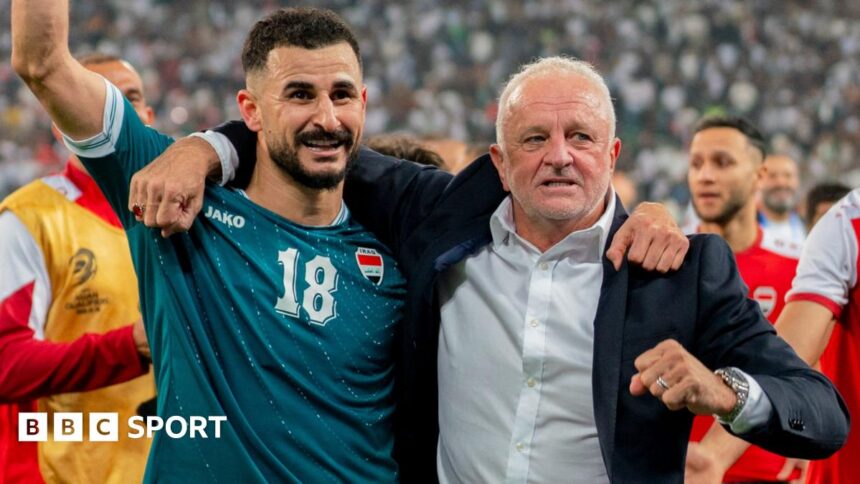
Graham Arnold, the experienced Australian who took the reins of the Iraq national team in 2025, now faces a challenge no coaching manual can address. His squad is scheduled to face the winner of Bolivia vs. Suriname in the Mexican city of Monterrey on March 31st. The prize is monumental: a spot in the expanded 2026 World Cup, co-hosted by the United States, Mexico, and Canada. Yet, Arnold’s focus has shifted from tactical drills to crisis management. “The priority must be the safety and well-being of the players and staff,” Arnold stated in a recent communication. “We are dealing with a force majeure situation that is completely beyond our control.”
The core of the issue is starkly logistical. Iraqi airspace has been closed since February 28th, following the initial US-Israeli strikes and Iran’s subsequent missile and drone responses targeting Israel and Gulf states. This closure has created a near-total travel blockade. While commercial workarounds via arduous land routes to neighboring countries might be theoretically possible, they introduce immense risk, uncertainty, and physical strain on athletes needing to be in peak condition for the biggest game of their lives. Furthermore, securing visas and safe passage for a national team delegation through a region on a war footing is a logistical and diplomatic nightmare.
The Stakes: More Than Just a Game
For Iraq, this play-off represents more than a sporting contest. Qualification for the 2026 World Cup would be a unifying triumph for a nation that has endured decades of conflict and instability. The “Lions of Mesopotamia” carry the hopes of millions, offering a rare source of national pride that transcends sectarian and political divides. The potential economic and inspirational boost of reaching the global stage cannot be overstated.
Conversely, being forced to forfeit or compete at a severe disadvantage due to circumstances entirely unrelated to football would be a cruel injustice. It raises profound questions about equity and access in world sport. FIFA’s statutes acknowledge the need for flexibility in exceptional circumstances, but precedent for postponing a final World Cup qualifier is virtually nonexistent. The governing body must weigh several critical factors:
- Player and Official Safety: The non-negotiable paramount concern.
- Sporting Integrity: Can a fair contest be held if one team undergoes a traumatic, disrupted buildup?
- Calendar Congestion: The global football schedule is a tightly packed machine, with little room for major rescheduling.
- Precedent: Any decision will set a benchmark for how football responds to regional wars.
Expert Analysis: The Precedent and the Pressure
Sports law and logistics experts are closely watching this developing crisis. “FIFA has previously relocated matches or ordered them played on neutral territory due to security concerns, as seen in various African qualifiers over the years,” notes Dr. Liam Carter, a professor of sports governance. “However, a full postponement of a final inter-confederation play-off, with the World Cup itself just months away, is uncharted territory. The travel disruption in the Middle East isn’t just an inconvenience; it’s a legitimate security threat that could prevent the team from departing at all.”
The pressure on FIFA is immense. The opposing federation (CONMEBOL or CONCACAF) and their team will understandably want to maintain the schedule, having earned their place fairly on the pitch. Yet, the court of public opinion and the principles of fair play lean heavily towards Iraq’s plight. Graham Arnold’s very public appeal is a strategic move to apply that pressure, framing the issue as one of basic safety and competitive fairness. His unique perspective as a coach who has navigated high-pressure qualifiers with Australia, and now manages a team in crisis, lends significant weight to his argument.
Predictions and Potential Resolutions
How will this tense standoff resolve? Several scenarios are possible, each with its own complexities.
Scenario 1: Postponement Granted. This is Arnold and Iraq’s desired outcome. FIFA would need to find a new date, likely in early June, just before the World Cup begins. This would require unprecedented coordination between four confederations (AFC, CONMEBOL, CONCACAF, and UEFA, as many European-based players would be involved) and could disrupt final World Cup preparations for the winner. It is the most compassionate but logistically fraught option.
Scenario 2: Relocation and Expedited Travel. FIFA could insist the match proceeds but work diplomatically to secure safe passage for the Iraqi delegation, potentially via military or specially chartered aircraft to a third country, then onwards to Mexico. This would be a high-stakes logistical operation.
Scenario 3: Play as Scheduled, Forfeit Looms. The worst-case scenario for Iraq. If airspace remains closed and no solution is found, Iraq may be forced to withdraw, handing their opponents a walkover victory. This outcome would be a devastating blow to Iraqi football and a public relations disaster for FIFA, accused of prioritizing calendar over compassion.
Scenario 4: Neutral Territory Offer. A compromise could involve moving the match to a neutral, secure venue outside of Mexico, perhaps in Europe. This would ease Iraq’s travel burden but penalize the American/Suriname winner, who earned the right to host the match.
A Conclusion Beyond the Pitch
The crisis facing the Iraq national team is a stark reminder that sport does not exist in a vacuum. The escalating US-Israeli war with Iran has repercussions that echo into the world of athletics, threatening to derail the dreams of players and fans alike. Graham Arnold’s call for a postponement is not a tactical gambit; it is a necessary appeal to humanity and reason.
FIFA now stands at a crossroads. Its decision will be measured not just in sporting terms, but in moral ones. To enforce a rigid schedule amid a regional war would be to ignore the very real human element at the heart of the game. Finding a way to grant Iraq a fair shot at the World Cup, even if it means bending a rigid calendar, is the only outcome that upholds the spirit of competition. The world will be watching, hoping that football’s governing body can demonstrate that in the face of conflict, the beautiful game can choose flexibility, safety, and fairness. The hope of a nation, and the integrity of sport’s greatest tournament, may depend on it.
Source: Based on news from BBC Sport.