Ireland’s Triple Crown Triumph Overshadowed as France Clinch Thrilling Six Nations Title
In a day of dizzying, high-stakes drama that stretched from Dublin to Paris, the 2024 Six Nations Championship delivered a finale for the ages. Ireland secured a hard-fought 42-27 victory over Scotland at the Aviva Stadium, claiming the coveted Triple Crown with a performance of grit and clinical finishing. Yet, as the celebrations began in Dublin, news filtered through from the French capital that would temper the joy: a staggering 48-46 victory for France over England saw Fabien Galthié’s side snatch the Championship title from Ireland’s grasp by a mere two points. The day encapsulated the brutal beauty and fine margins of elite sport—a glorious triumph instantly contextualized by distant events.
A Dublin Battle Forged in Fire: Ireland Weather the Scottish Storm
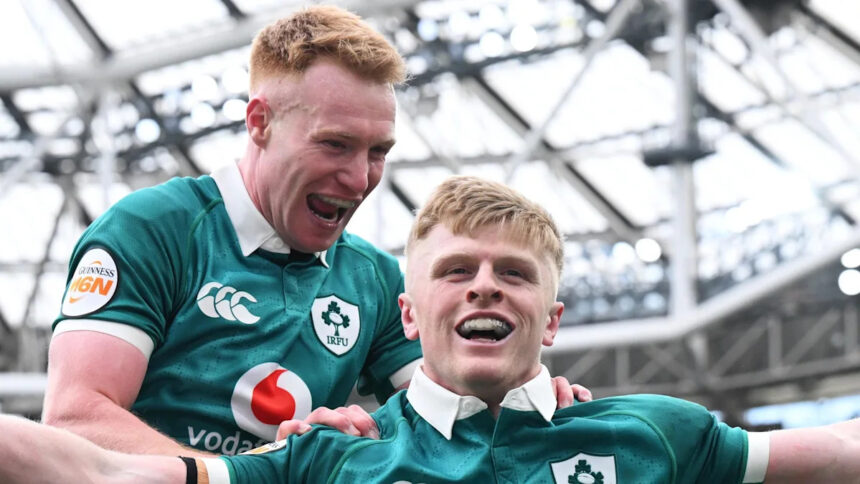
The atmosphere in Dublin was electric, with both sides entering the contest with mathematical, if not entirely realistic, title hopes. Ireland, seeking to send captain Peter O’Mahony off with silverware in what was potentially his final Six Nations home game, started with ferocious intent. The early pressure told as Jamie Osborne, showing immense composure in his first Championship start, sliced through for a try. The peerless Hugo Keenan was instrumental in the second, his sublime pass putting Dan Sheehan over, reinforcing his status as the world’s premier hooker.
Scotland, however, refused to be a footnote. A moment of magic from Finn Russell sent Darcy Graham scampering in, and when the mercurial fly-half intercepted to score himself after half-time, the visitors were within five points. The Aviva Stadium grew tense. Ireland’s response, however, was characteristic of the Andy Farrell era: resilient, smart, and utterly ruthless.
- Impact from the Bench: The introductions of Conor Murray and Jack Conan stabilized Ireland at a critical juncture.
- Defensive Steel: Key turnovers from replacements Ryan Baird and Cian Healy halted Scottish momentum deep in Irish territory.
- Clinical Edge: Ireland’s ability to convert pressure into points, notably through Garry Ringrose‘s creative spark and Jack Crowley‘s flawless 17-point kicking haul, proved decisive.
The final quarter saw Ireland pull away. Conor Murray burrowed over from close range before James Lowe‘s breathtaking break set up Harry O’Brien for a late double, sealing the bonus point and the Triple Crown. For Scotland, despite a consolation from Rory Darge, it was a 12th consecutive defeat to their Celtic rivals, a mental hurdle that continues to loom large.
The Parisian Pendulum: How the Title Slipped from Irish Hands
Even as Ireland navigated their second-half scare, the championship destiny was being written in a breathtaking, record-breaking spectacle at the Stade de France. The equation was simple: France, needing a bonus-point win and a margin of victory sufficient to overcome Ireland’s points difference advantage, faced an England side playing with unprecedented attacking verve.
What unfolded was a 94-point thriller that defied belief. France raced into a seemingly unassailable lead, only for England to fight back with four tries of their own. The lead changed hands multiple times in a chaotic final ten minutes. France’s eventual 48-46 win, sealed by a last-gasp Thomas Ramos penalty, was a monumental achievement under pressure. It handed them the championship on points difference, rendering Ireland’s superior points tally irrelevant. This result underscored the unforgiving nature of the Six Nations format, where a single slip in round two—Ireland’s narrow defeat to England at Twickenham—ultimately proved catastrophic to their title defense.
The key title-deciding factors were:
- Round Two Fallout: Ireland’s loss in London meant they were always chasing, dependent on other results.
- French Flair Under Pressure: France’s ability to secure the necessary bonus-point win in such a chaotic game was a monumental feat of nerve.
- The Points Difference Mirage: Ireland’s healthy differential after round four became moot, highlighting the primacy of tournament points.
Expert Analysis: What This Means for Ireland and France
For Ireland, the emotions are complex. Winning a Triple Crown in any year is a significant achievement, a testament to consistency and dominance over the Home Nations. The performance against Scotland showcased their formidable squad depth, with new faces like Osborne and Crowley integrating seamlessly. The leadership core of O’Mahony, James Ryan, and Caelan Doris remains world-class. However, the inability to retain the Championship will sting. Questions will be asked about the slow starts that plagued them against both England and Scotland, and whether the attacking structure became slightly predictable at critical moments.
For France, this is a championship won with resilience. After a stuttering start to the tournament and the seismic loss of Antoine Dupont to rugby sevens, they regrouped spectacularly. The victory, built on the brilliance of Gael Fickou, the boot of Thomas Ramos, and the power of their pack, announces their return as a force. Winning a tight, must-win game in such dramatic fashion will forge incredible belief as they look towards hosting the 2027 Rugby World Cup.
Scotland’s narrative remains one of “nearly men.” They possess the individual talent, exemplified by Russell and Darge, to trouble anyone, but converting performances into championship-defining wins continues to elude them. Their search for a first top-two finish since 1999 goes on.
Looking Ahead: World Cup Cycles and Shifting Sands
The 2024 Six Nations has acted as a pivotal checkpoint in the new World Cup cycle. Ireland, despite the title disappointment, are in a remarkably strong position. Their transition post-Johnny Sexton has been smoother than many anticipated, with Jack Crowley growing into the fly-half role. The challenge for Andy Farrell is to evolve the game plan further and blood more young talent, like Sam Prendergast, while maintaining their relentless standards.
France, now back-to-back champions, have successfully navigated a post-Dupont transition of their own. The emergence of a new generation, including the explosive Nolann Le Garrec at scrum-half, makes them formidable. The looming British & Irish Lions tour in 2025 adds another layer of intrigue, with many of these Irish and French stars destined to be central figures.
For the other nations, the gap to the top two remains evident but not unbridgeable. England showed thrilling attacking potential in Paris, while Italy’s historic win in Wales proves the competition’s growing depth. The 2025 championship, with its Lions shadow, promises to be even more compelling.
Conclusion
March 16, 2024, will be remembered as a day where two nations celebrated, but with contrasting tones. In Dublin, Ireland lifted the Triple Crown, a tangible reward for a campaign of power and precision, yet the celebration was tinged with the quiet acknowledgment of an opportunity missed. In Paris, France erupted in unbridled joy, having snatched the ultimate prize from the jaws of a ridiculous, high-scoring epic. This finale served as the perfect metaphor for the Six Nations: a tournament where history, passion, and sheer unpredictability collide. Ireland confirmed their status as a northern hemisphere powerhouse, but France, in the most dramatic fashion imaginable, reminded everyone that they remain the team to beat. The championship crown had changed hands, not in a direct duel, but in a breathtaking parallel narrative that only this great tournament could provide.
Source: Based on news from Yahoo Sports.