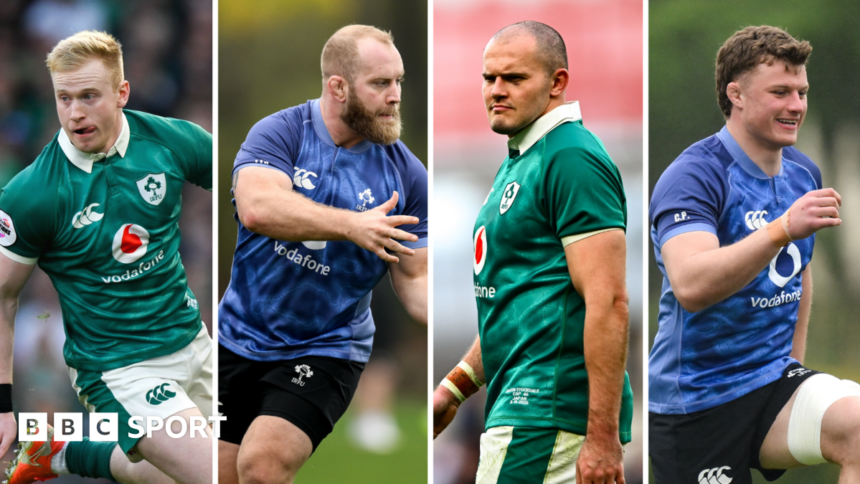
Ireland’s Bold New Era Begins in Paris: Loughman Starts as Lowe and Furlong Sidelined
The winds of change are blowing through the Irish camp as they arrive in Paris for the 2026 Six Nations opener. Head coach Andy Farrell has unveiled a team sheet that signals both a necessary adaptation and a confident step into a new cycle, naming a side brimming with opportunity amidst significant absentees. The headline acts are the returns of Jeremy Loughman and Jamie Osborne, but the omissions of titans like James Lowe, Tadhg Furlong, and James Ryan speak volumes about the challenges and evolution facing the reigning champions.
A Prop’s Perseverance: Loughman’s Long-Awaited Return
In the brutal, attritional world of front-row rugby, opportunity often comes dressed in the grim garb of an injury crisis. For Jeremy Loughman, his first Ireland start in over three years is a testament to relentless provincial form and patience. With Ireland’s entire first-choice loose-head trio—Andrew Porter, Paddy McCarthy, and Jack Boyle—all ruled out, the 30-year-old Munster man is thrust into the cauldron of the Stade de France.
Loughman’s last Test appearance was a brief cameo in the 2024 Championship. His only previous start came against Fiji in November 2022. This is not merely a backup being deployed; it is a seasoned pro given the ultimate chance to cement a new chapter in his international career. His scrummaging power and improved work-rate around the park will be critically tested against the formidable French pack. On the bench, Michael Milne provides cover, meaning Ireland’s loose-head resources for this pivotal clash are defined by a combined three caps.
- Key Context: Loughman’s start is born of necessity but earned through consistent performance for Munster.
- The Challenge: Faces immediate baptism against a powerful French scrum without the cushion of established starters beside him.
- Strategic Implication: Ireland’s set-piece strategy may adapt, with a likely emphasis on stability and quick ball over pure demolition.
Backline Rejig: Osborne’s Chance and the Lowe Conundrum
Perhaps the most intriguing selection is in the back three, where a cascade of events has opened the door for a new potential star. With Hugo Keenan—a model of consistency—ruled out with a training-ground hand fracture, Jamie Osborne steps into the 15 jersey. The Leinster back, known for his silky skills, big boot, and deceptive power, gets his first start at full-back at this level. His last outing for Ireland was against Japan in November, and this represents a monumental leap in responsibility.
More surprising for many is the absence of James Lowe. The try-scoring machine, with his cannon left boot and game-breaking ability, is a cornerstone of Ireland’s attacking framework. His omission from the starting XV suggests either a minor knock not disclosed or a deliberate tactical shift. It paves the way for Jacob Stockdale to continue his remarkable international resurgence on the wing. Stockdale’s aerial ability and experience in Paris will be invaluable, but the loss of Lowe’s territorial kicking and offloading threat alters Ireland’s left-edge dynamics significantly.
The midfield remains the settled partnership of Bundee Aki and Robbie Henshaw, offering a bedrock of experience for the reshuffled backfield to operate from.
Leadership and the Pack: Ryan and Furlong’s Absence Felt
The team sheet reveals a second layer of impactful changes in the tight five. The unavailability of Tadhg Furlong, the world-class tighthead prop, is a colossal blow. His unique blend of scrummaging, footwork, and handling is irreplaceable. His likely replacement, Tom O’Toole, is a fine player but faces the Herculean task of filling that void. Alongside him, the omission of lock and former captain James Ryan indicates either a fierce competition won by Joe McCarthy and Tadhg Beirne, or a managed return from a minor issue. Ryan’s lineout prowess and abrasive carrying will be missed.
This new-look pack, featuring Cian Prendergast at blindside flanker, presents a different profile. Prendergast’s athleticism, lineout option, and link play suggest Ireland may look to move the huge French pack around with pace and width, rather than engaging in a direct, slow-burning arm-wrestle. The leadership mantle falls even more heavily on the shoulders of Peter O’Mahony and Caelan Doris.
- Front-Five Shift: Loss of Furlong’s X-factor and Ryan’s set-piece assurance is a major storyline.
- New Back-Row Dynamic: Prendergast’s inclusion adds mobility and a third lineout jumper.
- Leadership Test: O’Mahony’s role in guiding a pack with several new key components is crucial.
Parisian Pressure: Analysis and Predictions for Le Crunch
This selection is a fascinating cocktail of enforced change and bold choice. Farrell is not merely plugging holes; he is reshaping the team’s identity under pressure. The French, smarting from their own recent history in this fixture, will see a target in Ireland’s new front row and untested backfield combination. Their game plan will be brutally simple: test Loughman and Milne at the scrum, and bombard Osborne with high balls in the Parisian night sky.
However, to see this only as an Irish weakness is to misread Farrell’s philosophy. This team is selected for its ball-playing ability and tactical flexibility. Osborne offers a second playmaking axis from the back. Stockdale and Nash are lethal in broken play. A pack with Beirne, Prendergast, and Doris is engineered for disruptive, high-tempo rugby.
Prediction: This will be a tighter, more nervy affair than recent encounters. Ireland’s new combinations may take time to gel, potentially conceding early pressure and points. The bench, featuring the experience of Conor Murray and the power of Ryan Baird, will be critical. If Ireland can survive the first 30 minutes within a score, their cohesion and fitness could tell in the final quarter. Expect a monumental defensive shift and a match decided by fine margins—potentially a single score either way. Ireland’s championship mettle is being tested from the very first whistle.
Conclusion: A Defining Night for Ireland’s Next Generation
As the lights blaze at the Stade de France, this is more than just a first game of a tournament. It is a statement of intent for Ireland’s future. The era defined by the unquestioned presence of Sexton, Furlong, Lowe, and Keenan is subtly transitioning. Tonight, players like Jeremy Loughman and Jamie Osborne are not just deputies; they are potential architects of the next chapter.
Their performances, under the most intense scrutiny, will answer pressing questions about Ireland’s depth and adaptability. Victory in Paris with this reshuffled deck would be one of Andy Farrell’s finest achievements, a win built not on established pedigree but on collective resolve and a bold new vision. Defeat would be framed as a understandable stumble amidst a personnel crisis. The truth, as always, will be forged in the heat of the scrum and the chill of the Parisian night. Ireland’s 2026 campaign begins not with a whisper, but with a roar of opportunity.
Source: Based on news from BBC Sport.