Kimi Antonelli’s High-Speed Shunt Throws Mercedes into Australian GP Chaos
The serene blue skies over Melbourne’s Albert Park circuit were shattered by the sound of screeching carbon fiber and the collective gasp of the paddock. In a heart-stopping moment during final practice for the Australian Grand Prix, Mercedes’ teenage sensation Andrea Kimi Antonelli suffered a massive, high-speed crash, casting a dark cloud over the team’s weekend and setting off a desperate race against time.
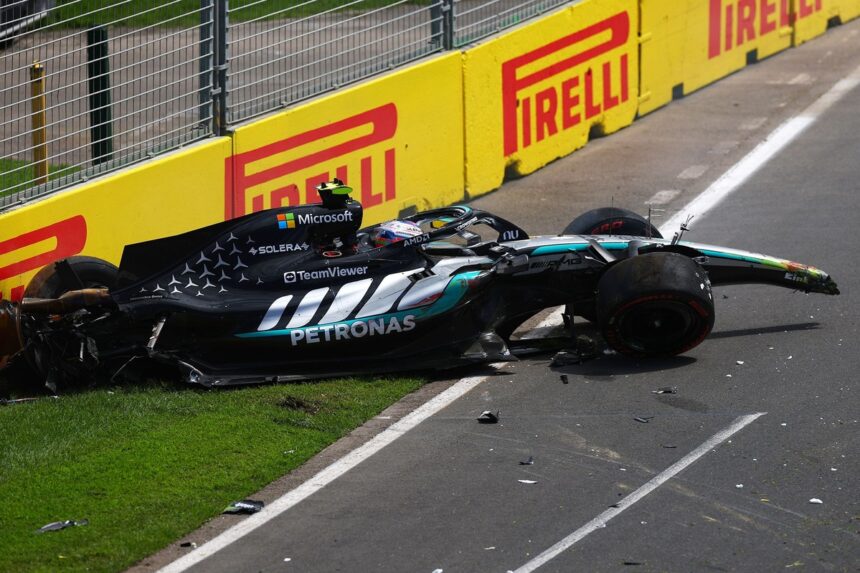
With just over ten minutes remaining in FP3, the Italian rookie, having just bolted on a set of soft Pirelli tyres for a qualifying simulation, lost control of his Mercedes W17. The violent impact with the Turn 2 barriers left his car severely damaged but, thankfully, Antonelli emerged unscathed, walking away unaided. The incident, however, has triggered a monumental repair job for the Brackley squad and thrown their entire Saturday strategy into disarray.
A Split-Second Mistake with Major Consequences
Replays of the incident tell a familiar yet terrifying Formula 1 story: a minuscule error amplified by razor-sharp limits. Antonelli approached the high-speed, left-hand Turn 2 complex, a corner demanding immense commitment. As he turned in, the right-rear tyre of the Mercedes clipped the aggressive inside kerb. This seemingly minor disturbance was enough to unsettle the car’s aerodynamic platform.
The rear of the W17 instantly snapped away, sending Antonelli into a spin. With limited runoff, he slid backwards across the track before the rear made heavy contact with the Tecpro barriers. The impact was substantial, with debris from the rear wing and suspension littering the track, bringing out the red flag and halting the session.
Key factors in the crash:
- Switch to Soft Tyres: The transition to the softer, grippier compound requires a driver to recalibrate their braking and turning points. The increased mechanical grip can catch out even the most experienced.
- Albert Park’s Treacherous Kerbs: The circuit’s kerbs are notoriously unforgiving. A clip can launch a car, disrupting the delicate downforce balance.
- Rookie Pressure: In only his third Grand Prix weekend, Antonelli is still building a mental catalogue of limits. Pushing to extract maximum performance in final practice is a high-pressure task.
The most important takeaway, echoed by a relieved team principal Toto Wolff, was that Antonelli was physically okay. “The car did its job, the halo did its job, and Kimi is fine. That’s what matters first,” Wolff stated to media scrum. The mental impact, however, on a young driver in such a high-profile seat, remains to be seen.
The Impossible Repair Job: Brundle’s Grim Qualifying Prediction
While the driver was safe, the machine was not. The Mercedes W17 sustained extensive damage to its rear end, including the gearbox, rear suspension, and crash structure. The complex carbon fiber monocoque also needed a thorough inspection for any hidden cracks. This level of damage initiated a frantic scene in the Mercedes garage as mechanics began the assessment.
The timeline was brutally tight. With qualifying scheduled for just a few hours after the FP3 conclusion, the task appeared Herculean. Sky Sports F1 commentator and former driver Martin Brundle did not mince words in his immediate analysis. “He’ll not be in qualifying,” Brundle declared emphatically. “That car is seriously wounded. The rear end is completely destroyed. They might get it ready for the race if they work through the night, but qualifying looks a write-off.”
Brundle’s prediction, based on decades of paddock experience, highlights a critical challenge in modern F1. The complexity of these hybrid machines means even a well-rehearsed pit crew cannot perform miracles with a three-hour turnaround. The team must also consider the FIA parc fermé regulations, which severely limit what can be changed on the car once qualifying begins without incurring grid penalties.
Domino Effect: Strategy Implications for Mercedes and Antonelli
Antonelli’s crash creates a cascade of strategic complications for Mercedes. The immediate, glaring issue is grid position. If Brundle’s prediction holds and the car cannot be repaired in time, Antonelli would likely start Sunday’s race from the pit lane or even the back of the grid if certain components are replaced.
This scenario forces a complete strategic pivot:
- Race-Focused Setup: Starting from the back, Mercedes would abandon a pure performance setup for one focused on tyre management and overtaking.
- Alternative Tyre Strategy: They would be free to start on the hardest available tyre compound, aiming for a long first stint and capitalizing on potential safety cars—a common occurrence at Albert Park.
- Data Deficit: Antonelli lost crucial high-fuel running and qualifying simulation data in FP3. This puts him at a significant knowledge disadvantage compared to rivals.
For the team’s other driver, George Russell, the incident also brings pressure. With one car potentially out of contention, the team’s hopes for a strong points finish rest solely on his shoulders. It also limits their ability to split strategies to cover different race scenarios.
Looking Ahead: Resilience in the Face of Adversity
The true test for Andrea Kimi Antonelli begins now. How a driver responds to a major crash is a defining part of their career. The paddock will watch closely to see if he carries any hesitation into the race weekend and, more importantly, how he works with the team to overcome this setback.
Prediction for the Australian GP Weekend:
Given the scale of the damage, Martin Brundle’s assessment is likely correct. Expect Antonelli to miss qualifying. The Mercedes crew will perform a herculean effort to build a new car around his survival cell for Sunday. His race will be a recovery mission, targeting a point or two through attrition and smart strategy. For George Russell, the goal becomes a clear top-five finish to salvage constructor points. The crash transforms Mercedes’ weekend from one of potential podium contention to one of damage limitation.
This incident is a brutal reminder of the fine margins in Formula 1. A kerb strike measured in millimeters can alter the destiny of a team’s entire Grand Prix. While Kimi Antonelli walked away, proving the incredible safety of modern F1 cars, his crash at Albert Park serves as a fiery initiation into the relentless, unforgiving world of elite motorsport. His journey back through the field on Sunday, should the Mercedes be ready, will be a story of resilience watched by the entire F1 world.
Source: Based on news from Yahoo Sports.