McCullum’s Crusade: Will England’s Revolutionary Coach Get to Finish the Job?
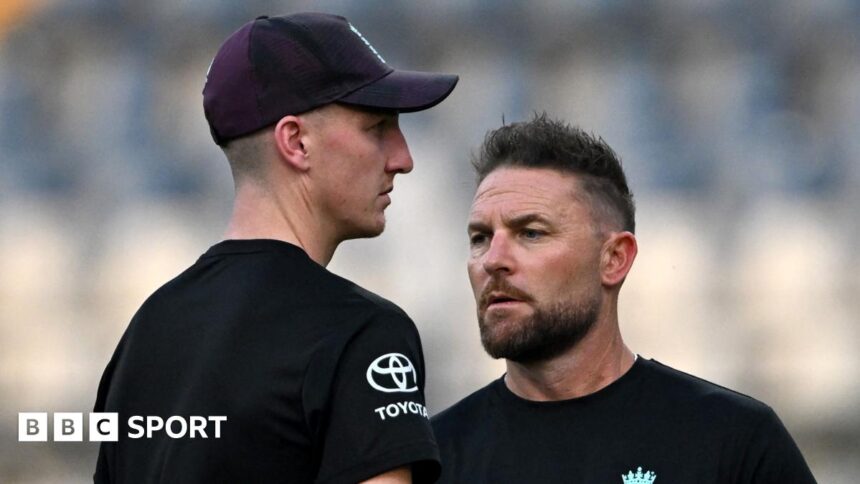
The roar of Mumbai had faded to a murmur. The confetti, destined for England, lay unused. In the hollow quiet of a lost semi-final, Brendon ‘Baz’ McCullum found his captain. A slouched, devastated Harry Brook, alone by the boundary’s edge, became the focal point for a coach whose own future was suddenly, fiercely, in question. Their tight embrace was more than consolation; it was a silent testament to a bond forged in a revolutionary style of cricket, and for McCullum, it felt like a potential farewell. In the aftermath of England’s agonising seven-run defeat to India, which sealed their exit from the T20 World Cup, the most pressing question isn’t about a missed sweep or a tactical tweak. It is this: having transformed English cricket’s soul, will Brendon McCullum get the chance to see his vision through?
The Embrace That Spoke Volumes: Legacy Beyond the Trophy
That image of McCullum and Brook is the poignant bookmark to this chapter of English cricket. It encapsulates the human element of ‘Bazball’ – a philosophy often discussed in terms of run-rates and bravado, but at its core, built on unshakeable trust and public vulnerability. McCullum didn’t head to the boardroom or the press box first; he went to his player. This act underscores his entire tenure. He inherited a Test team shrouded in fear and a white-ball squad resting on the laurels of 2019, only to see it become jaded and directionless.
His impact is measured in more than wins; it’s measured in transformation.
- Test Revolution: He and Ben Stokes resurrected a moribund Test team, instilling a fearless, record-breaking brand of cricket that captivated a global audience.
- Cultural Reboot: He removed the fear of failure, championing aggressive intent as a non-negotiable, freeing a generation of players.
- White-Ball Re-ignition: While the T20 World Cup ended in heartbreak, his approach reinvigorated a squad that had stagnated, taking them to the semi-final’s brink against the tournament’s best team.
The seven-run margin against India is a cruel metric. It suggests not a gulf in class, but a moment of fine margins. For McCullum, it likely reinforces his belief that the method is sound, but the execution under extreme pressure needs hardening. The question for the ECB is whether they see the journey or just the destination.
The Case For and Against: Scrutinising the McCullum Project
McCullum has been unequivocal: he wants to stay. But the decision rests with the ECB’s director of cricket, Rob Key, who must weigh a compelling yet complex dossier.
The Case for Renewal (The Bigger Picture):
Advocates will argue that Brendon McCullum has delivered on his primary mandate: to make England relevant and thrilling again. Test cricket is alive and well in England, with sold-out crowds and seismic victories. In white-ball cricket, he steered the ship to the knockouts of both the 50-over World Cup (a disappointing defence but a semi-final berth) and now this T20 World Cup. The jubilant Mumbai crowd that witnessed England’s exit saw a team fight relentlessly, a hallmark of his leadership. His partnership with Stokes in Tests is sacred, and disrupting that would be perilous. Furthermore, with a monumental Ashes series in Australia looming in 2025-26, continuity is not just preferable; it’s strategic. He has the buy-in from the entire playing group, a currency more valuable than any short-term contract.
The Case for Change (The Hard Numbers):
Critics will point to the trophy cabinet. Since his appointment, England have not won a major ICC trophy. The defeat by India follows a poor 50-over World Cup defence in India. Some will question if his high-risk mantra, perfectly suited to the ebbs and flows of Test cricket, needs refinement in the condensed, high-pressure scenarios of tournament knockout games. Is there a tactical brittleness when plan A is challenged? There’s also the issue of format specialization. The era of a single coach across all formats is fading. The ECB may consider a split, seeking a T20 specialist to hone the fine margins that cost them in Guyana, while allowing McCullum to focus solely on the Test behemoth he helped create.
Predictions: The Likely Path Forward for England and Baz
Reading the tea leaves from recent statements and the inherent conservatism of cricket administration, a pragmatic, hybrid outcome seems most probable.
Prediction 1: A New Contract, But With Refined Focus. The most likely scenario is that Rob Key offers McCullum a contract extension, but with a subtly altered or clarified scope. The core McCullum-Stokes axis will be preserved for the Test arena, deemed too successful and culturally vital to dismantle. His role with the white-ball teams, however, may become more holistic – focusing on overarching philosophy and player development, while a de facto lead coach (possibly from within the existing setup like Paul Collingwood) handles the day-to-day tournament tactics. This protects his transformative influence while addressing the need for nuanced tournament play.
Prediction 2: The All-Format Mantle is Relinquished. McCullum, a pragmatist himself, may proactively suggest a reshuffle. He could argue that the demands of all three formats are unsustainable and that the Test team requires his full attention to conquer Australia. This graceful pivot would allow him to cement his legacy in the arena where his impact has been most profound, while allowing the ECB to appoint a dedicated white-ball supremo without the narrative of a sacking.
Prediction 3: The Clean Break (Outside Chance). Should the ECB’s review fixate solely on the lack of silverware, a shock non-renewal cannot be entirely ruled out. This would be a brutally short-sighted decision, one that would risk mutiny from a playing group that reveres him, and would likely be met with widespread bewilderment across the cricket world. It would signal a return to the result-at-all-costs anxiety that McCullum was hired to eradicate.
Conclusion: More Than a Coach, A Catalyst
As the downbeat captain Harry Brook and his coach shared that moment by the boundary, they weren’t just mourning a match. They were potentially mourning the premature end of an era. Brendon McCullum’s tenure was never just about coaching; it was about catharsis. He exorcised the timid spirit of English cricket and replaced it with a joyful, aggressive identity. To judge him solely on the T20 final they missed out on is to miss the point entirely.
The ECB now faces a character-defining decision. Do they seek a new technician to chase incremental gains in ICC tournaments, or do they back the cultural architect who has already delivered English cricket’s greatest modern gift: its soul? The embrace in Mumbai was a goodbye of sorts. But for the sake of English cricket’s bold, thrilling future, it should only be a goodbye to this tournament, not to the man who made them believe again. The chance to finish the job isn’t just deserved; it’s essential.
Source: Based on news from BBC Sport.