Mercedes’ Shanghai Symphony Hits a Sour Note: Dominance Meets First Signs of Vulnerability
The narrative of the 2026 Formula 1 season, through its opening chapters, has been a monologue. Mercedes, armed with a revolutionary zero-pod concept that has finally matured into a weapon of total track domination, has spoken with unanswerable pace. Yet, during the tense, rain-threatened qualifying session for the Chinese Grand Prix, a new sentence was whispered. It was a sentence of doubt, of opportunity, and of a potential shift in the tectonic plates of the sport’s new era. While the Silver Arrows once again locked out the front row, the cracks in their impregnable armor, however faint, were visible for the first time.
A Record-Breaking Pole Amidst Growing Pains
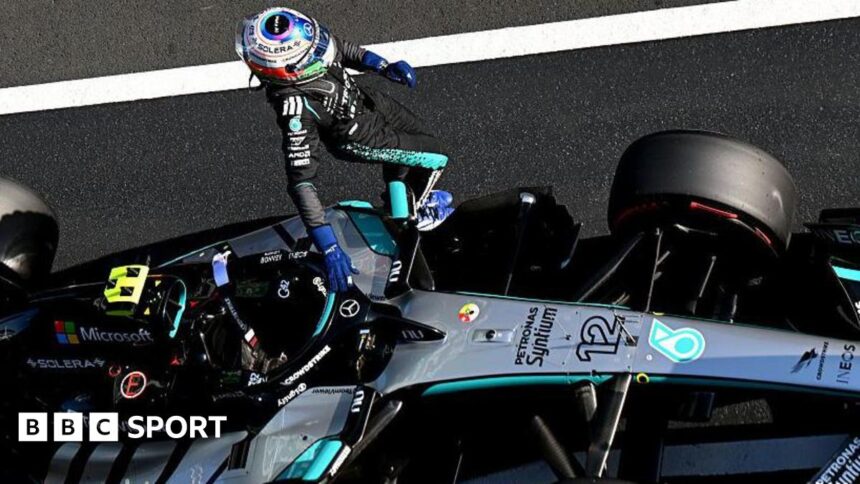
On paper, the result is another Mercedes masterclass. Kimi Antonelli, the 19-year-old phenom who stepped into the seat vacated by the retired Lewis Hamilton, etched his name into the history books. By claiming pole position in Shanghai, he became the youngest driver ever to do so, breaking a record set by Sebastian Vettel in 2008. Alongside him, championship leader George Russell completed the team’s third consecutive front-row lockout. The raw speed of the W16 is undeniable.
But the journey to that result was uncharacteristically fraught. Both drivers reported significant balance issues, struggling with rear grip and a car that seemed more of a handful than at any point this season. Russell, in particular, was vocal on the radio about the car’s unpredictability. Antonelli’s record lap was a triumph of sublime talent over a less-than-perfect machine. This was not the serene, metronomic dominance of Australia; this was a scrap. Mercedes’ vulnerability was not in the final timing sheet, but in the process that created it. The team had to dig deep, and the margin for error, for the first time, evaporated.
The Scarlet Shadow: Ferrari Closes the Gap
The most telling statistic from qualifying is not the pole time, but the gap behind it. Lewis Hamilton, now leading Ferrari’s charge, finished just 0.351 seconds adrift of Antonelli. To understand the significance, one must look back:
- In Australia: The gap from pole (Russell) to the next fastest non-Mercedes (then a McLaren) was over 0.6 seconds.
- In China Sprint Qualifying: The gap from pole (Antonelli) to P3 (Hamilton) was 0.648 seconds.
In the space of one day, Ferrari effectively halved their qualifying deficit. This is a monumental shift. It transforms Mercedes from an untouchable entity into a catchable target. Ferrari’s SF-26 clearly took a step forward in set-up overnight, and the Scuderia’s long-run pace in Saturday’s sprint race was equally promising, with Hamilton and Charles Leclerc demonstrating they could fight at the sharp end.
This surge aligns with a narrative of Ferrari’s missed opportunities. In Melbourne, a strategic misstep took them out of a potential podium fight. In the China sprint, both drivers showed they could battle wheel-to-wheel with the Mercedes early on. The car has inherent race pace. For the first time this season, Ferrari arrives on Sunday with genuine, data-backed belief that victory is possible, not just a hopeful aspiration.
Race Day Prognosis: Strategy, Pressure, and Pit Wall Wars
Shanghai International Circuit, with its long straights and demanding, high-speed corners like the Turn 1-2-3 complex, is a track that punishes instability. Mercedes’ newly revealed handling gremlins could have profound implications over 56 laps.
Key factors for the Grand Prix will include:
- Tyre Degradation: If the Mercedes is a handful for its drivers, it will likely be kinder to its tyres. Ferrari’s more stable car, however, could allow them to push harder for longer. This creates a fascinating strategic dichotomy.
- Start Performance: With Hamilton and Leclerc lurking on the second row, the run to Turn 1 will be critical. Any hesitation or wheelspin from the Mercedes pair could see them swallowed by the scarlet cars.
- Strategic Agility: Ferrari, with the underdog status, can afford to be aggressive. Mercedes, suddenly under pressure, must make flawless calls. The pit wall battle between the two legendary teams becomes a high-stakes chess match.
- Psychological Edge: Antonelli faces immense pressure: protecting his first pole, a record on his shoulders, and a charging seven-time world champion in his mirrors. How he handles this will be a defining moment in his young career.
A Turning Point in the 2026 Title Fight?
It is premature to declare the Mercedes dominance over. One difficult qualifying session does not undo three races of supremacy. The W16 remains the fastest car on the grid, and in clean air, its pace is likely still devastating. However, Shanghai has proven it is not invincible. The field, led by a resurgent Ferrari, has been given a blueprint and, more importantly, a psychological boost.
What we witnessed in China is the critical transition from a one-team exhibition to a potential championship battle. Mercedes must now react. They will need to understand and solve the balance issues that emerged, and do so quickly, as the development war intensifies. For Ferrari, the mandate is clear: convert this qualifying promise into a race-day threat. A podium is the minimum; a victory would blow the title fight wide open.
The 2026 season finally has its subplot. The first signs of vulnerability in the Mercedes empire have been spotted. Whether Ferrari, or another team, can storm the gates remains to be seen. But the message from Shanghai is clear: the reign, while still powerful, is no longer peaceful. The fight for supremacy has officially begun.
Source: Based on news from BBC Sport.