Harry Hardwick’s Decade-Long Gamble: The Brutal Reality Behind the UFC Dream
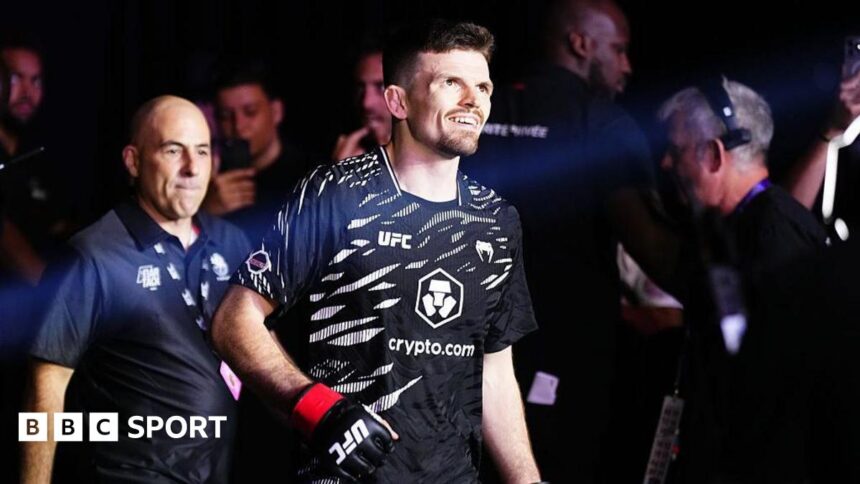
The scent of frying bacon and brewing coffee was a universe removed from the sterile, violent air of the UFC Apex. For years, Harry Hardwick navigated the cramped space of his father’s cafe in Middlesbrough, balancing plates and his future, each shift funding a dream that statistics insisted was a fantasy. In September 2025, a decade after he first stepped into a professional cage, that improbable dream materialized in a UFC contract. But the culmination of a ten-year journey lasted less than five minutes, ending not with a raised hand, but in a wheelchair. Hardwick’s story isn’t just a tale of debut jitters; it’s a raw, unfiltered manifesto on the grim economics of hope in mixed martial arts. “It’s not a sensible idea, pursuing MMA,” Hardwick admits—a stark confession that cuts to the heart of the sport’s brutal truth.
The Unsensible Path: A Decade in the Shadows
While his peers pursued university degrees or climbed traditional career ladders, Harry Hardwick was trading punches in regional halls for a few hundred pounds a fight. The path to the UFC is arguably the most grueling in professional sports, a gauntlet of financial hardship, physical damage, and profound uncertainty. Hardwick’s decade-long ascent underscores a critical, often ignored reality: MMA is a terrible investment for most.
Consider the timeline: a 2015 professional debut, years of balancing training with grueling service work, and the constant strain of self-funding camps, travel, and medicals. The “overnight success” narrative is a myth. For every fighter spotlighted on a UFC broadcast, thousands languish in obscurity, their dreams quietly extinguished by injury, bankruptcy, or the simple, exhausting weight of time. Hardwick’s cafe days weren’t a quaint backstory; they were the essential financial lifeline keeping an unsustainable career afloat. His candid assessment of the pursuit as “not sensible” is a rare moment of public clarity from within the machine, acknowledging that the gamble rarely pays out.
The Five-Day Notice Crucible: Opportunity vs. Preparedness
The call came with just five days’ notice. An opponent was needed for Brazil’s dangerous Kaue Fernandes. For the UFC, it was a slot filled. For Hardwick, it was the culmination of a lifetime’s work, compressed into a frantic, jet-lagged week. Accepting short-notice fights is a classic double-edged sword in MMA: a gateway to the big show, but often a tactical nightmare.
Expert analysis of this scenario reveals inherent disadvantages:
- Strategic Disruption: A full camp is a 10-12 week symphony of physical peaking, technical drilling, and opponent-specific game planning. Five days allows for little more than weight cutting and travel.
- Physical Risk: Entering a UFC-level fight without optimal conditioning increases injury risk exponentially. The body is not primed for peak performance or recovery.
- Psychological Whiplash: The mental shift from training mode to the brightest lights in the sport is immense. There’s no time to gradually build the focus and emotional control required.
Hardwick’s decision was born of necessity—these windows can slam shut forever. However, it placed him in a near-impossible position against a prepared opponent, highlighting the compromised circumstances under which many fighters finally get their shot. The debut became less a fair test and more a survival trial.
The Aftermath: Pain, Wheelchairs, and the Dream’s Next Chapter
The outcome was swift and harsh. A first-round finish by Fernandes left Hardwick with a debilitating injury, requiring a wheelchair exit from the very octagon he had fought so long to enter. The visual was devastating: the physical price of the dream rendered undeniably literal. This moment transcends a simple loss on a record. It speaks to the catastrophic physical cost inherent to the sport, a cost often borne far from the pay-per-view main events.
What does recovery look like now? Not just physical, but professional and psychological. A debut loss, especially a traumatic one, can redefine a fighter’s trajectory within the UFC’s notoriously unforgiving ecosystem. The promotion’s matchmakers now see an 0-1 fighter coming off a severe injury. The road back to relevance is steep. Hardwick must rehabilitate his body, lobby for another chance, and likely face another uphill battle on the undercard—all while the financial clock continues to tick. The dream, though realized, now faces its most difficult test yet.
Predictions & The Hard Truth for Aspiring Fighters
So, what does Hardwick’s story predict for the future of MMA’s aspirational class? His experience should serve as a crucial case study.
Prediction 1: The “Short-Notice Trap” Will Be Scrutinized. As fighter advocacy grows, the ethics of offering life-changing opportunities under high-risk, low-prep conditions will face greater criticism. The narrative may shift from “seizing your shot” to “being set up to fail.”
Prediction 2: The Financial Reality Will Deter Talent. Hardwick’s “not sensible” declaration is a powerful message. As the economic barriers to a sustainable MMA career become more widely known, sports with clearer pathways (like professional football or boxing) may siphon off athletic talent.
Prediction 3: Hardwick’s Resilience Will Define His Legacy. The true measure of Hardwick’s career won’t be his debut. It will be his response. If he can recover, secure a full camp, and return to win, his story becomes one of legendary perseverance. If not, he becomes another statistic in the high-attrition rate of the sport’s lower tiers.
The most important prediction is this: most dreams will fail. That is the unvarnished reality Hardwick voiced. For every champion, hundreds of Harry Hardwicks invest their youth, their health, and their savings into a lottery with brutal odds.
Conclusion: The Senseless Pursuit That Defines a Sport
Harry Hardwick’s journey from his dad’s cafe to a UFC wheelchair is the authentic, unglamorous spine of mixed martial arts. It’s a story not of triumph, but of tenacity in the face of a fundamentally unsensible gamble. His willingness to voice the quiet part—that this is a terrible idea for most—is a profound contribution to the sport’s discourse. It challenges the glossy marketing and highlight-reel hype, forcing fans to acknowledge the immense sacrifice and frequent heartbreak that fuel the entertainment.
MMA is built on the backs of fighters who defy sensibility, who mortgage a secure future for a chance at glory that, as Hardwick’s debut proves, offers no guarantees of a happy ending. His story isn’t over, but its current chapter serves as an essential, sobering reminder. The bright lights of Las Vegas aren’t just a destination; for many, they are a mirage, and the path to them is paved with broken bodies and deferred lives. The true fight begins long before the octagon door closes, and for most, it continues long after the result is read.
Source: Based on news from BBC Sport.