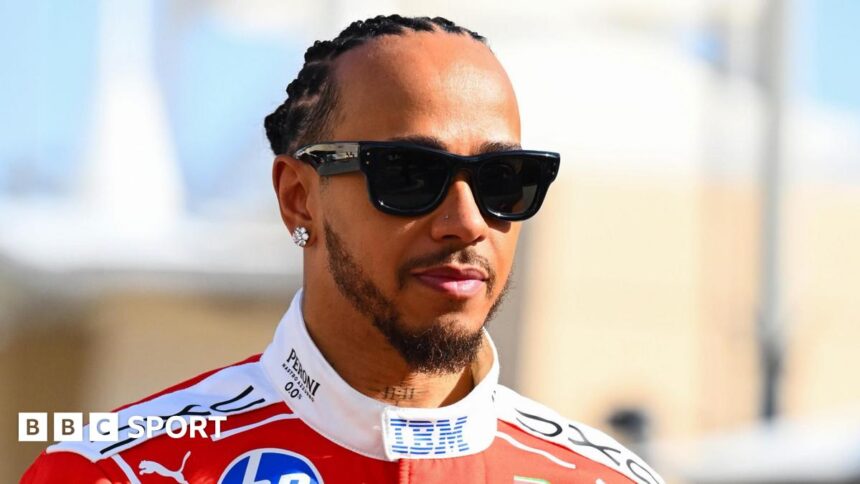
Hamilton’s Warning: Are F1’s New “Energy-Starved” Rules Alienating the Fans?
The scent of hot oil and the scream of high-revving engines have returned as Formula 1 pre-season testing gets underway in Bahrain. Yet, beneath the familiar facade of speed and glamour, a profound and perplexing revolution is taking place inside the cockpits and engineering rooms. And according to the sport’s most successful driver, it’s a revolution the average fan may struggle to comprehend. Lewis Hamilton, now in the iconic red of Ferrari, has launched a pointed critique at the sport’s latest technical directive, labeling the new power unit regulations “ridiculously complex” and warning that “none of the fans are going to understand it.”
The “Degree Required” Dilemma: Inside Hamilton’s Critique
Hamilton’s comments, made after his first official morning of testing with Ferrari, cut to the heart of a growing tension in modern F1: the balance between cutting-edge hybrid technology and spectator accessibility. “I sat in a meeting the other day and they’re taking us through it,” Hamilton revealed. “And yeah, it’s like you need a degree to fully understand it all.” His concern isn’t merely driver frustration; it’s a fear of disconnection. The seven-time world champion, a master at communicating the sport’s drama to a global audience, is sounding the alarm that F1 is building a wall of complexity between the on-track action and the people watching it.
The core of the issue lies in the latest phase of F1’s power unit evolution. The 2026 regulations, being phased in with preparatory rules now, mandate a near 50-50 power split between the internal combustion engine (ICE) and electrical components. This isn’t a simple toggle between two power sources. It has created a scenario where the engines are, in Hamilton’s implied description, energy starved. Drivers and teams must now engage in a high-speed, real-time puzzle of energy management, recovering and deploying electrical power with unprecedented precision. The driver’s role is shifting further from pure racer to systems manager, a change that risks obscuring the raw, visceral contest fans crave.
Decoding the “Energy-Starved” Engine: A Technical Tightrope
To understand the “ridiculously complex” landscape Hamilton describes, one must look under the bodywork. The new rules significantly increase the electrical output from the MGU-K (Motor Generator Unit-Kinetic) while placing stricter limits on fuel flow and energy deployment. The result is a power unit that is constantly balancing on a knife-edge of efficiency.
- Precision Energy Harvesting: Drivers must now recover far more electrical energy under braking and from the exhaust gases (via the MGU-H, which remains) to feed the hungry hybrid system.
- The Deployment Chess Game: Electrical energy deployment is no longer a simple “push-to-pass” button. Teams will have complex strategies for when to use their electrical boost, potentially saving it for defensive moves, attacking laps, or critical overtakes, all while staying within a strict total energy budget per lap.
- The Fuel Flow Conundrum: With tight fuel mandates, the internal combustion engine must operate at peak thermal efficiency almost constantly. Drivers may need to “lift and coast” even more to save fuel, which converts directly to electrical energy, adding another strategic layer.
This creates a driving experience where maximising energy recovery is as important as hitting an apex. A mistake in energy management could leave a driver defenseless on a straight or without enough boost to attempt an overtake. The complexity is immense, and as Hamilton notes, explaining why a car suddenly becomes vulnerable or potent mid-race will be a formidable challenge for commentators and a potential source of confusion for viewers.
The Fan vs. Engineer Divide: Can F1 Bridge the Gap?
Hamilton’s critique touches on a fundamental challenge for 21st-century Formula 1. The sport’s identity is inextricably linked to being the pinnacle of automotive technology, a laboratory for innovations that eventually trickle down to road cars. This pursuit of technical excellence, however, often comes at the cost of simplicity. The question becomes: at what point does complexity become a barrier to entry?
For the dedicated fan who revels in technical deep-dives, these regulations are a dream. The strategic battles in the team garages will be more intense than ever. But for the casual viewer—the lifeblood of the sport’s recent global surge—the risk is a race that becomes an opaque procession of cars managing invisible resources. The drama of wheel-to-wheel combat could be overshadowed by post-race explanations of energy deployment charts and fuel-saving algorithms. F1 has faced this before with complex tire strategies and aerodynamic mysteries, but Hamilton suggests this energy management layer is a new peak of obscurity.
The sport’s broadcasters and media face a herculean task. They must develop new tools and graphics to visualize energy levels, deployment zones, and recovery rates in real-time, making the invisible battle as compelling as an overtake. If they fail, Hamilton’s prediction of fan bewilderment could become a reality.
Predictions: Will Complexity Kill the Show or Create a New Genius?
The immediate impact of these rules will be a widening of the competitive gap, at least initially. The teams that “decode” the complex energy management puzzle fastest will gain a significant advantage. We may see more variable race paces, where one car is harvesting energy while another is deploying, leading to seemingly unpredictable swings in lap time. This could, paradoxically, create exciting if confusing, on-track action.
Furthermore, the driver skill set will be further refined. The next generation of F1 champions will not only be the bravest late-brakers but also the most astute energy accountants. A new kind of racing intellect will be celebrated. However, the danger is that the driver who is best at managing systems, rather than the one who takes the most audacious racing risks, becomes the consistent winner. This shift could subtly alter the emotional connection fans have with the drivers they idolize.
The long-term success of these regulations hinges on F1’s ability to communicate the complexity. If the sport can turn the energy management battle into a clear, engaging narrative—a second-by-second strategic duel visible to all—it could enrich the spectacle. If it remains a hidden, behind-the-scenes calculus, it will validate Hamilton’s concerns and create a disconnect.
Conclusion: A Champion’s Plea for the Soul of Racing
Lewis Hamilton’s “ridiculously complex” verdict is more than a complaint; it is a plea from a driver who has spent his career at the intersection of supreme skill and global stardom. He understands that Formula 1’s magic lies in the marriage of human courage and technological marvel, a story that must be felt intuitively by the fan in the grandstand or on their sofa. The new energy regulations threaten to tilt that balance too far toward impenetrable engineering.
As the 2024 season unfolds and the groundwork is laid for the 2026 revolution, the sport’s authorities must listen. The goal should not be to dumb down the technology, but to elevate the storytelling. The electricity in the batteries must be matched by electricity in the grandstands, born from understanding, not confusion. Hamilton, in his new scarlet chapter, has thrown down a crucial challenge: Formula 1 must ensure its future is not only powerful and efficient but also, fundamentally, comprehensible and thrilling. The race to explain the race is now as critical as the race itself.
Source: Based on news from BBC Sport.