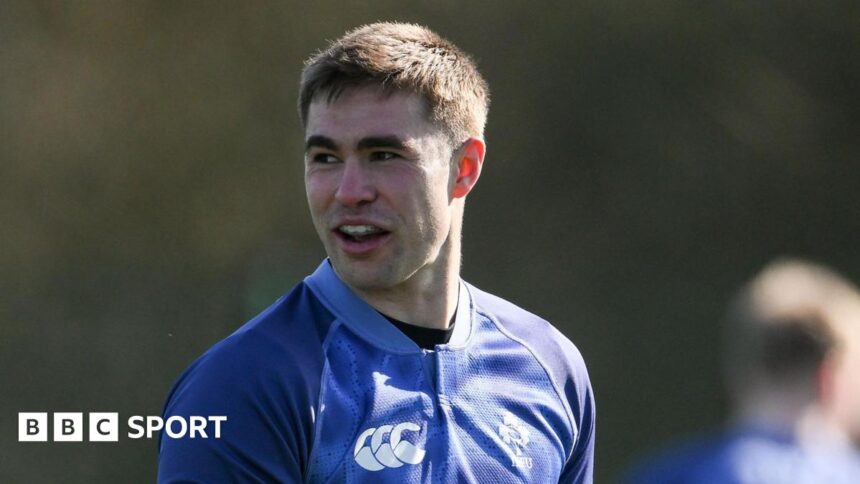
Not About Proving a Point: Jack Crowley’s Present Tense Focus After Reclaiming Ireland’s 10 Shirt
The Aviva Stadium was a gallery of iconic snapshots. Stuart McCloskey’s thunderous, try-saving tackle on Marcus Smith, a statement of defensive brutality. The coaching box, a scene of unbridled, fist-pumping delirium. Rob Baloucoune soaring in the air and scorching the turf. In Ireland’s resounding 42-21 victory over England, the headline-worthy moments were plentiful. And quietly, assuredly, steering the ship from the epicenter of it all, that suited Jack Crowley just fine.
Reinstated at fly-half, the young Corkman didn’t need to be the poster boy. His contribution was measured not in flashy highlights, but in control: 17 points from the tee, a calm tactical hand, and the poise of a player who has navigated a storm of scrutiny. In the intense glare of Ireland’s fly-half debate, Crowley’s performance was a masterclass in staying present, a lesson that his journey is not about proving a point, but about running the team.
The Crucible of Competition: Navigating Ireland’s Fly-Half Conundrum
The narrative around the Irish number 10 jersey since the departure of a legend has been relentless. Every kick, every pass, every decision is weighed against a ghost and measured against a rival. When Sam Prendergast was handed the reins for the opening rounds of the Six Nations, the external noise reached a crescendo. For Crowley, demoted but not diminished, the challenge was profound.
Mental fortitude became as crucial as any skill. This period was less about technical overhaul and more about resilience and perspective. The public debate framed it as a battle, a binary choice. Within the camp, the message from Andy Farrell would have been about readiness, about supporting the team while fiercely competing for the shirt. Crowley’s response against England demonstrated he had absorbed that ethos completely. His performance wasn’t fueled by a public rebuttal; it was built on preparation and a clear-minded understanding of the game plan.
A Study in Composure: Deconstructing Crowley’s Command Against England
On the field, Crowley’s impact was defined by its efficiency and timing. Unlike the buccaneering carries of McCloskey or the electric breaks of Baloucoune, his work was foundational. He provided the platform upon which the more spectacular moments were built.
- Game Management: He played the game in the right areas, leveraging the powerful kicking game of Jamison Gibson-Park inside him. His decision-making was crisp, knowing when to shift point of attack and when to apply pressure.
- Goal-Kicking Reliability: In a game where momentum is key, his 100% return of 17 points from the tee kept the scoreboard ticking and applied constant pressure on England. Each successful kick reinforced team confidence.
- Defensive Solidarity: He stood firm in the channel, making his tackles and organizing the line, embodying the defensive grit that Farrell demands from every player, regardless of position.
This was the essence of a modern test fly-half. The fireworks were provided by others, but the control and leadership emanated from the number 10. He didn’t force the game; he conducted it.
The Farrell Effect: A Culture Beyond the Individual
To understand Crowley’s poised response, one must look to the environment crafted by Andy Farrell. The delirious celebrations in the coaching box were not just about tries; they were a visible manifestation of a next-man-up philosophy and a profound collective belief.
Farrell has built a squad where the jersey is sacred, but no individual is irreplaceable. Competition is constant, but it is healthy and internal. This framework protects players. For Crowley, it meant his “dropping” was not a terminal verdict but a part of the journey. The system allowed him to work, improve, and return without the burden of external narrative breaking the team’s internal bond. The performances of McCloskey, Baloucoune, and Gibson-Park were celebrated as squad successes, which in turn reflected well on the man pulling the strings.
Looking Ahead: Crowley’s Shirt to Lose and Wales on the Horizon
As Ireland prepares for a pivotal home clash with Wales, Crowley finds himself in a familiar, yet newly fortified, position: first-choice fly-half. The challenge now evolves. The narrative shifts from “reclaiming” to “consolidating.”
Prediction for Wales: Expect a more expansive Crowley. With the confidence of the England performance underpinning him and the leadership role firmly his again, Ireland’s attack could unleash its full repertoire. Wales will bring ferocity, but Crowley’s newfound command and the seamless cohesion of the players around him—the gain-line dominance of McCloskey, the X-factor of Baloucoune, the tempo from Gibson-Park—make Ireland formidable favorites. The key for Crowley will be maintaining that present-tense focus, treating the Wales game not as a coronation, but as another 80-minute project.
Conclusion: The Quiet Assurance of a New Era
Jack Crowley’s journey back to the Ireland starting fly-half jersey is a compelling subplot in the team’s ongoing evolution. In an age of instant reaction and hot takes, his path underscores a timeless sporting truth: the loudest statements are often made in silence, through consistent action.
His performance against England was powerful precisely because it wasn’t about him. It was about the team, the system, and the moment. By focusing on his role within the collective, he delivered a performance that solidified his standing more convincingly than any grandstand play ever could. The fly-half debate will rumble, because it always does. But for now, Crowley has answered it not with words, but with a calm, assured demonstration of control. The shirt is his. And as the images of that famous win fade into memory, the most enduring one for Ireland’s future might just be the sight of their number 10, head up, steering the ship steadily forward, present and accounted for.
Source: Based on news from BBC Sport.